Script breakdown templateA script breakdown template, filled in for a real short film.
A breakdown is a list of everything each scene needs, made before anyone prices or schedules it. Skip it and the schedule is a guess. This one is a real breakdown of Midnight Diner: 7 scenes, 2 1/8 pages, in the categories the industry breakdown sheet uses.
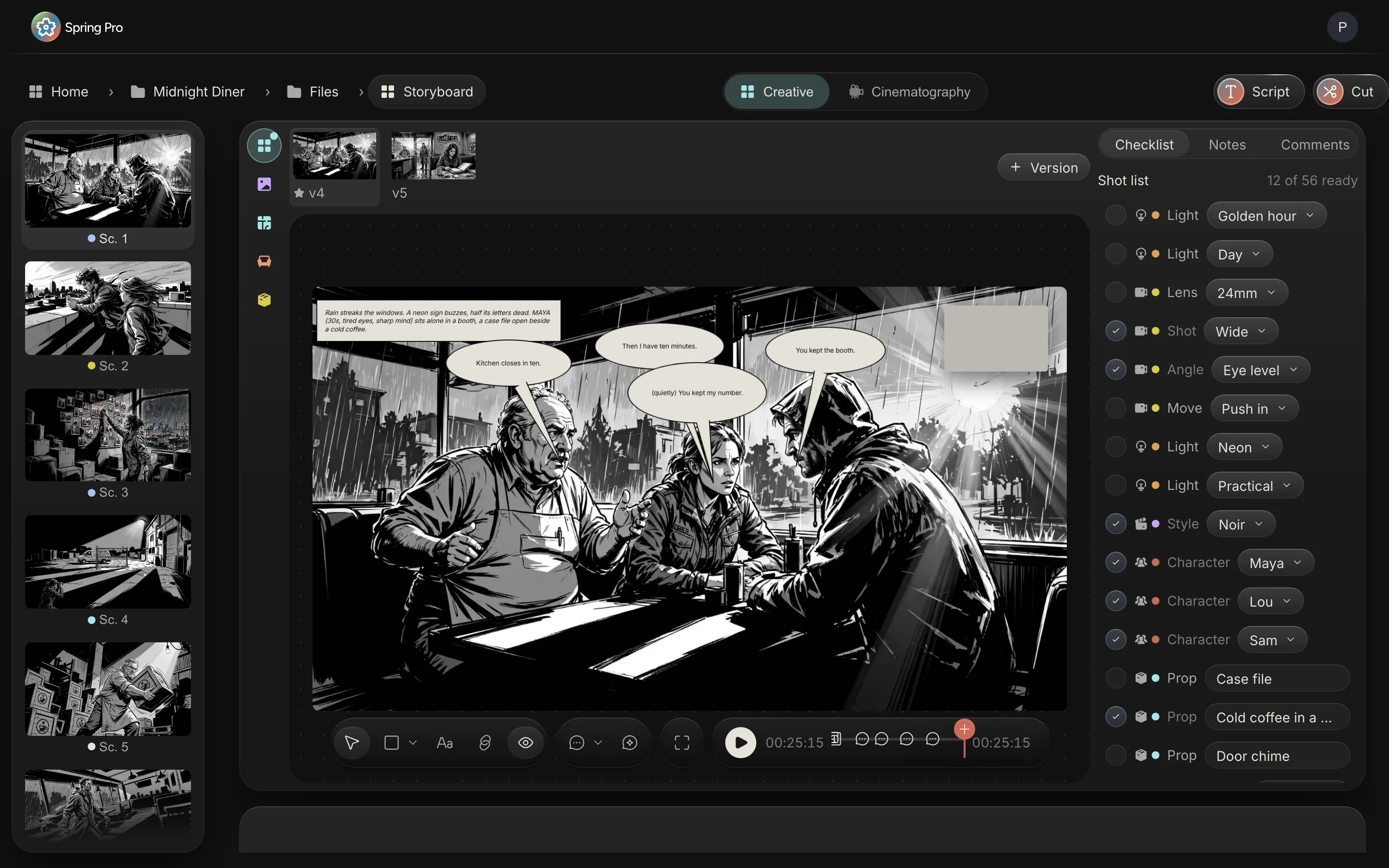
Updated 2026-10-12. Every screen is Spring Pro running Midnight Diner, our demo production.
The sample, and the download
Sample data: Midnight Diner, our demo production (7 scenes, 2 1/8 pages, 4 shoot days). The CSV opens in Excel and Google Sheets. Replace the rows with your own.
Breakdown by scene
| Sc | Heading | Pages | Cast | Extras | Stunts | Props | Set dressing | Wardrobe | Hair and makeup | Vehicles | Special effects | VFX | Sound | Equipment |
|---|---|---|---|---|---|---|---|---|---|---|---|---|---|---|
| 1 | INT. DINER - NIGHT | 4/8 | Maya; Lou; Sam | Late-night customer at the counter; Short-order cook (background) | Case file; Cold coffee in a diner mug; Door chime | Neon sign, half the letters dead; Booth with worn red vinyl; Rain bars outside the windows | Maya: field jacket, jeans, worn boots; Sam: soaked raincoat; Lou: grease-stained apron | Maya: tired eyes; Sam: rain-wet hair and skin | Rain rig outside the windows | Neon buzz; Rain on glass | 100 kVA generator; Rain towers (2) | |||
| 2 | EXT. ROOFTOP - DAY | 3/8 | Sam; Maya | Sam leans on the ledge (safety line) | Surveillance photo of the river warehouses | Hide the modern safety rail on the ledge | Maya: field jacket, collar up; Sam: raincoat, dry | Wind fans for the coats | Skyline clean-up: remove modern signs | City wind, no traffic | Kit lift to the roof | |||
| 3 | INT. MAYA'S APARTMENT - NIGHT | 2/8 | Maya | Rooftop photo, pinned at the centre; Red string and pins | Wall of photos and red string; Moving boxes, never unpacked | Maya: home clothes, cardigan | Maya: tired eyes | Street traffic through the window | Handheld rig with follow focus | |||||
| 4 | EXT. WAREHOUSE - NIGHT | 1/8 | Maya | Maya's camera with a long lens; Idling van | Chain-link gate; Single sodium light on a pole | Maya: dark layers, hood | White panel van, engine idling | Haze for the sodium light | Sodium glow and haze | Van engine idle | 135mm long lens and heavy sticks; 100 kVA generator | |||
| 5 | INT. WAREHOUSE - CONTINUOUS | 2/8 | Lou; Maya | Loader one (non-speaking); Loader two (non-speaking) | Crate slip and glass shatter | Crates stamped with the diner's logo (12); Lou's clipboard; Breakaway glass bottles | Diner logo stencil on the crates | Lou: work jacket over the apron; Loaders: overalls | White panel van, doors open | Breakaway glass bottles | Glass shatter: record on set and from library | Dolly and track for the tracking shot | ||
| 6 | INT. DINER - LATER | 2/8 | Sam | Sam's phone; Chairs up on the tables | Neon sign dies on cue (switched practical) | Sam: soaked raincoat | Neon sign dies on cue | Phone voicemail tone | Tower for the high wide | |||||
| 7 | EXT. ROOFTOP - DAWN | 3/8 | Maya; Sam | Maya sits on the ledge (hidden safety line) | Maya's camera, hero (same as Sc. 4) | Maya: torn, dusty field jacket; Sam: raincoat | Maya: bruises and a cut lip | Crane for the dawn rise |
How to fill it in
- Read the script once for the story, then again with a pencil for the scene facts: interior or exterior, set, day or night, and length in eighths of a page.
- On the second pass, mark everything a department has to supply, one category at a time.
- Write each element on the scene it appears in, once. The same prop in three scenes gets three rows, so no scene is missing it.
- Hand each department its column. They add what they know the script does not say.
- Re-check after every script revision. A changed scene changes its row.
The categories
A breakdown sorts every need into the same few categories, so each department reads only its own column. The sample uses twelve:
- Cast
- Extras
- Stunts
- Props
- Set dressing
- Wardrobe
- Hair and makeup
- Vehicles
- Special effects
- VFX
- Sound
- Equipment
Why the pages are in eighths
A script page is cut into eight parts, so a scene that runs half a page is 4/8 and a scene that runs a line and a half is 1/8. It looks fussy. It is how a scheduler adds up a day.
Midnight Diner adds up to 2 1/8 pages. At that size you can see the whole film on one sheet, which is exactly what makes it a good template to copy.
Read the sample before you copy it
Scene 1 lists three cast, three props and the set dressing that makes the diner a diner: the neon sign with half its letters dead, the booth with worn red vinyl, rain bars outside the windows. Those lines are what the art department prices.
Nothing on the sheet is a surprise to anyone who read the script. That is the test of a good breakdown. If a department head finds something at the table read, the breakdown missed it.
Do it in Spring Pro, where the breakdown feeds everything
In Spring Pro the breakdown lives on the scenes of the screenplay. Each scene holds its elements in those categories, and every to-do sits on its scene with a department, a priority from one to three, a due date and an owner from the crew list.
The schedule, the call sheets and the budget read the same scenes, so a prop added in the breakdown shows up as something waiting to be priced. You do not retype it into a second tool.
Questions
What is a script breakdown?
A script breakdown is a scene-by-scene list of everything the script needs: cast, props, wardrobe, vehicles, locations and effects. Producers use it to schedule and budget the shoot.
Who does the script breakdown?
Usually the 1st assistant director or the production manager, with department heads adding the details for their own categories.
Do I need a breakdown for a short film?
Yes. A short has fewer scenes but the same problem: you still need to know what each scene needs before you schedule and budget it.
More about script breakdown
What each scene needs is listed once, by the people who know, and every other document should read it.
Set up your
production today.
The script, the storyboard, the schedule, the call sheets and the budget in one project.