How to make an independent film, from the script to the cut.
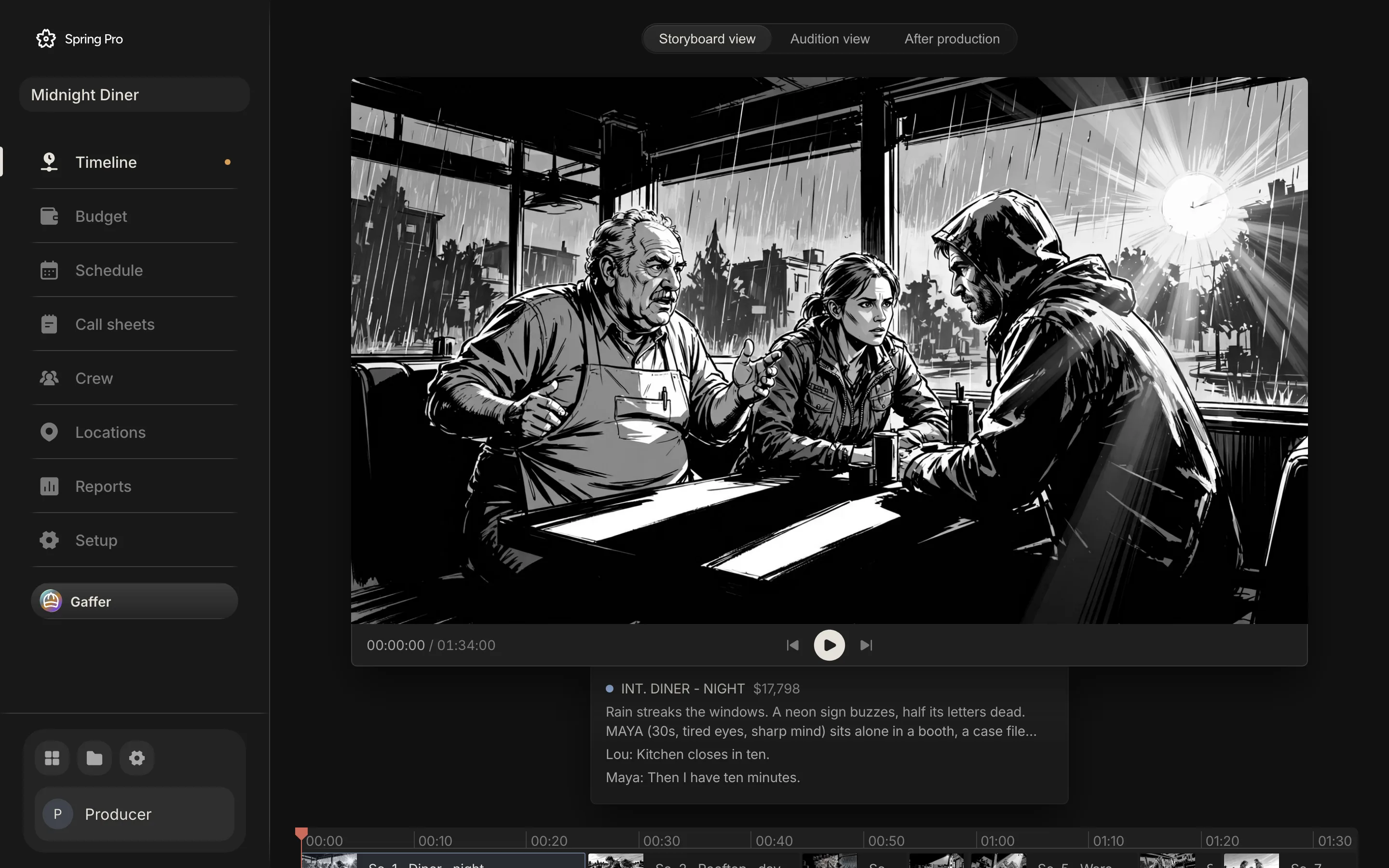
Real screen: Midnight Diner, our demo production, in Spring Pro.
The short answer. Make an independent film in this order: write a script small enough to afford, break it down into what each scene needs, plan the shots, schedule the days, set the call sheets and the budget, shoot, then edit. Start with a short, keep the locations and the cast few, and expect the whole chain to take far longer than the shoot.
Independent filmmaking is a long chain of plain jobs: a script, a breakdown, a plan for the shots, a schedule, a call sheet, a budget, the shoot and the cut. This guide walks the chain once, in order, and for each step says what it is, where beginners go wrong and what it costs. The example is Midnight Diner, a short crime film taken through every step with its real numbers, so you can see the whole thing at once. It is a long process: every planning step also works with a script, a spreadsheet and a printer, and Spring Pro is one optional way to do it.
In this guide 22 sections
- Quick answers
- The eight stages of making an independent film, and when each is really made
- What independent filmmaking means, and what it costs
- The film we follow: Midnight Diner
- Before you start: four choices that shape the rest
- Stage 1: The script
- Stage 2: The breakdown
- Stage 3: The storyboard and the shot list
- Stage 4: The schedule
- Stage 5: The call sheet
- Stage 6: The budget
- Stage 7: The shoot
- Stage 8: The cut
- What this guide leaves out: money, marketing and distribution
- How long making films takes, and what the sources can tell you
- How indie filmmakers work today, and what breaks when a scene changes
- From a no-budget short to a feature: what changes
- Doing it in Spring Pro, one optional way
- The checklist
- How these numbers were made
- Questions people ask
- Sources
Quick answers
What is an independent film? A feature or short made outside the major film studio system, as Wikipedia's article puts it. It usually costs far less than a studio film.
In what order do you make one? Script, breakdown, shots, schedule, call sheet, budget, shoot, cut. The table below says when each is really made, because the budget gets a rough first pass much earlier than that list suggests.
How long does it take? Much longer than the shoot, on the figures we read. Wikipedia says pre-production typically takes three to six months, a lower-budget film shoots in three to four weeks, and post-production takes days to years. None of those figures is for a short, and we found no reliable timing for one, so we quote none.
How much does it cost? There is no agreed number. Wikipedia says no precise figure defines a low-budget film and that a micro-budget one can cost as little as a few thousand dollars. One filmmaker reports an award-winning short that cost $500. Our sample, Midnight Diner, plans $358,654 with all 44 people paid.
Do you need software? Not to plan a short. A script, a spreadsheet and a printer are enough, and the templates have the sheets filled in with Midnight Diner's data. You will need editing software for the cut.
Where do you start? With a short film, one or two locations and a small cast. The writer of Filmdaft's guide to a first short says the first independent short they made had one location, which kept costs down and cut out company moves.
The eight stages of making an independent film, and when each is really made
The sections below follow the order of the deeper guides, but a real production overlaps the stages, and the money comes earlier than the list suggests. In a Film Independent interview, once the script is ready a line producer builds a realistic schedule and a rough line-by-line budget, so that the film can start raising funds. So read the budget section before you hire anyone.
| Stage | What it is | When it is really made | What reads from it |
|---|---|---|---|
| 1. Script | The film on paper: scenes, action, dialogue | First, and again at every rewrite | Everything below |
| 2. Breakdown | A list of what each scene needs: cast, props, wardrobe, vehicles, effects, sound | Once the script has stopped changing every day | The schedule, the budget, the call sheets |
| 3. Storyboard and shot list | The frames and the camera plan for each scene | In prep, before the shoot days are fixed | The schedule, because setups take time, and the shoot |
| 4. Schedule | Which scenes on which day, in what order | After the breakdown and before money is committed | The call sheets, the cast report, the cost of each day |
| 5. Call sheet | One page for one day: where, when, who, what is needed | Before each shoot day, usually the day before | The crew's morning |
| 6. Budget | What the film costs, by account, and who approves a change | A rough pass with the schedule, to start raising money, then adjusted as the plan changes | Every decision to spend |
| 7. The shoot | The days on set, and a report of what happened | On the dated days | The cut, and the real cost |
| 8. The cut | The edit, then sound and colour, into a film | During and after the shoot | The finished film |
This page is the hub for the whole chain, and each stage has a deeper guide on this site: how to break down a script, how to make a shooting schedule, how to make a call sheet and how to budget a short film. Spreadsheet starts for each are in the templates.
What independent filmmaking means, and what it costs
Wikipedia defines an independent film as a feature or short made outside the major studio system. Such films usually have considerably lower budgets than studio films and are often shown at festivals before distribution. Large companies now own "indie" arms, so the line is not sharp.
"Low budget" and "no budget" have no official size. Wikipedia's article on low-budget film says no precise number defines a low-budget production, and that it depends on genre and country. It says a micro-budget film is sometimes made for as little as a few thousand dollars. We read no source that defines "no budget" with a number, so here it means a film where nobody is paid and the only cash is what cannot be borrowed.
The lines are opinion, not data. In 2014, Stephen Follows asked 542 film professionals where they sit. The average ceiling they gave was about $396,000 for micro-budget and about $2.12 million for low budget. These are answers to a question, not production costs.
| Source | What it gives | What kind of evidence it is |
|---|---|---|
| Wikipedia, low-budget film | No precise number. Micro-budget can be as little as a few thousand dollars | An encyclopedia article |
| Stephen Follows, 2014 | About $396,000 as the average ceiling for micro-budget, about $2.12 million for low budget | The opinions of 542 film professionals |
| Neil Chase | An award-winning short that cost $500 | One filmmaker's own account |
| Midnight Diner | $358,654 locked, with all 44 people paid | A demonstration plan, not a real shoot |
The first three rows say the range is wide. The last is there so that you do not mistake our sample for a typical first film: this plan pays everyone, while many first films lean on friends who help out, which Filmdaft's writer says keeps the budget down. Treat its numbers as a way to see how a plan fits together, not as a price tag.
The film we follow: Midnight Diner
Midnight Diner is a short crime film made as a demonstration inside Spring Pro. A burned-out investigator uses herself as bait to expose the night diner owner running contraband off the river, and pulls her old partner back in.
It has seven scenes in 2 1/8 pages, four sets and three speaking parts. Its plan lists 44 people (5 cast, 32 crew and 7 vendors), each with a rate, and four dated shoot days from 5 October 2026. It is not a case study of a real shoot, so every number here is a plan, and each one is computed from the project. The sample's date is 12 October 2026, after its shoot days, so the budget screen counts those days as spent even though no daily report is filed.
| Stage | What the project holds | A real number |
|---|---|---|
| Script | 7 scenes in 2 1/8 pages, four sets, three speaking characters | About 1 minute 34 seconds on screen, planned from the words |
| Breakdown | 84 element entries in 12 categories, and 90 department to-dos | Scene 1 alone has 21 entries |
| Storyboard and shot list | A frame for each of the 7 scenes, and a shot list for each | 45 shot-list picks (size, angle, lens, move, light and style) |
| Schedule | Four shoot days in a six-day plan, one set a day | $21,733 to $26,247 a day, $94,159 in all |
| Call sheet | One sheet for each of the four shoot days | Day 1: 3 cast, 21 things needed on set, 29 to-dos still open |
| Budget | $326,049 of accounts plus a 10% contingency | $358,654, locked on 4 October 2026 |
| The shoot | A planned 11-hour day, overtime after hour 10 at 1.5 times | One extra hour on Day 1 costs $2,993 |
| The cut | The 7 storyboard frames, laid on the director's cut at their planned times | 1 minute 34 seconds before any footage exists |
One honest note on size. The film is short, but its plan is paid at every level, which is why the budget looks large for 1 minute 34 seconds of film.
Before you start: four choices that shape the rest
Four early choices decide more than any tool. Make them before you write a page of the plan.
- Make a short first. Neil Chase's guide notes that an independent film can be a short, that many indie shorts have found audiences, and that some led to features. Wikipedia adds that many first-time filmmakers make a low-budget film to prove their talent.
- Keep the locations few. The Filmdaft writer's first short had one location, which saved money and cut out company moves. Midnight Diner has four sets and plans four days, one for each.
- Keep the cast and the crew small. Wikipedia says a low-budget independent film may be made by a skeleton crew of eight or nine, or fewer. In Filmdaft's version it is a director, a director of photography, a gaffer or grip, a sound person, a makeup artist if the genre needs one and a production assistant or two, with most people covering several jobs.
- Decide who is the producer. On a short, the writer and director is often the de facto producer too, covering casting, rehearsals, scouting, fundraising, rentals and call sheets, as the same Filmdaft guide says.
None of this is a rule. It is what the guides we read advise for a first film, and it is why Midnight Diner, with four sets and 44 people, is not a model for your first one.
Stage 1: The script
What it is. The film on paper: scenes, action and dialogue, laid out so that everyone can read it. Every later stage is a view of the script, so a change here moves everything below it.
The beginner's mistake. Writing a film you cannot afford. A script costs time to write, but the money is spent when it is shot, and every set, night and effect on the page is paid for later. The number one tip in Filmdaft's guide to a first short is to be realistic about location.
What it costs. Mostly time: Wikipedia says a screenwriter typically writes a screenplay over several months and may rewrite it several times. Size is the other cost. In Stephen Follows' study of 2,520 feature scripts, one page averaged about 55 seconds of screen time, so a page is a rough minute, give or take 20%.
A real number. Midnight Diner's script is seven scenes in 2 1/8 pages, each scene sized in eighths of a page, from 1/8 to 4/8. By the page rule that is about two minutes (the Script page adds up 129 seconds), though a script this small is far outside the study behind the rule, which calls 60 to 89 pages a short script. The app plans a scene's time from its words instead, and gets 1 minute 34 seconds.
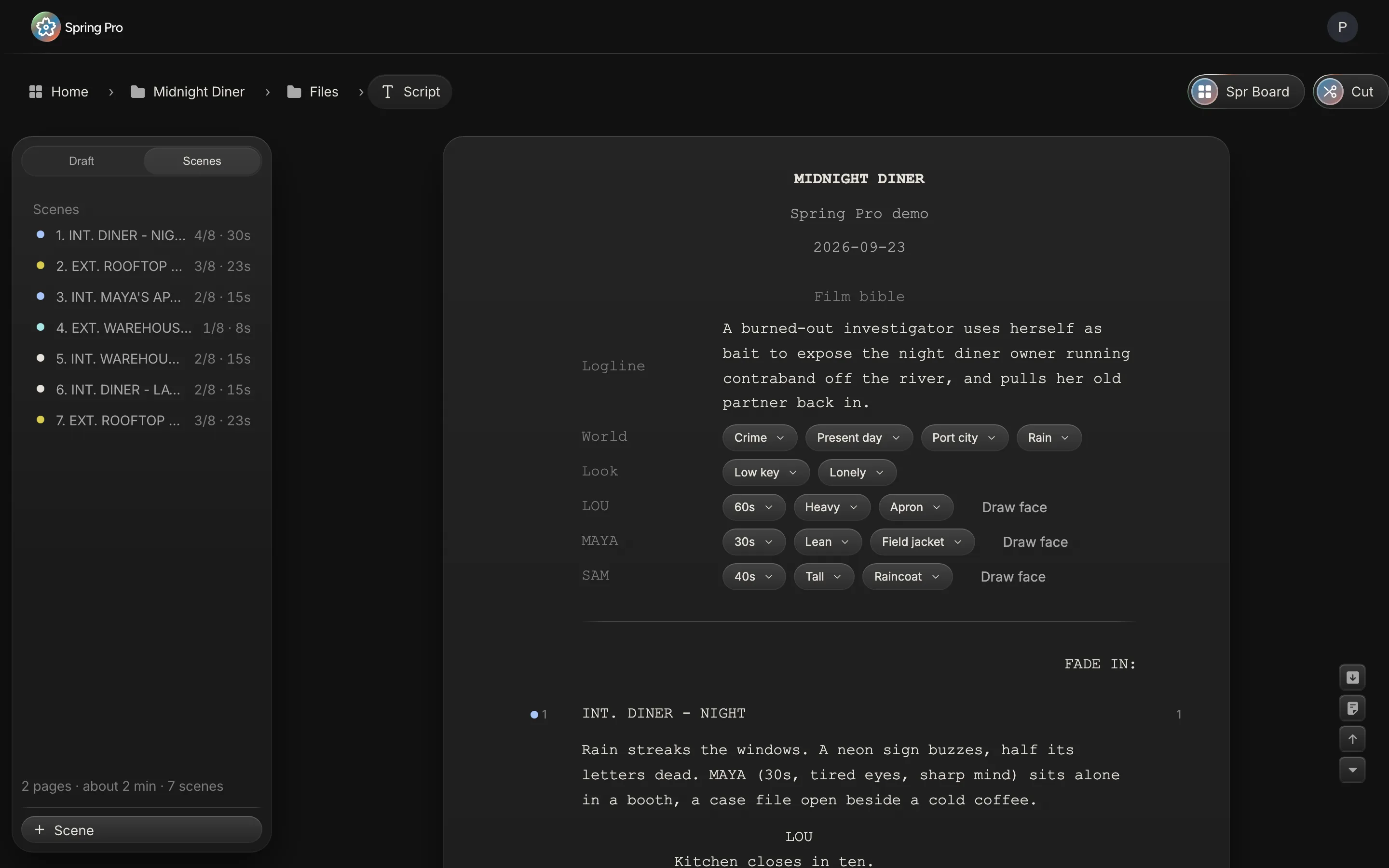
Where to go next. Size every scene in eighths of a page (script eighths), then break the script down. The schedule reads those sizes. When a scene is rewritten later, everything built from it has to follow.
Stage 2: The breakdown
What it is. The script reduced to lists of what each scene needs: cast, extras, props, set dressing, wardrobe, hair and makeup, vehicles, effects, sound and equipment. Wikipedia calls those lists the foundation of the production board, which is fundamental to the schedule and the budget. It is usually the 1st assistant director's job.
The beginner's mistake. Listing only what is written. The costly surprises are often the implied items, such as an animal or a child performer, and the weather on an exterior day is another. A line producer in the Film Independent interview, whose advice is about Los Angeles, says an untrained dog can put a simple scene behind by hours, and that children work fewer hours and need a paid studio teacher on set.
What it costs. Your time first, then the cost of anything missed: it turns up on the day as a missing prop or an unbooked vehicle while the crew waits.
A real number. Midnight Diner's breakdown holds 84 element entries in 12 categories, 72 of them distinct, and 90 department to-dos across 13 departments. Scene 1 alone, a half page in a diner at night, has 21 entries in 9 categories, from a case file to a rain rig outside the windows and a 100 kVA generator.
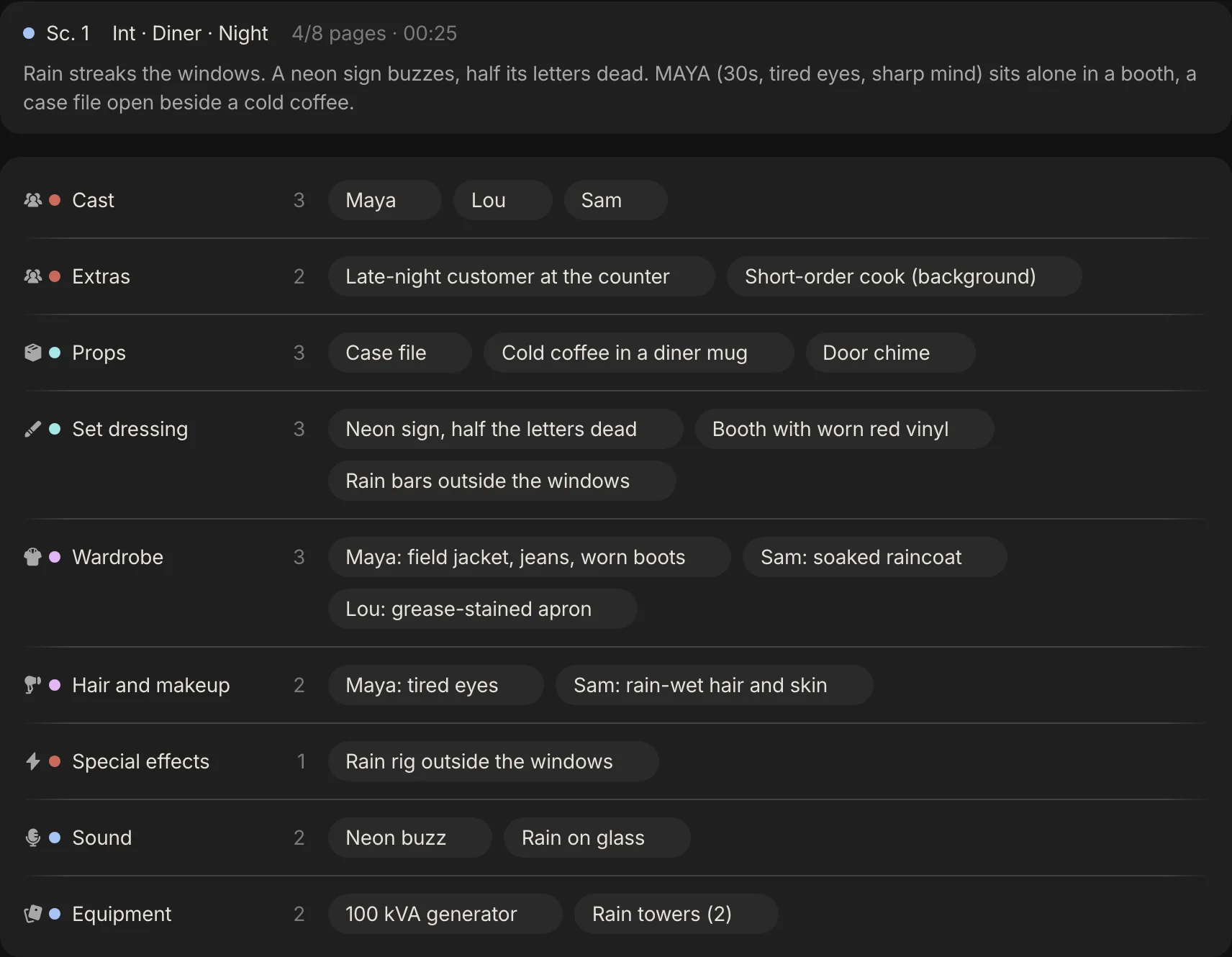
Go deeper. The method, with a real scene and the colours, is in how to break down a script, and there is a script breakdown template to start from.
Stage 3: The storyboard and the shot list
What it is. A shot list is, in Filmdaft's words, a detailed breakdown of every camera shot you plan to film in a scene: shot type, angle, camera movement and notes on cast, props or lighting. A storyboard is a sequence of simple illustrations that pre-visualise the film. Together they are the camera plan.
The beginner's mistake. Arriving with no plan for coverage and finding out on the day. Each setup takes time for lighting and camera placement, rehearsal, the takes and the resets. Wolfcrow's scheduling guide says a well-prepped dialogue day of 12 to 16 setups is realistic on a lean indie film, and a complex day of 20 or more setups pushes into overtime, meal penalties or the next day.
What it costs. Time before the shoot. The shot list is usually made in pre-production by the director and the cinematographer, as Filmdaft says, and Wikipedia says a film may be storyboarded with illustrators and concept artists.
A real number. Midnight Diner's storyboard page shows a card for each of its seven scenes, and the shot list holds 45 picks: seven each of size, angle, lens, move and style, and ten of light, four of them in scene 1. Played at their planned times, the frames run 1 minute 34 seconds, so the film has a first draft you can watch before anything is shot.
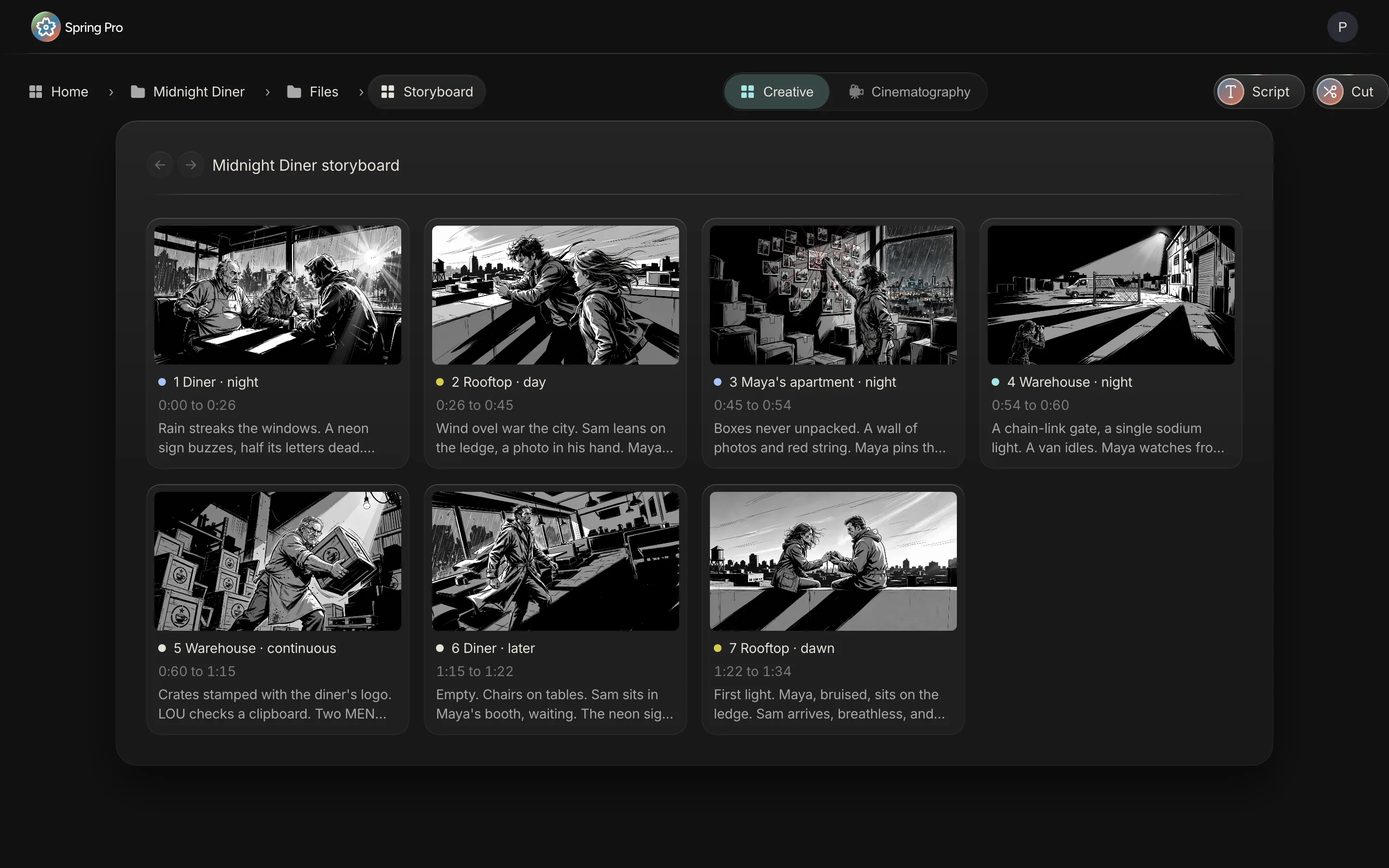
Go deeper. The shot list picks feed the schedule, because setups take time. The shot list template has the same columns as a spreadsheet.
Stage 4: The schedule
What it is. The plan that puts every scene on a dated shoot day, at a place, with a cast. Wikipedia says an assistant director manages the shooting schedule, and that the producer hires a line or production manager to create the schedule and the budget.
The beginner's mistake. Counting days from pages alone, or shooting in script order. Pages set one floor and the number of sets sets another, and every move between sets takes part of a day. Wolfcrow gives paces for features: 4 to 5 pages a day for well-funded indies and 5 to 8 or more for low-budget shoots with simple scenes.
What it costs. Time is money here. The line producer in the Film Independent interview frames budget problems as time problems: overtime, extra days and delays. Wolfcrow advises holding one contingency day for every five shoot days.
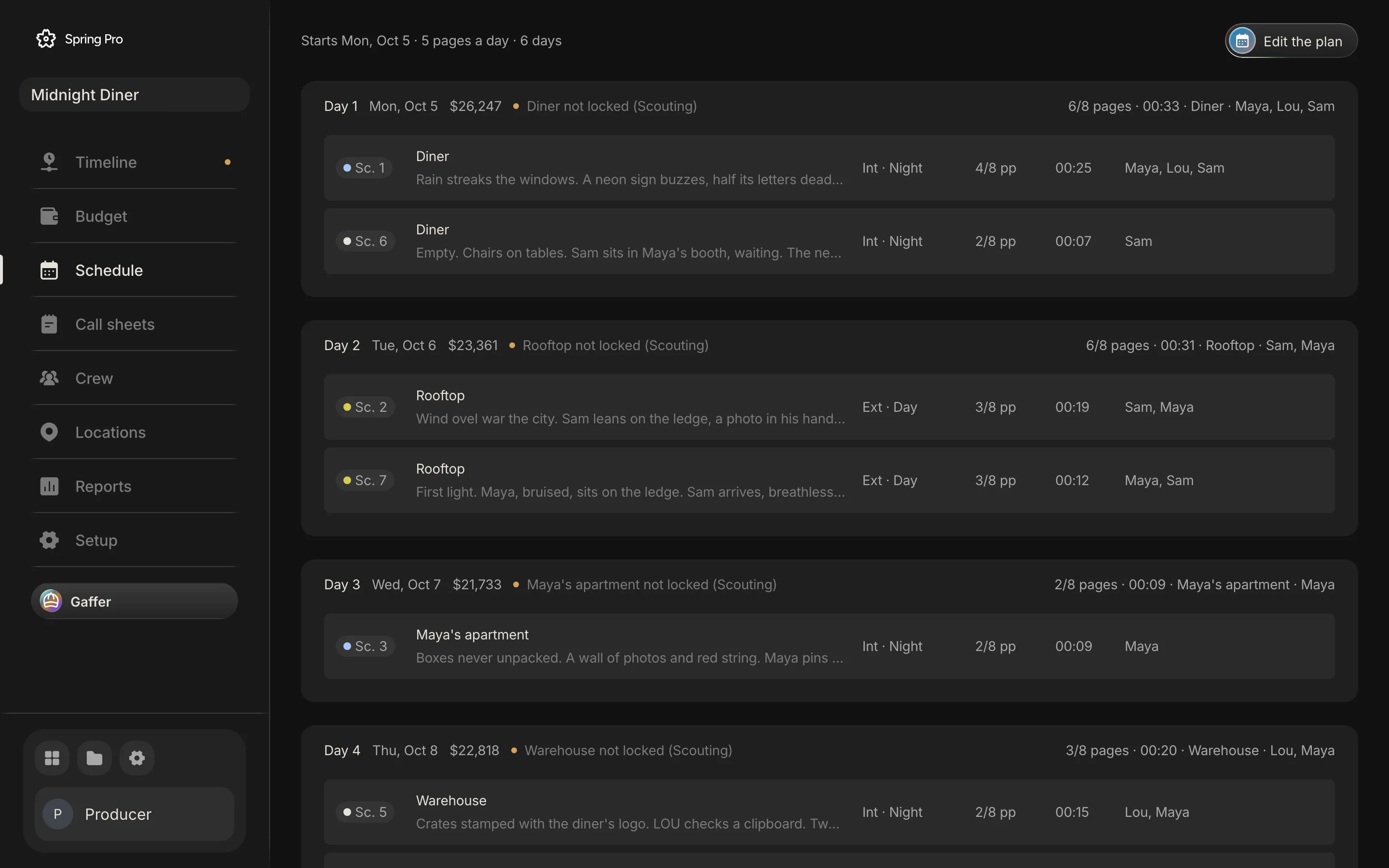
A real number. At 4 to 8 pages a day, 2 1/8 pages is 27% to 53% of one shoot day, a rough guide because those paces are for features. Midnight Diner plans four days, because it has four sets and each gets its own day. The four days cost $21,733 to $26,247 each to plan, and $94,159 in all.
| Day | Date | Set | Scenes | Pages | Planned cost |
|---|---|---|---|---|---|
| Day 1 | Mon 5 October | Diner | 1 and 6 | 6/8 | $26,247 |
| Day 2 | Tue 6 October | Rooftop | 2 and 7 | 6/8 | $23,361 |
| Day 3 | Wed 7 October | Maya's apartment | 3 | 2/8 | $21,733 |
| Day 4 | Thu 8 October | Warehouse | 5 and 4 | 3/8 | $22,818 |
Go deeper. The method, with the rest rules and what an overtime hour costs, is in how to make a shooting schedule, and the whole picture is in film production scheduling.
Two terms to learn next: turnaround, the rest between days, and the day out of days for the cast. The stripboard is the working form of the schedule, and there is a film schedule template.
Two cases need extra care: exteriors, which depend on the weather, and night scenes, which push the next day's call later. Midnight Diner has both.
Stage 5: The call sheet
What it is. The page that tells every person on the shoot where to be and when, for one day. Wikipedia says a shoot day begins with the crew arriving by their call time, that actors usually have their own separate call times, and that call sheets are given out to tell cast and crew when and where to turn up the next shooting day.
The beginner's mistake. Starting from last week's sheet and changing the date. Its errors come with it. Build each sheet from the schedule, so that the scenes, the cast and the place on it are the ones the schedule holds, and read it the way the crew will.
What it costs. Little to make, and a lot when it is wrong. A wrong call time turns up as people waiting, and waiting is paid. On Day 1 of Midnight Diner, one extra hour of crew and cast labour costs $2,993.
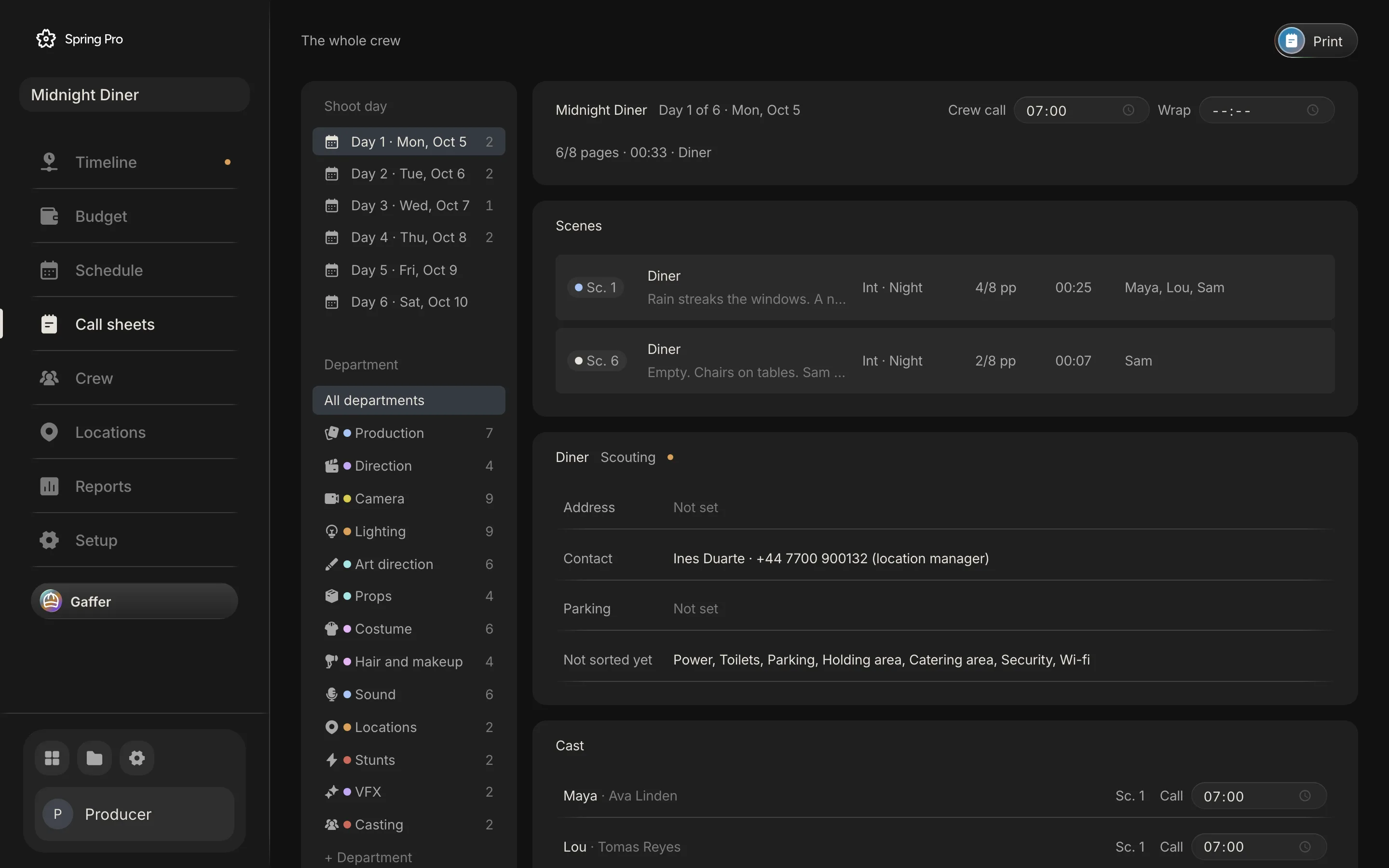
A real number. Day 1's sheet carries scenes 1 and 6, three actors, 21 things needed on set from the breakdown, and 29 to-dos still open across 11 departments. Two gaps show on it in the sample: every call is still the default 07:00, and the diner's address and parking are not set.
Go deeper. The full method is in how to make a call sheet, the term is in the glossary, and there is a call sheet template. A sheet is only as good as the place on it, which has to be scouted, permitted and locked first.
Stage 6: The budget
What it is. The price of everything the script, the plan and the schedule need, sorted into accounts, with a contingency on top. In the Film Independent interview, a rough budget is where you start: allocations inside it can shift, and the aim is the lowest cost at which the film can be made without sacrificing the story and vision.
The beginner's mistake. Spending on the wrong things. No Film School says the most expensive first-film mistake is renting the most expensive camera, which can raise insurance and become a big line, when the money would go further on overtime, extra shoot days and food. The same site's list of low-budget mistakes includes spending three to five thousand dollars on a wrap party.
What it costs. Do not assume a friend's place costs nothing. The line producer in the Film Independent interview, speaking about Los Angeles, warns that shooting in a family neighbourhood can suddenly need a police officer, a film monitor and a fire safety officer, so check what your own city requires. The cost is also time: a budget is a plan, and it ages as the schedule changes.
A real number. Midnight Diner's budget was locked on 4 October 2026 at $358,654: $326,049 across 27 accounts plus a 10% contingency of $32,605. The shoot itself (crew, kit, sets, wardrobe, locations and food) is 55% of the accounts, above-the-line costs (story, producers, director and cast) 26%, and post-production 14%. People are 88% to 94% of every shoot day's planned cost, and that is the line that mostly disappears on a film made with unpaid friends.

Go deeper. The chart of accounts, the lock and what to track after it are in how to budget a short film, and there is a film budget template. Spending after the lock needs tracking too: what has been promised, bought and paid, against the budget.
Stage 7: The shoot
What it is. The shoot is where the plan meets the day. Wikipedia describes it: the crew arrives by call time, grip, electric and production design work a step ahead of camera and sound, the actors do costume, hair and makeup and rehearse, and then the action is shot in as many takes as the director wishes. The script supervisor notes any continuity issues, and the aim is to stick to the budget and the schedule.
The beginner's mistake. Leaving sound to fix later. Neil Chase's guide says audiences might forgive a blurry shot but will not overlook poor sound. The other classic mistake is a day with too many setups, covered under the storyboard stage.
What it costs. On a paid shoot, hours are the bill. Midnight Diner plans an 11-hour day with overtime after hour 10 at 1.5 times the rate. One extra hour of crew and cast labour on Day 1 adds $2,993, and a 14-hour Day 1 adds $8,979.
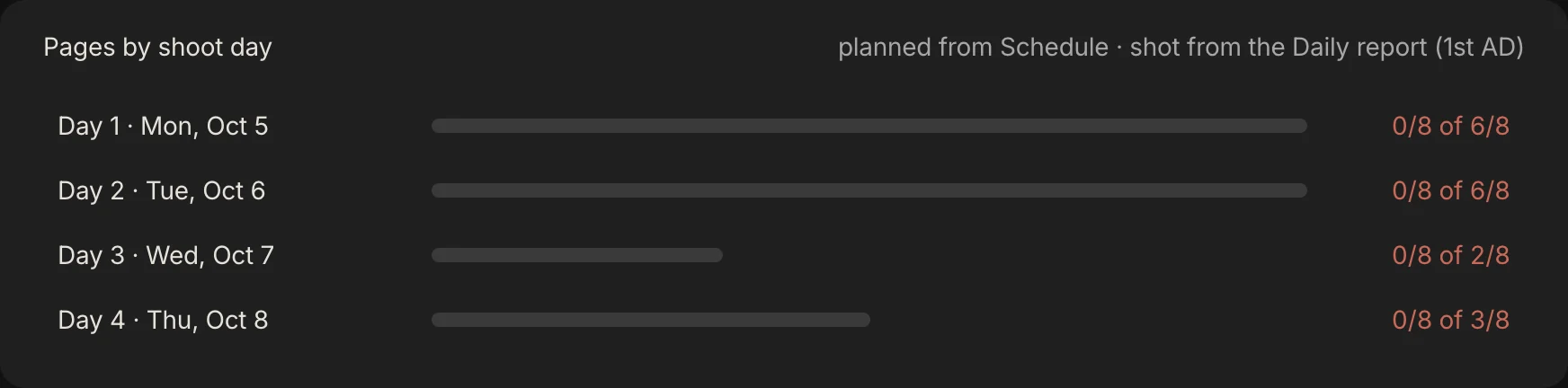
A real number. The four shoot days cost $94,159 to plan, which is 29% of the money in the accounts. The rest is flat fees, prep and wrap days, and fixed lines such as post and insurance. After each day a daily report sets what happened against the plan, and in the sample no day is reported yet, so the Reports page reads 0 of seven scenes shot.
Go deeper. The daily report is explained in the glossary entry, and the rest and meal rules that make hours expensive are in turnaround and meal breaks on a film shoot.
Stage 8: The cut
What it is. The edit: the footage assembled into the film, then the sound, music, effects and colour. Wikipedia describes a rough cut, a fine cut and then a picture lock, when the editor and the director agree the final cut, and says post-production can take days to years.
The beginner's mistake. Treating post as the easy part. The Filmdaft writer says bad sound can sink a short film's festival chances, and that on a tight budget the editor often picks up the sound design. Chase adds that too much footage can make a film feel disjointed, and advises getting feedback on the rough cut.
What it costs. In a paid plan, post is a large block. Midnight Diner budgets $45,285 for editing, VFX, colour, sound post, music and deliverables, which is 14% of its accounts.
A real number. Before anything is shot, Midnight Diner already has a first cut to watch: the seven storyboard frames, laid on the director's cut at their planned times, run 1 minute 34 seconds. That is a plan you can play, not a cut of footage.
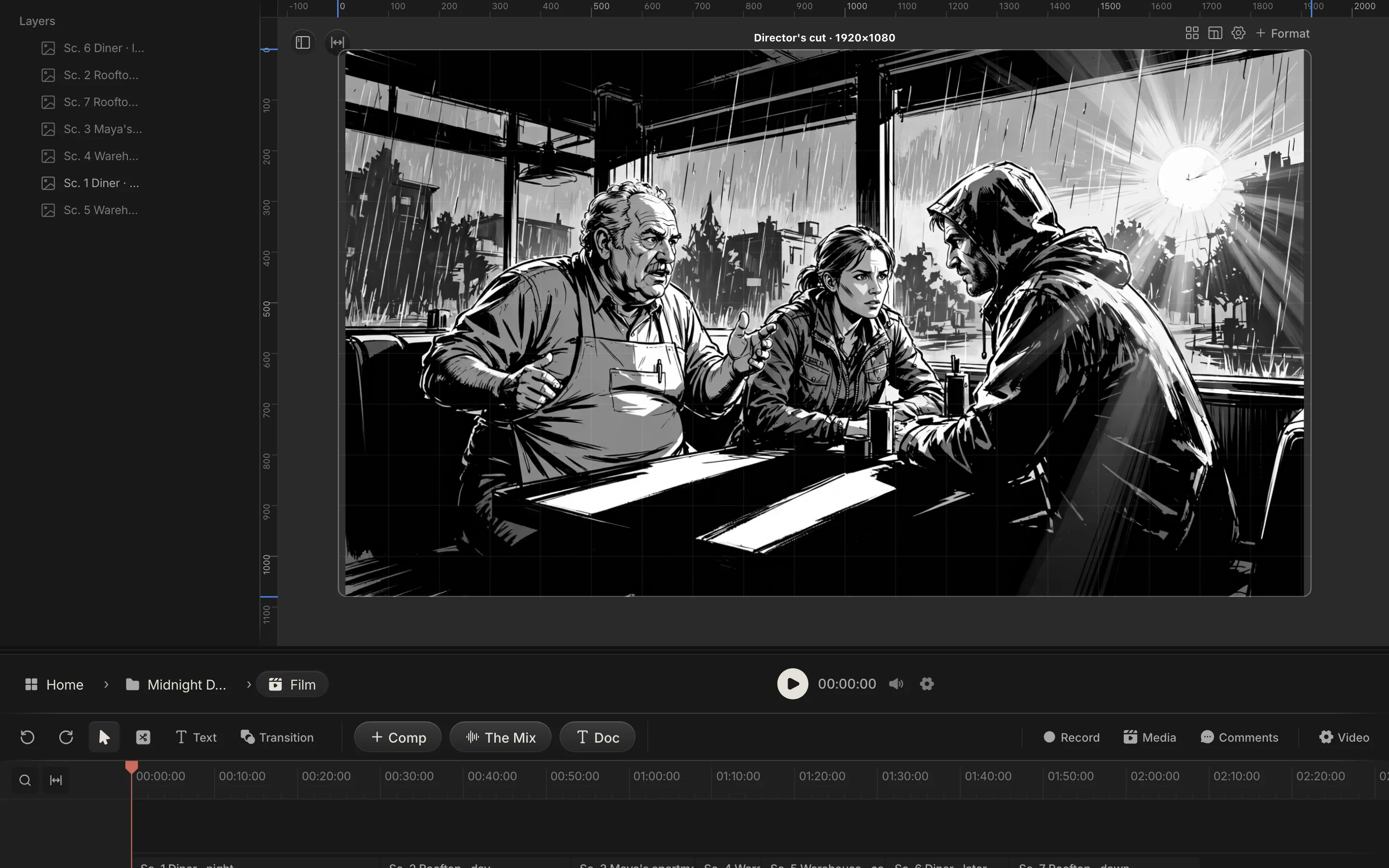
Go deeper. Cut is a button on the script and storyboard pages: it places each scene's chosen frame on the director's cut, and you edit on the timeline from there as footage comes in.
What this guide leaves out: money, marketing and distribution
Funding, casting, marketing, festivals and distribution are all part of making an independent film, and this guide only touches them. Neil Chase's guide lists ten stages, and puts funding, marketing, festivals and distribution around the plan: its funding list runs from investors and crowdfunding to grants, pre-sales and your own money, which it calls risky. It also warns that festival entry fees can add up.
Wikipedia says that digital tools have made the means of production cheaper, but that financing, traditional distribution and marketing remain difficult outside the traditional system. Spring Pro does not find investors, run auditions, market a film or distribute it. Its budget tracks agreed funding against spending week by week, and holds an account for publicity and festivals, which is $1,500 in the sample.
How long making films takes, and what the sources can tell you
Beginners ask how long it takes, and the honest answer is that the sources we read give figures for a film, not for a short. The table sets those figures beside Midnight Diner's own plan, which is a plan and not a record.
| Stage | What the sources say (none times a short) | Midnight Diner's plan |
|---|---|---|
| Script | A screenwriter typically takes several months. A line producer quoted by Wikipedia puts one to three years from developing a script to a shooting script | A seven-scene script. No writing time is recorded |
| Pre-production | Typically three to six months | No prep calendar in the project |
| The shoot | Five to eight weeks for a mid-range movie, three to four weeks for a lower-budget one | Four shoot days, 5 to 8 October |
| Post-production | Days to years, depending on the film and the resources | A 1:34 first cut from the storyboard, before any footage |
| Distribution | No duration given. Wikipedia says financing, distribution and marketing remain difficult outside the traditional system | Not planned in the project |
These figures are for a movie, not a short, and a short is smaller. On them, pre-production can run longer than the shoot, and post-production is given as anything from days to years, so there is no rule. We found no source that times each stage of a short, so we do not.
How indie filmmakers work today, and what breaks when a scene changes
In our view, a short is often planned in documents and a spreadsheet or two, and larger productions add scheduling and budget software. This is our view from our own work, not a survey, and we have not tested other products, so the middle row describes a setup, not a named tool. What tells the ways apart is what you redo when a scene changes.
| Way of working | Good for | When a scene changes you must |
|---|---|---|
| Documents and spreadsheets | A short with one or two locations, and no software to learn | Edit the breakdown, the schedule, every call sheet and the budget by hand, and check each against the others |
| A separate tool for each stage | A crew that already uses them | Re-enter or re-import the change in each tool, and keep the exports in step |
| One project where the stages read the same scenes (Spring Pro) | A plan that changes every week and is read by many people | Edit the scene and check what moved. You still choose the elements, the days and the calls yourself |
If your film is a short with one or two locations, the first row is enough. The cost of keeping the stages apart shows when the plan changes every week.
From a no-budget short to a feature: what changes
The chain does not change with size. What grows is the number of people who read each document, and the cost of a wrong one. These sizes are rough labels, not industry definitions.
| Size | Typical shape | What changes in the chain | Where Spring Pro stops |
|---|---|---|---|
| No-budget short | You, some friends, one or two locations | You are the producer, and each stage can be a page or a sheet | Call sheets print, and cannot be emailed from the app |
| Funded short | A small paid crew and a few days | The breakdown, the schedule and the budget are read by people other than you | No payroll or timecards for a paid crew, no emailed call sheets, and everyone on a project can approve |
| Independent feature | A line producer, a longer shoot, revisions | Rough and detailed budgets, rest rules, a revision routine, cash by week | No payroll or timecards, no accounting ledgers, and everyone on a project can approve |
| Series or several units | Many scripts, blocks and units | A schedule for each block | One script and one unit per project |
Several units and several episodes in one schedule are the biggest limit, and we say so plainly: the method holds for them, but this tool does not yet.
Doing it in Spring Pro, one optional way
Every planning stage above can be done with a script, a spreadsheet and a printer. Spring Pro is one way to hold the whole chain in one project, so that the stages read the same scenes. It runs in a web browser, with nothing to install.
What it does at each stage: you write on a screenplay page with scene numbers and page count as you type, and import Final Draft and Fountain files. Each scene holds its elements in the twelve breakdown categories, and a storyboard frame and a shot list.
Plan the shoot builds a first schedule by set and by day or night, and each dated day shows its pages, cast, warnings and planned cost. Call sheets fill in from the schedule, the crew list and the locations, and they print.
The budget is built from the crew's deals and the schedule, and it can be locked and every later change logged. Reports include the daily production report. The edit is in the same project, and Gaffer, an assistant, reads the whole production and answers with real names and numbers. It changes nothing unless asked, and one undo reverts what it did.
What it does not do yet: payroll, timecards and accounting ledgers; per-person permissions, because everyone on a project can approve; several units or several episodes in one schedule; emailing call sheets, which print instead; and recording cameras on set, which is coming in a desktop app.
The tool pages, which are our own product pages, are storyboard software, script breakdown software, shooting schedule software, call sheet software and production budget software. For a comparison with another tool, read our StudioBinder alternative page.
The checklist
Copy this. Tick it before the first shoot day.
- The script is small enough to afford: you have counted its sets, nights, crowds and effects
- Every scene is sized in eighths of a page and broken down by category, and the implied elements are listed
- Anything that needs a specialist, such as an animal, a child, an effect or a stunt, has been priced and scheduled on purpose
- Every scene has a shot list, and no day holds more setups than it can finish
- Scenes are grouped by set and by light, and each day has its rest and its meals
- Every location is confirmed, and its permit is in hand if it needs one
- The budget has a contingency, one person who approves spending, and a place to log changes
- Each call sheet is built from the schedule, and one version goes out, usually the day before
- Sound has a plan, and someone owns it
- You know who edits, and who will give feedback on the rough cut
How these numbers were made
Every number about Midnight Diner comes from the project itself, computed by the app's own engines (the screenplay layout, the schedule and the budget) and matched to the screens on this page. The build stops if the project changes so that a number here stops being true. Midnight Diner is a demonstration production, not a case study of a real shoot, and its budget is a paid plan, not a benchmark.
Every outside claim comes from a page we fetched and read on 12 October 2026. Several are blogs or vendors and are labelled so, and a page we could not open is not cited. We found no reliable source for how long a short film takes at each stage, or for what a first short costs on average, so we quote neither.
Questions people ask
How do I make an independent film?
Write a script small enough to afford, break it down, plan the shots, schedule the shoot days, make a call sheet for each day and a budget for the whole film, shoot, then edit. The order and what each stage costs are above, and each stage has a deeper guide, starting with how to break down a script.
How do I make an independent film with no budget?
Make a short, keep it to one or two locations and a small cast, and plan carefully, because No Film School tells first-timers that perfect comes from prep, not from paying a ton of money. Do not assume a friend's place costs nothing: a line producer speaking about Los Angeles warns that it can still need a police officer, a film monitor and a fire safety officer, so check your own city's rules. The film budget template is a place to count them.
How much does it cost to make an independent film?
There is no agreed figure. Wikipedia says no precise number defines a low-budget film, and a 2014 survey of 542 professionals gives opinions, about $396,000 as the average ceiling for micro-budget. See how to budget a short film for the method.
What is the difference between low budget and no budget filmmaking?
No source we read defines either with a number. Wikipedia says low budget is relative to genre and country, and micro-budget can be as little as a few thousand dollars. On this page "no budget" means nobody is paid.
How long does it take to make an independent film?
Longer than the shoot. Wikipedia gives pre-production as typically three to six months and the shoot as three to four weeks for a lower-budget film, with post-production from days to years. None of those figures is for a short, and we found no reliable timing for one.
What do independent filmmakers need to start?
A script, a small cast, one or two locations, a camera, sound and a plan. Filmdaft lists a skeleton crew of a director, a director of photography, a gaffer or grip, a sound person, a makeup artist if the genre needs one and a production assistant or two. The schedule and the budget are the plan: see how to make a shooting schedule.
Do indie filmmakers need a producer?
Someone has to do the producer's work. On a short, the writer and director is often the de facto producer, as Filmdaft says. On a larger film a line producer builds the schedule and the budget, as in the Film Independent interview.
Should I make a short film before a feature?
Many first-time filmmakers make a low-budget film to prove their talent before larger productions, as Wikipedia notes, and Neil Chase says some indie shorts have led to feature films. A short also lets you test the whole chain with a few days of shooting.
In what order do you make a film?
Script, breakdown, storyboard and shot list, schedule, call sheet, budget, shoot, cut. In practice the budget gets a rough first pass with the schedule, and each call sheet is made shortly before its shoot day, usually the day before. See the call sheet guide.
Sources
Every outside claim that names a source comes from one of these, read on the date shown. Standard conventions, such as the eighths rule and the usual specialist cases, are common practice. Figures from agreements and summaries change at each negotiation, so check the current text before you rely on a number.
- Wikipedia, filmmaking (the film production article): the five stages, crews, call times and post-production. Checked 2026-10-12.
- Wikipedia, independent film. Checked 2026-10-12.
- Wikipedia, low-budget film. Checked 2026-10-12.
- Wikipedia, script breakdown. Checked 2026-10-12.
- Wikipedia, storyboard. Checked 2026-10-12.
- Neil Chase, how to make an independent film: a guide for filmmakers (a filmmaker's blog, updated May 2025). Checked 2026-10-12.
- Filmdaft, my eight steps to making a short film (a filmmaking site, last updated October 2026). Checked 2026-10-12.
- Filmdaft, what is a shot list (a filmmaking site that also offers its own template). Checked 2026-10-12.
- Stephen Follows, the average budget of a low or micro-budget film (a 2014 survey of 542 film professionals about where the lines fall). Checked 2026-10-12.
- Stephen Follows, does one page of a screenplay really equal one minute of screen time? (a study of 2,520 feature scripts, March 2026). Checked 2026-10-12.
- Film Independent, a line producer on building a better budget (a 2017 interview with a line producer of over 40 features, whose permit advice is about Los Angeles). Checked 2026-10-12.
- Wolfcrow, how to schedule a film (a filmmaking education site, September 2025). Checked 2026-10-12.
- No Film School, the most expensive mistake filmmakers make on their first movie (February 2025). Checked 2026-10-12.
- No Film School, mistakes to avoid when creating your low-budget film (July 2021, from a director's interview; the article lists four). Checked 2026-10-12.
More about making a film, start to finish
A beginner or an independent filmmaker needs the whole path in order, and a way into each stage.