Shot list templateA shot list template, filled in scene by scene.
A shot list is the director's plan for how each scene is covered: how wide, from where, with what lens, moving or still. The best shot list is short enough that the crew actually reads it. This one is the real shot list of Midnight Diner, one row per scene.
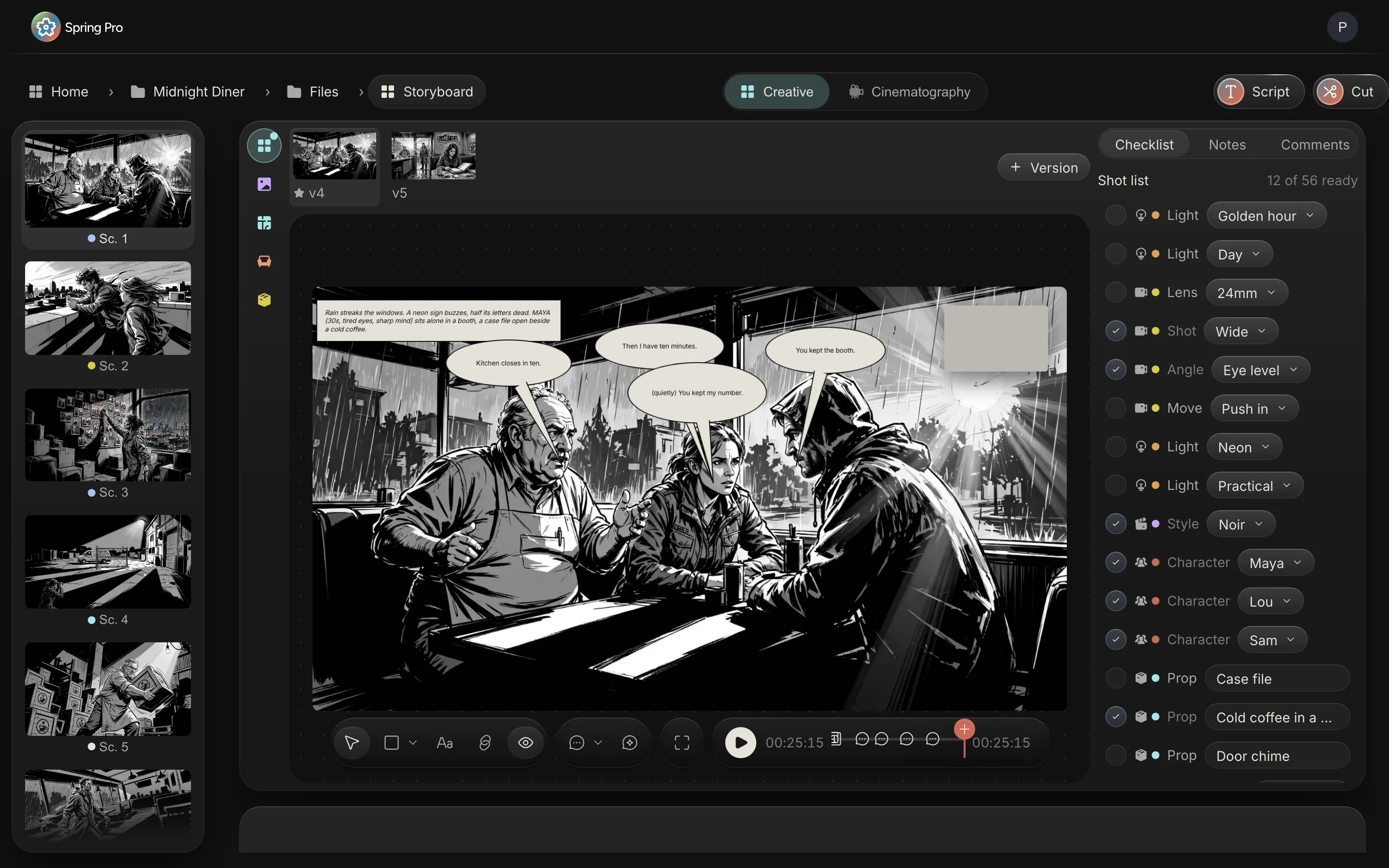
Updated 2026-10-12. Every screen is Spring Pro running Midnight Diner, our demo production.
The sample, and the download
Sample data: Midnight Diner, our demo production (7 scenes, 2 1/8 pages, 4 shoot days). The CSV opens in Excel and Google Sheets. Replace the rows with your own.
Shot list by scene
| Sc | Set | Time | Size | Angle | Lens | Move | Light | Style | Cast | Props |
|---|---|---|---|---|---|---|---|---|---|---|
| 1 | Diner | Night | Wide | Eye level | 24mm | Push in | Golden hour; Day; Neon; Practical | Noir | Maya, Lou, Sam | Case file; Cold coffee in a diner mug; Door chime |
| 2 | Rooftop | Day | Two shot | Low | 50mm | Static | Day | Naturalistic | Sam, Maya | Surveillance photo of the river warehouses |
| 3 | Maya's apartment | Night | Over the shoulder | High | 35mm | Handheld | Practical | Noir | Maya | Rooftop photo, pinned at the centre; Red string and pins |
| 4 | Warehouse | Night | Wide | Low | 85mm | Static | Night | Noir | Maya | Maya's camera with a long lens; Idling van |
| 5 | Warehouse | Continuous | Medium | Eye level | 24mm | Tracking | Low key | Noir | Lou, Maya | Crates stamped with the diner's logo (12); Lou's clipboard; Breakaway glass bottles |
| 6 | Diner | Later | Wide | High | 35mm | Pull out | Low key | Noir | Sam | Sam's phone; Chairs up on the tables |
| 7 | Rooftop | Dawn | Two shot | Eye level | 50mm | Crane | Golden hour | Dreamy | Maya, Sam | Maya's camera, hero (same as Sc. 4) |
How to fill it in
- Write the scene in one line, then decide how many setups it needs. Fewer is faster.
- For each setup pick the shot size, the angle, the lens and the move.
- Note the light, because it decides the order you shoot the setups in.
- Add the cast and the props in frame, so the right people and objects are on set.
- Draw the frame if you can. A rough sketch does more than a paragraph.
The six picks
The sample uses the choices a director actually makes for each setup:
- Size: wide, medium, close, extreme close, over the shoulder, two shot, insert
- Angle: eye level, high, low, overhead, Dutch
- Lens: from 14 mm wide to 135 mm long
- Move: static, pan, tilt, push in, pull out, tracking, handheld, crane
- Light: day, night, golden hour, neon, practical, low key, high key
- Style: noir, naturalistic, documentary, symmetric, dreamy
How to read the sample
Scene 1, the diner, is a wide at eye level on a 24 mm lens, pushing in, lit by neon and practical lights, in a noir style. Everyone in the crew can see from that one line what the camera, the grips and the electrics are about to do.
Some scenes carry more than one light, because the same scene is shot in more than one condition. The list shows all of them, separated by semicolons.
A list and a picture beat a list alone
A shot list tells the crew what you want. A storyboard frame shows them. Keeping the two together is what stops "I thought you wanted it wider".
Do it in Spring Pro, where each scene has both
In Spring Pro the shot list sits next to the storyboard frame for the scene, with the same choices as above. Each row can be ticked off, and each belongs to a department, so the shot list doubles as that department's to-do list.
Art and cinematography have their own boards on the same scene: a moodboard, set and props boards, and a floor plan, camera and light plan. Nothing lives in a separate file.
Questions
What is a shot list?
A shot list is an ordered list of the camera setups needed to cover each scene, with the size, angle, lens and movement of each, so the director, camera and lighting teams prepare the same plan.
What is the difference between a shot list and a storyboard?
A shot list describes each shot in words and numbers. A storyboard draws it. They work best together, because the list is exact and the picture is unmistakable.
How many shots should a scene have?
As few as the scene needs. Each extra setup costs time, so plan the coverage the cut actually uses.
More about storyboard and design
Directors, camera and art need to see the same scene before the day, and the plan has to survive the changes.
Set up your
production today.
The script, the storyboard, the schedule, the call sheets and the budget in one project.