Film schedule templateA film shooting schedule template, laid out as a stripboard.
A shooting schedule is the script turned into days. Each scene becomes a strip, and strips are stacked into dated shoot days. This is the real stripboard for Midnight Diner: 7 scenes across 4 shoot days, with the pages and the planned cost of each day.
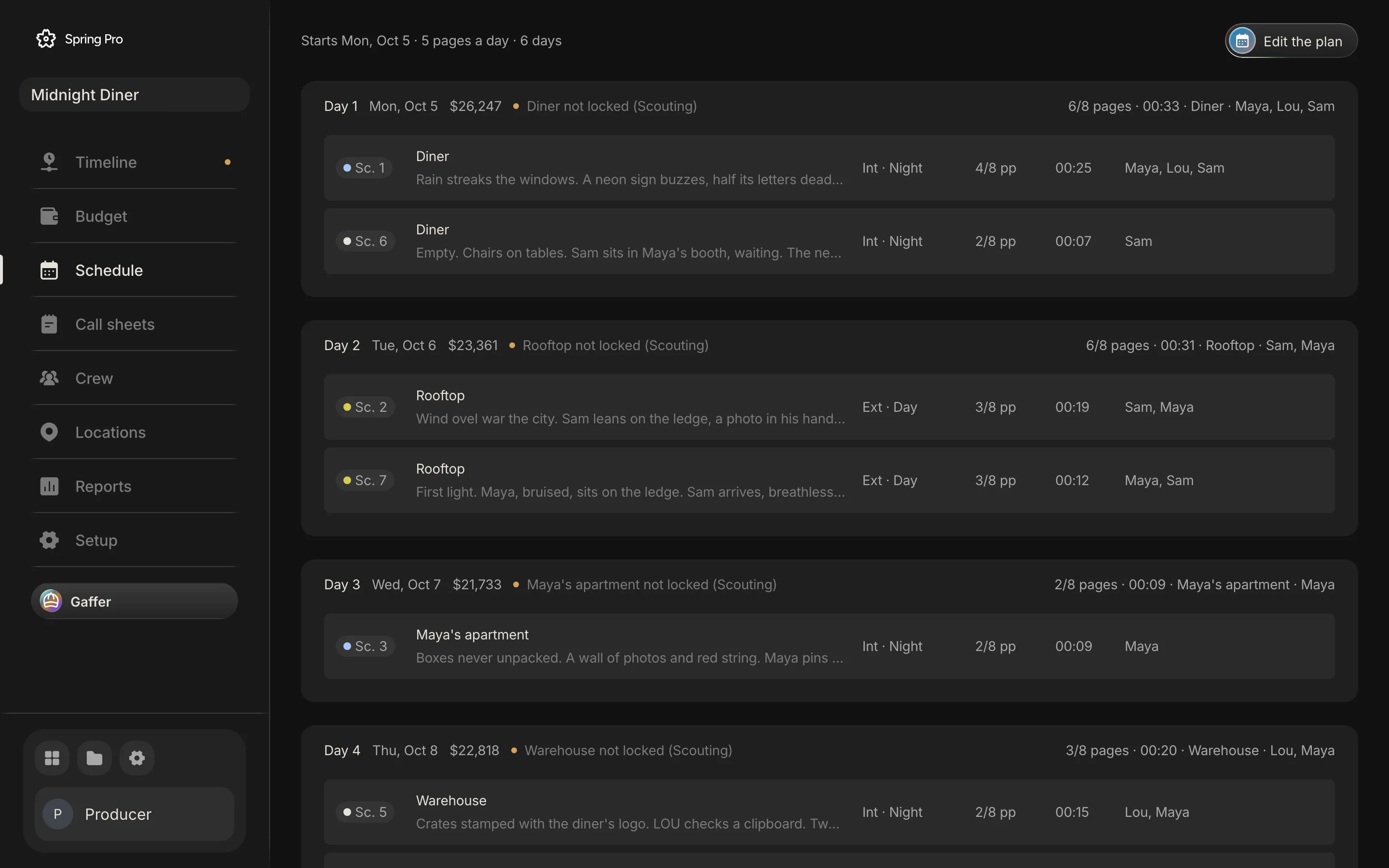
Updated 2026-10-12. Every screen is Spring Pro running Midnight Diner, our demo production.
The sample, and the download
Sample data: Midnight Diner, our demo production (7 scenes, 2 1/8 pages, 4 shoot days). The CSV opens in Excel and Google Sheets. Replace the rows with your own.
Stripboard
| Day | Date | Sc | Set | I/E | Time | Pages | Cast | Planned cost |
|---|---|---|---|---|---|---|---|---|
| 1 | 2026-10-05 | 1 | Diner | INT | Night | 4/8 | Maya, Lou, Sam | |
| 1 | 2026-10-05 | 6 | Diner | INT | Later | 2/8 | Sam | |
| End of day 1 | 6/8 | 26247 | ||||||
| 2 | 2026-10-06 | 2 | Rooftop | EXT | Day | 3/8 | Sam, Maya | |
| 2 | 2026-10-06 | 7 | Rooftop | EXT | Dawn | 3/8 | Maya, Sam | |
| End of day 2 | 6/8 | 23361 | ||||||
| 3 | 2026-10-07 | 3 | Maya's apartment | INT | Night | 2/8 | Maya | |
| End of day 3 | 2/8 | 21733 | ||||||
| 4 | 2026-10-08 | 5 | Warehouse | INT | Continuous | 2/8 | Lou, Maya | |
| 4 | 2026-10-08 | 4 | Warehouse | EXT | Night | 1/8 | Maya | |
| End of day 4 | 3/8 | 22818 |
How to fill it in
- List every scene as a strip: number, set, interior or exterior, day or night, length in eighths, cast.
- Group strips by set first, then by day or night, so the crew is not moving the whole unit for every scene.
- Fill each day to the pages you can realistically shoot. Add the strip lengths and stop at your number.
- Put the dates on the days, skipping the days nobody works.
- Check each day for the three usual problems: too many pages, two sets, day and night mixed.
How to read the sample
Day 1 is the diner: scenes 1 and 6, both interior and both at night, 6/8 pages. Day 2 is the rooftop, scenes 2 and 7, both exterior and both in daylight, 6/8 pages. Day 3 is Maya's apartment alone. Day 4 is the warehouse.
Each day has one set and one kind of light. That is the whole trick of a stripboard. It is not clever. It is a day where nobody moves.
Colours and what they tell you
On a stripboard the strips are coloured by interior or exterior and by day or night. The usual convention is white for day interiors, yellow for day exteriors, blue for night interiors and green for night exteriors.
The point is that you can see a bad day at a glance. A day with yellow and blue strips in it is a day that crosses from daylight to dark.
What makes a day too much
A page-count target is the first check. How many pages a day you can shoot depends on the work: dialogue moves fast, stunts and effects do not. Set a target for your own production and flag the days above it.
The second and third checks are more than one set in a day, and day and night in the same day. Both are company moves, and a company move eats hours.
Do it in Spring Pro, where the strips already exist
In Spring Pro every scene is already a strip, sized from its own pages, so you are not typing strips. Drag a strip to a day, or let plan the shoot build a first pass by set and by day or night, filled to your pages-a-day target.
Each dated day shows its pages, cast, warnings and planned cost, because the budget reads the same schedule. Move a scene and the cost moves with it.
Questions
What is a stripboard?
A stripboard is a shooting schedule laid out as strips, one per scene, stacked into shoot days and coloured by interior or exterior and day or night, so the shape of the schedule is visible at a glance.
How many pages can you shoot in a day?
It depends on the work. Dialogue scenes move faster and action, stunts and effects move slower, so set a page target for your own production rather than copying a number.
Should I schedule in script order?
Usually not. Scenes are grouped by location, day or night and cast availability to save moves, then put in an order that suits the production.
More about shooting schedule
A schedule is a labour bill. The cost of an error is paid in hours.
- Film production scheduling: the whole picture. The complete guide
- Scenes become strips. Strips become shoot days. The tool
- How to make a shooting schedule for a film, with a real sample.
- Turnaround and meal breaks on a film shoot: the rules and a calculator.
- What a day out of days report is, and how to read one.
- One line schedule vs stripboard: the same four days, three ways.
- How to schedule a night shoot for film: the calls, the meals, the rest and the loadings.
- Film weather cover day: how to swap a rain day, with worked costs.
- Scheduling through script revisions: the colours, the routine and what each change costs.
- What is a stripboard?
- What is a day out of days?
- What is turnaround on a film set?
Set up your
production today.
The script, the storyboard, the schedule, the call sheets and the budget in one project.