Movie script format, shown on a real page, and how a scene is sized.
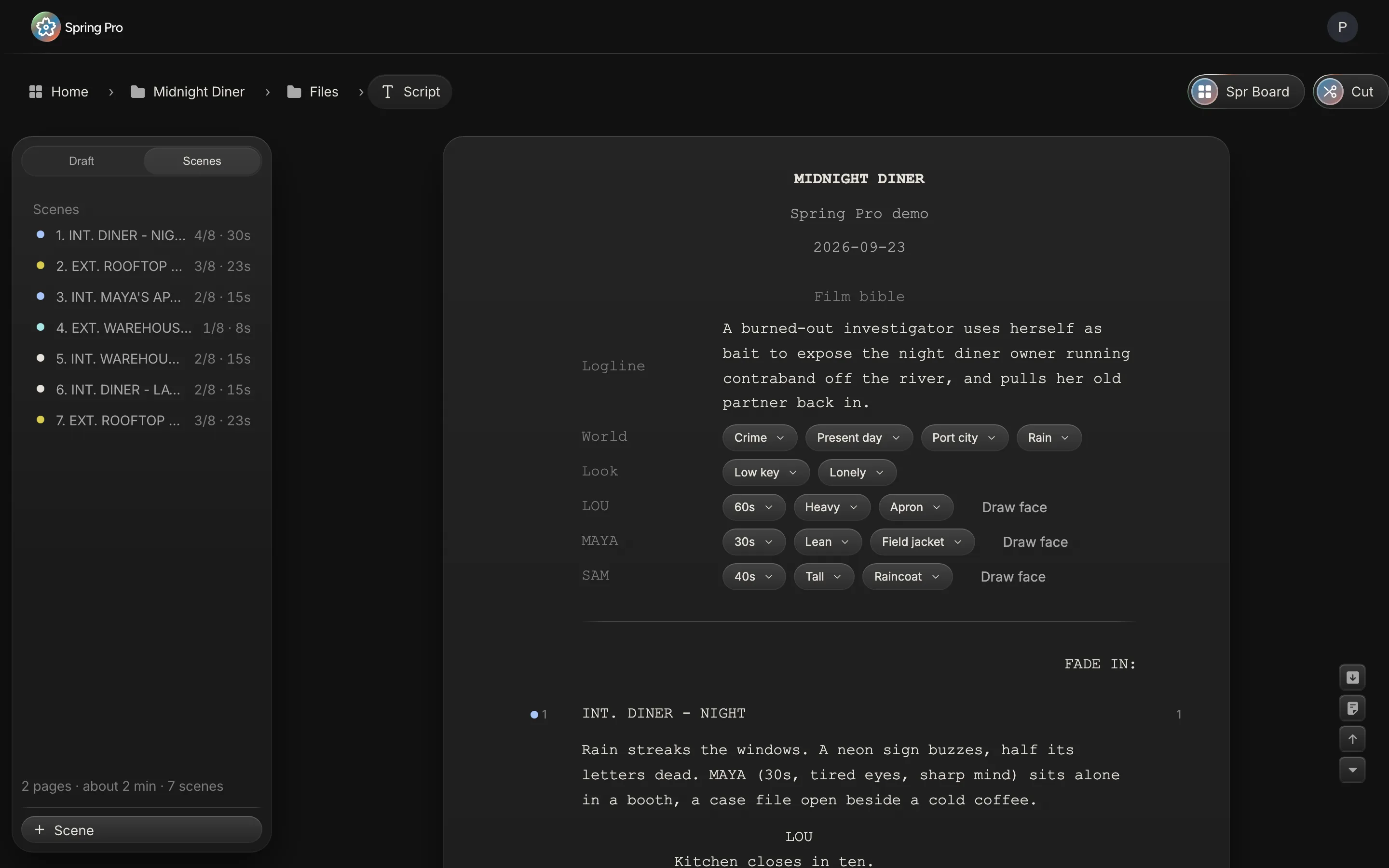
Real screen: Midnight Diner, our demo production, in Spring Pro.
The short answer. A movie script is set in 12 point Courier on a US Letter page (A4 in the UK), built from six elements in fixed places: scene heading, action, character, dialogue, parenthetical and transition. Every page is the same size, so page count became a rough clock of a minute a page, and a scene is sized in eighths of a page so a schedule can add them up.
A lot of advice on movie script format is about looking professional. The better reason is that other people measure the page: a producer turns it into minutes, a scheduler turns it into days. This guide formats one real script, Midnight Diner, row by row, and follows its scene headings into the breakdown and the schedule. Every number about it is computed from the script, or checked against it when the page is built, and the rules come from sources read and dated below.
In this guide 16 sections
- Quick answers
- Why script format matters, and where it goes wrong
- The film we are formatting, and what to settle first
- The six elements of film script format, and where each one sits
- A movie script format example: one real page, row by row
- 12 point Courier and the page-a-minute rule: what the data says
- How a scene is sized: rows, eighths and seconds
- What a scene heading becomes in the breakdown
- What a scene heading does to the schedule
- Writing it in Spring Pro, and what it does not do yet
- How people format a script today, and what breaks when a scene changes
- From a short to a feature: what changes
- The format checklist
- How these numbers were made
- Questions people ask
- Sources
Quick answers
What is movie script format? A fixed layout. A screenplay is built from six elements (scene heading, action, character, dialogue, parenthetical and transition), each at its own indent, in 12 point Courier on a US Letter page in the US and A4 in the UK. Wikipedia gives the standard face as 12 point, 10 pitch Courier.
Why Courier, and what is a page worth? Every character has the same width, so a page holds a known amount of text and pages can be compared. Final Draft, a software vendor, says the page-a-minute rule grew out of that standardisation. Stephen Follows compared 2,520 produced scripts with their runtimes and found about 55 seconds a page on average, and only 18.2% of scripts within 5% of a page a minute.
What are eighths? A page cut into eight parts, so a scene's length is counted in eighths, and Spring Pro writes it as whole pages plus eighths, such as 1 3/8. A scheduler adds a day's eighths to see how many pages it holds. See script eighths.
How does a scene heading reach the schedule? Its place becomes the set and its time of day the light that a plan groups scenes by, and the scene's length in eighths becomes the day's page count. Real screens below show the breakdown sheet and the first day, and the page works out what one changed word does to the first plan by running the app's planner on the script.
Do I need screenwriting software? No. The format is a layout, and any tool that sets the font and the indents will do. Software that formats as you type saves the work, and Spring Pro writes on the same page and reads Final Draft and Fountain files.
Why script format matters, and where it goes wrong
The rules are tight because the measuring is real. The 2026 to 2027 Nicholl rules ask for standard industry format (12 point Courier) and a feature of 80 to 125 pages, and say a script outside standard format, or one with margins cheated to run past 125 pages, may have that counted against it in judging. The same rules say an entrant must be recommended by an official Nicholl Partner. Limits and routes change from year to year, so read the current rules before you enter anything.
Inside a production the page is read by people who may never meet the writer, and a loose format costs each of them something.
| Reader | What they take from the page | What goes wrong when the format is loose |
|---|---|---|
| A competition or script reader | Page count as length, format as craft | Cheated margins may count against the script, and its length is misjudged |
| The producer | Page count as running time, about a minute a page | The runtime, and the cost that follows from it, is guessed from the wrong length |
| The 1st AD | Each scene heading and its length in eighths | Days are built from guessed lengths, which risks overtime |
| The breakdown | The names above dialogue and the words in action | A character or a prop is missed and turns up on the day |
| The director, DP and department heads | Where and when each scene happens | A vague heading leaves every department guessing |
No Film School says a script chosen for production has to be turned into a breakdown sheet, so unclear scene headings, action and dialogue make the director's, the DP's and the 1st AD's work hard. Format is also what lets a change travel: when a heading changes, the breakdown and the schedule can follow it only if it is written the way they read it.
The film we are formatting, and what to settle first
Midnight Diner is a short crime film. A burned-out investigator uses herself as bait to expose the night diner owner running contraband off the river, and pulls her old partner back in.
It has 7 scenes in 4 sets and 3 speaking characters, and on the Spring Pro page it runs 2 pages. This guide is the pillar of the script and screenplay set, and both the breakdown and the schedule read what you write here.
Settle these before you format anything, because every later step reads them:
- The page. 12 point Courier, with 1.5 inches of margin on the left and 1 inch on the other sides. Those are the figures in Filmdaft's guide, which takes them from a Final Draft blog post, so they are not independent of that vendor. Wikipedia says American scripts use US Letter paper and British ones A4, with margins of at least an inch. Spring Pro prints with 1.5 inches on the left, 1 inch at the top and right, and 0.8 inch at the bottom, which is what lets 55 rows fit a sheet, where a 1 inch bottom margin would fit 54.
- One spelling for each place. A scheduler groups scenes by the place in the heading, so DINER and THE DINER are two places to it.
- The time words you will use. Day and night cover most scenes. Words such as later and continuous only work when the scene before them is clear.
- No camera directions in action unless you are directing. Filmdaft says not to write shots such as CLOSE UP SHOT unless you are directing the movie, and to use anything that tells the director how to shoot only rarely in a spec script. Shots belong on the storyboard and in a shot list.
- One master script. Everyone reads the same lines. A copy in another file is how headings drift.
The six elements of film script format, and where each one sits
A screenplay uses a handful of elements, and each has one place on the page. Spring Pro sets the page in characters, because Courier gives 10 to the inch: the text area is 60 characters (6 inches) wide, and each element sits a fixed number of characters in from its left edge. No Film School lists the same measures in inches.
| Element | What goes in it | Spring Pro, in characters | No Film School, in inches |
|---|---|---|---|
| Scene heading | Inside or outside, the place, the time of day, in capitals | indent 0, width 60 | indent 0.0, width 6.0 |
| Action | What the audience sees and hears, in the present tense | indent 0, width 60 | indent 0.0, width 6.0 |
| Character | The speaker's name, in capitals | indent 22 (2.2 inches) | indent 2.0, width 4.0 |
| Dialogue | What the character says | indent 10, width 35 | indent 1.0, width 3.5 |
| Parenthetical | A short note on how the line is said, in brackets, between the name and the line | indent 16, width 24 | indent 1.5, width 2.5 |
| Transition | A cut or a fade, in capitals | Pushed to the right end of the text area | indent 4.0, width 2.0 |
Sources differ by a tenth or two of an inch. Filmdaft puts the character name about 3.7 inches from the page edge, which is 2.2 inches past a 1.5 inch margin and matches Spring Pro, where No Film School lists 2.0. Use your software's own template and do not mix two.
Scene heading. Wikipedia says a slug line, also called a master scene heading, typically holds three things: inside or outside, the location and the time of day. In a shooting script the headings are numbered, and Spring Pro numbers every heading from its place in the order and shows the number in both margins.
Action. It is written in the present tense and limited to what an audience can see or hear. Spring Pro flags an action paragraph of more than four lines, a limit of its own that we did not find in the sources read.
Character and dialogue. The name sits in capitals above the speech, with an extension after it: V.O. for voice-over, O.S. for off screen. Spring Pro adds (CONT'D) when the same character speaks again after an action line, and an extension never makes a new name.
Transition. No Film School calls transitions film editing instructions that generally only appear in a shooting script, and tells a spec writer to avoid one unless nothing else shows the story element. Spring Pro's check still looks for an opening FADE IN: and a closing FADE OUT. and flags a script without them, which is its own rule and not one from the sources read. None of those sources says where FADE IN: sits, so the sample sets it with the other transitions, at the right end.
A seventh kind of line, the note, is for the writer: it never prints and never counts toward the page length.
A movie script format example: one real page, row by row
Here are the first 23 rows of page 1 of Midnight Diner, exactly as Spring Pro lays them out. Each row is one printed line. The indent is in characters from the left edge of the text area, with 10 characters to the inch.
| Row | Element | Indent | Text |
|---|---|---|---|
| 1 | Transition | 52 | FADE IN: |
| 2 | Blank row | ||
| 3 | Scene heading | 0 | INT. DINER - NIGHT |
| 4 | Blank row | ||
| 5 | Action | 0 | Rain streaks the windows. A neon sign buzzes, half its |
| 6 | Action | 0 | letters dead. MAYA (30s, tired eyes, sharp mind) sits alone |
| 7 | Action | 0 | in a booth, a case file open beside a cold coffee. |
| 8 | Blank row | ||
| 9 | Character | 22 | LOU |
| 10 | Dialogue | 10 | Kitchen closes in ten. |
| 11 | Blank row | ||
| 12 | Character | 22 | MAYA |
| 13 | Dialogue | 10 | Then I have ten minutes. |
| 14 | Blank row | ||
| 15 | Action | 0 | The door chimes. SAM (40s, soaked coat) stands in the |
| 16 | Action | 0 | doorway. Maya does not look up. |
| 17 | Blank row | ||
| 18 | Character | 22 | SAM |
| 19 | Dialogue | 10 | You kept the booth. |
| 20 | Blank row | ||
| 21 | Character | 22 | MAYA |
| 22 | Parenthetical | 16 | (quietly) |
| 23 | Dialogue | 10 | You kept my number. |
Read it from the top. The opening transition is pushed to the right end of the text area, 52 characters in. The heading starts at the margin with a blank row above it, and the action under it wraps at 60 characters.
Each character name sits 22 characters in, and the speech under it 10 characters in, wrapped at 35. Maya's parenthetical, row 22, sits at 16 between her name and her line. A blank row separates every block, but not a name from its speech, and white space counts: 29 of the script's 88 rows are blank, about a third.
Page 1 stops at row 53, not 55. Scene 5's heading needs a blank row above it, a blank row under it and the first two rows of what follows, which with the heading is five rows, and only 2 were left. So the scene opens page 2. Spring Pro keeps a heading with the first two rows that follow, a character name with the first two rows of its speech, and never leaves a single row of a paragraph alone at the foot of a page.
12 point Courier and the page-a-minute rule: what the data says
Courier gives every character the same width, which is why a page can be counted. Wikipedia defines pitch as the number of letters in one inch of a monospaced face, and the screenplay standard is 12 point, 10 pitch Courier. That article adds that the two common typewriter pitches, 10 and 12, give six lines to the vertical inch.
Put numbers on a Letter page. Spring Pro prints with a 1 inch top margin and a 0.8 inch bottom margin, which leaves 9.2 inches, and 55 rows of 12 point leading take 660 points of it. Wikipedia notes that the default settings of Final Draft's Courier give 55 lines a page too.
So Courier does not make a page a minute. It makes every page the same size, so one number can stand for the length of a script, and Final Draft says the page-a-minute rule grew out of that. The minute is a measured average, and the table shows how loose it is.
| Source | What it looked at | What it found |
|---|---|---|
| Stephen Follows, March 2026 | 2,520 produced feature scripts against IMDb runtimes, credits included. The sample skews to well-known titles, and low-budget independent films are under-represented | About 55 seconds a page on average. The median script is 119 pages for a 108 minute film. Only 18.2% of scripts fall within 5% of a page a minute |
| The same study, by genre and paper | Comedy and musicals, and 351 scripts on A4 paper | Comedy has the highest ratio, 1.15 pages a minute, which is about 52 seconds a page. Musicals sit under one page a minute, at 0.9. A4 scripts run closer to a minute a page: 1.02 pages a minute and a median of 110 pages, against 119 on Letter |
| Final Draft, July 2026 (a software vendor) | An explainer on the rule | A well formatted 100 page script often runs 95 to 110 minutes, a figure it credits to unnamed executives and producers, with no study cited. Action pages can run long, and fast dialogue pages short |
| Wikipedia, screenplay | A general reference | Calls the rule of thumb widely contested, and says a page of dialogue usually takes less screen time than a page of action |
Use the rule for a whole script, not for one page. Follows's own warning is that for a 120 page script there is roughly a four-in-five chance the estimate is out by more than six minutes, in either direction.
That is why Spring Pro keeps the rule where it is useful, in the pages a schedule adds up, and plans each scene's playing time from its words. The next section shows both.
How a scene is sized: rows, eighths and seconds
A scheduler needs each scene's length in a unit that adds up. No Film School describes the eighth as dividing each screenplay page into eight sections, and says to note the eighths you film each day beside each scene. Writing a length as whole pages plus eighths, such as 1 3/8, is how Spring Pro does it.
Spring Pro does the same sum from the layout. A page is 55 rows, so an eighth is 6.875 rows. A scene's rows, counted from the blank row above its heading to its last row, are divided by that and rounded up to the next whole eighth, never below 1/8.
Scene 1 has 24 rows. 24 divided by 6.875 is 3.49, which rounds up to 4, written 4/8. The Scenes list then shows its time on the page rule: 4 eighths of 60 seconds is 30 seconds.
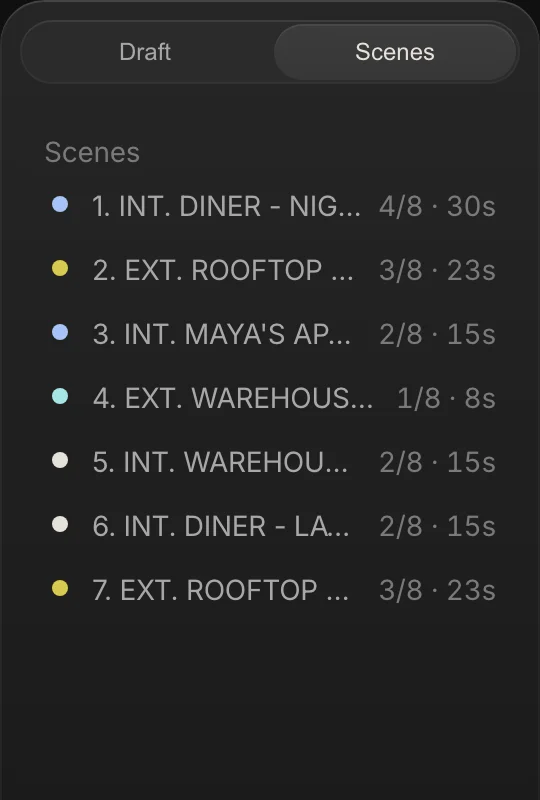
| Sc | Heading | Rows | Exact eighths | Written as | Page rule, seconds | From the words, seconds |
|---|---|---|---|---|---|---|
| 1 | INT. DINER - NIGHT | 24 | 3.49 | 4/8 | 30 | 25.5 |
| 2 | EXT. ROOFTOP - DAY | 15 | 2.18 | 3/8 | 23 | 19.0 |
| 3 | INT. MAYA'S APARTMENT - NIGHT | 8 | 1.16 | 2/8 | 15 | 9.5 |
| 4 | EXT. WAREHOUSE - NIGHT | 5 | 0.73 | 1/8 | 8 | 5.5 |
| 5 | INT. WAREHOUSE - CONTINUOUS | 11 | 1.60 | 2/8 | 15 | 15.0 |
| 6 | INT. DINER - LATER | 8 | 1.16 | 2/8 | 15 | 7.5 |
| 7 | EXT. ROOFTOP - DAWN | 16 | 2.33 | 3/8 | 23 | 12.0 |
| Total | 87 | 12.65 | 17/8, 2 1/8 pages | 129 | 94.0 |
Two clocks sit in that table. The page rule says 4/8 of a page is 30 seconds. Spring Pro also plans each scene's playing time from its words (dialogue at 2.5 words a second plus half a second a line, action at 3 words a second), and the breakdown sheet, the schedule and the storyboard show that time.
They disagree. The scenes add up to 129 seconds (2:09) on the Scenes list, because each scene is rounded up to a whole eighth. The true rows come to 95 seconds (1:35) on the same rule, and the plan from the words says 94 (1:34). The Scenes list runs 36% over because 7 short scenes each round up.
The status line makes a fourth claim: 2 pages, about 2 minutes. It divides all 88 rows by 55 and rounds to the nearest minute, so 1.6 becomes 2.
None of the four is a measurement, and they are estimates until the film is shot. The eighths are for adding up pages, not for timing a cut, and the more small scenes a script has, the more they overstate it. We found no study tying a scene's eighths to the hours it takes to shoot, so none is claimed. Scene 1's 24 rows include a stray line, "eeee", that the demo script still carries, and the blank row above it.
What a scene heading becomes in the breakdown
A heading is not decoration. Its three parts are fields that the breakdown and the schedule read, and its length comes from the rows under it. The table follows scene 1 through both.
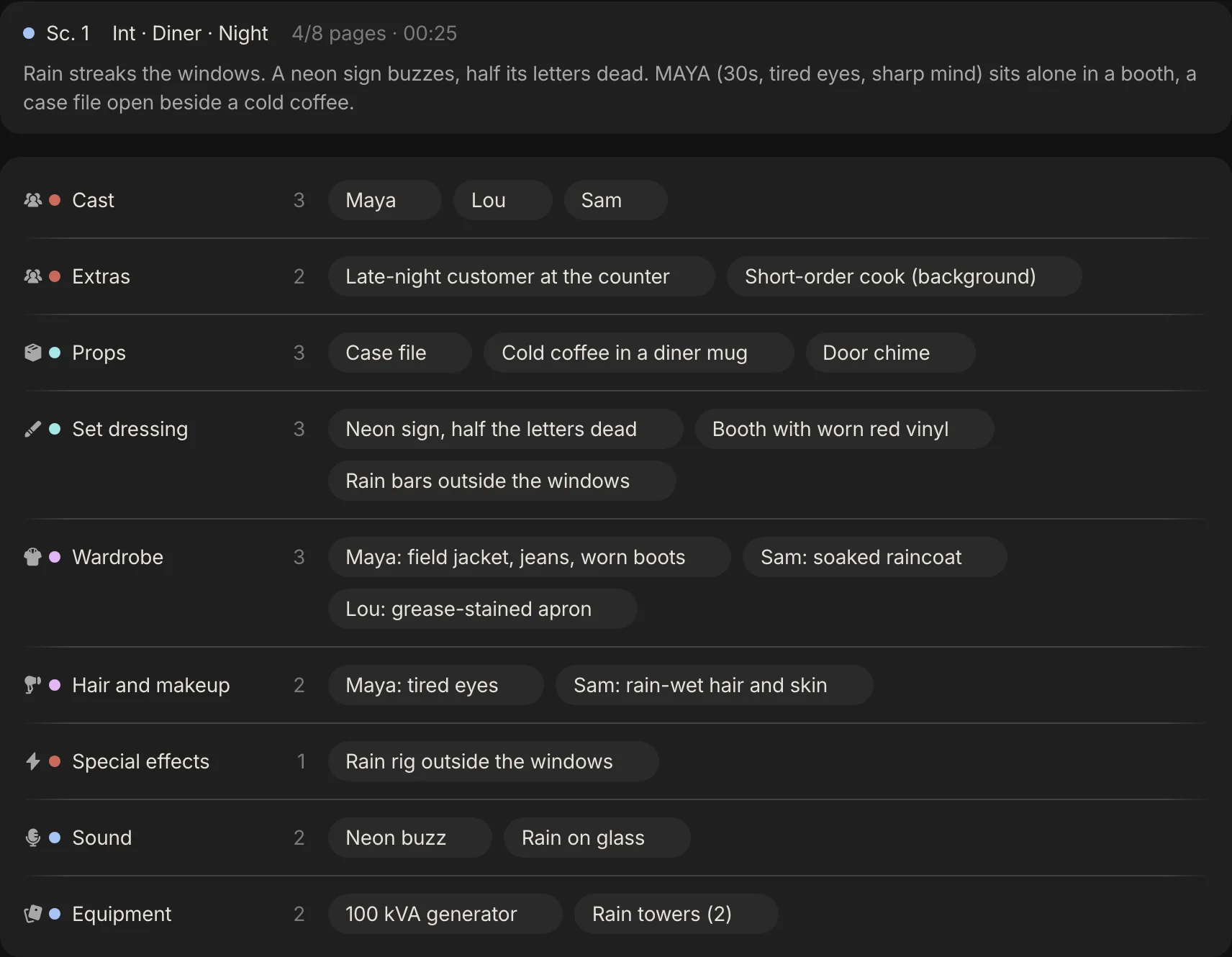
| Part | In scene 1 | In the breakdown | In the schedule |
|---|---|---|---|
| Inside or outside | INT | Shown on the sheet as Int, and in the dot beside the scene number, together with the time word | Shown on each strip. The planner does not group by it |
| The place | DINER | Names the set. One set for each place: Diner, Rooftop, Maya's apartment and Warehouse are 4 sets from 7 headings | Scenes at one place and in one light are grouped, and a place with more pages than the pages-a-day target splits across days. A plan never puts two places in one day |
| The time of day | NIGHT | Day or night for lighting, and the colour of the dot | A plan never mixes day and night in one day. Later and continuous take the light of the scene before |
| The length | 4/8 (24 rows) | Shown as 4/8 pages with its planned time | Added up for each day against the pages-a-day target |
The warehouse shows how sets work. Scene 4 is an exterior and scene 5 an interior, but both name the warehouse, so they are one set. Spell it two ways and a scheduler sees two places, and the next section prices that.
The names above dialogue are the other half. Spring Pro reads a scene's speaking characters from its cues, in order of first line, and stores them with the scene. The cast in the breakdown is picked on the scene's checklist, so the two differ where someone is present and silent: scene 4 has no cue at all, yet Maya is in it, and in scene 5 only Lou speaks while Maya hides in the dark.
The breakdown and the schedule read the master script's own lines, not a copy. About a second after each save, Spring Pro also updates the stored scenes and sets: a new place adds a set, and a place no scene uses any more is retired, not hard deleted.
How to break down a script takes it from here, and script breakdown software shows the sheet in the app.
What a scene heading does to the schedule
Press Plan the shoot and Spring Pro builds a first schedule from each scene's heading and size: scenes grouped by place and by day or night, script order kept inside a group, days filled up to a pages-a-day target. It never puts two places, or day with night, in one day. Here is what it makes of Midnight Diner. Run it again later and Spring Pro asks first, because a new plan replaces the days you arranged by hand.
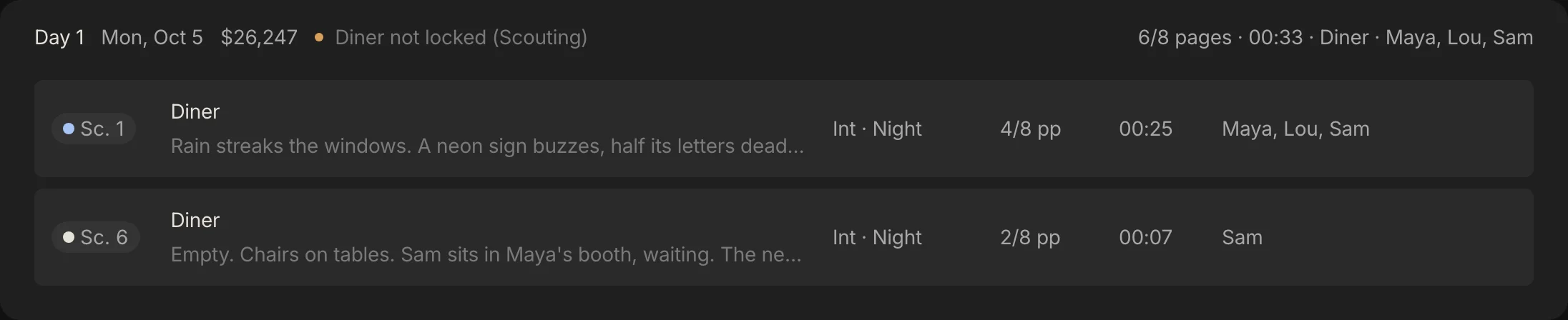
The target is pages a day. Spring Pro starts at 5 and you can pick 3, 4, 5, 6 or 8. No Film School gives five as what an independent production could aim for, and says a major studio production might get through only one.

| Day | Scenes | Place | Light | Pages |
|---|---|---|---|---|
| 1 | 1, 6 | Diner | night | 6/8 |
| 2 | 2, 7 | Rooftop | day | 6/8 |
| 3 | 3 | Maya's apartment | night | 2/8 |
| 4 | 4, 5 | Warehouse | night | 3/8 |
The project's own schedule has six days on its plan line, and the last two are still empty, so it has the same four shoot days. Day 4 holds the two warehouse scenes in the other order, and the four days cost $94,159 on the cost engine's planned 11 hour day.
The light is read from the time word. Night, evening and dusk are night, and day, morning, dawn, noon and afternoon are day. Any other word, such as later or continuous, takes the light of the scene before it, so the dot and the planner can disagree: scenes 5 and 6 are night to the planner and show the interior day dot.
Now change one word and run the plan again. Change later to day in scene 6's heading and the planner will not keep it with scene 1: 5 days, $115,892, which is $21,733 more. Keep them together anyway and the day carries a Day and night mixed warning.
Spell scene 5's place as "The warehouse" and the two warehouse scenes split: 5 days again, $21,733 more. Change dawn to night in scene 7 and the rooftop scenes split: $23,361 more.
These are what-ifs on one budget, not quotes, and a producer can keep scenes together on purpose. The point is that a word in a heading is data, cheap to get right when you write it and expensive to find on the schedule. See how to make a shooting schedule, film production scheduling and shooting schedule software.
Writing it in Spring Pro, and what it does not do yet
Spring Pro writes on the page shown at the top. A script with INT. or EXT. headings is laid out as a screenplay, and a script without them opens in two columns, for videos that are not written as scenes.
- Type it. A line that starts INT., EXT. or I/E becomes a heading, in capitals. A short name in capitals, then Enter, makes a character and opens their dialogue. Tab takes the suggestion when one is showing, and otherwise cycles the element: action, scene heading, dialogue, parenthetical, transition.
- Or pick it. A heading is picked, not typed: inside, outside or both, a place from the places already in the script, and a time from day, night, dawn, dusk, morning, evening, continuous, later or moments later. A speaker, a voice (normal, V.O., O.S. or continued), a direction and a transition are picked the same way, and a scene's menu duplicates, moves or deletes it.
- The page checks itself. Rules only, no model. The status line counts pages, minutes and scenes and how many lines are to check: content above the first scene heading, a missing or odd time of day, dialogue with no name, a name not in capitals, a name spoken once that looks like a typo, an action paragraph over four lines, camera direction, and no FADE IN: or FADE OUT. Midnight Diner has none.
- Bring a script in. Import a Fountain (.fountain, .txt or .md) or a Final Draft (.fdx) file, or paste Fountain text. Scenes, dialogue, parentheticals and transitions come across, and an .fdx's title page and scene numbers are not read. Fountain is a plain text markup language for screenwriting.
- Take it out. Export Fountain text, or print or save as PDF: US Letter, 55 rows a sheet with a 0.8 inch bottom margin, a title page first and page numbers from page 2. The face is Courier Prime, with Courier New and then Courier as fallbacks, so the page is set in a Courier-class face and not always literally Courier.
- Start from a draft. Write the idea in the Draft tab, in any shape. Convert to scenes asks Gaffer to propose the scenes, and Update scenes does the same after a rewrite. Each proposal is new, changed, removed, split or merged, with a reason, and nothing changes until you tick the ones you want and apply them. A scene you edited by hand is marked Your edit and starts unticked, scene ids survive an update so the boards stay attached, and one Undo last update puts the scenes back.
What it does not do yet, said plainly. It does not export Final Draft (.fdx) files, only import them. Scene numbers come from the order and are not locked, so inserting or moving a scene renumbers the rest, and there are no A-scenes or omitted scenes. The printed PDF carries page numbers but not scene numbers.
It has no coloured revision pages and no dual dialogue, and it prints US Letter only, so an A4 page count will differ. If you need locked scene numbers or revision pages today, issue them from the program you write in, and import the script here for the breakdown and the schedule.
How people format a script today, and what breaks when a scene changes
Scripts are written in a word processor with a template, a plain-text Fountain file, or a screenwriting program that formats as you type. They differ in what you redo when a scene changes. This is our view from our own work, not a test of products.
| Way of working | Good for | When a scene changes you must |
|---|---|---|
| A word processor with a script template | One writer, a short script, nothing else reading it | Reflow the page, renumber the scenes by hand, and retype the heading and the length wherever the schedule keeps them |
| A plain-text Fountain file and a tool that formats it | A file that opens in any text editor | Re-export, then update the breakdown and the schedule in whatever holds them |
| A screenwriting program that formats as you type | Writers who want the page set as they type, with locked numbers and revisions where the program offers them | Export or import the script, then update the breakdown and the schedule wherever they are kept. Some programs bundle a breakdown or a schedule, and we did not test any |
| One project where the script, the breakdown and the schedule read the same lines (Spring Pro) | A script that changes weekly and is read by many people | Edit the scene. Its size, set, playing time, warnings and the cost of its day follow, but the days stay as you arranged them until you plan the shoot again, which replaces them. Breakdown elements such as props are added by hand or by Gaffer on request, not read from the script, and scene numbers are not locked |
The format is the easy part. The cost is the second copy of the heading, and the person who has to retype it. If you write elsewhere, import the .fdx or Fountain file and the scenes, their sizes and their sets come with it.
From a short to a feature: what changes
The format does not change with size. What grows is the number of people who read the page, and the cost of a loose heading. These sizes are rough labels, not industry definitions.
| Size | Who touches the page | What to watch |
|---|---|---|
| Solo or YouTube video | You | Do you need screenplay format at all? A script with no INT. or EXT. headings opens in two columns, and a section heading such as Intro is not stored as a set, though the Production desk lists it as a place |
| Short film | The writer and the director | One spelling for each place, and remember that eighths round up: Midnight Diner's 7 scenes run 36% long on the Scenes list |
| Commercial | Writer, agency and client | Many versions of the same scenes: each Update scenes saves the draft behind it as a version |
| Indie feature | Writer, director and 1st AD | Page limits (the Nicholl range is 80 to 125 pages) and revisions: scene numbers move when scenes move, and Spring Pro does not lock them |
| Series or episodes | Several writers, several scripts | A project can hold several scripts, but several units or episodes in one schedule are not built yet |
The median produced script in Follows's study is 119 pages, inside the Nicholl range of 80 to 125. The range says what a competition accepts, not what gets made.
The format checklist
Copy this. Tick it before you hand the script to anyone.
- Every scene starts with a heading: inside or outside, one spelling for the place, and a time of day
- Action is in the present tense and says only what can be seen or heard
- Every speaker's name is in capitals above the speech, with V.O., O.S. or CONT'D where they apply
- Parentheticals are short, and transitions are used only where an edit needs them
- No camera directions in action unless you are directing
- 12 point Courier on US Letter (A4 in the UK), a 1.5 inch margin on the left and at least 1 inch elsewhere, and no cheated margins
- The page count is checked against your target, and read as a rough minute a page, not a measurement
- Scenes are sized in eighths for the schedule, and the place and the time are checked once more before the breakdown
- One master script, with every change made there
How these numbers were made
Every number about Midnight Diner comes from the project's own script, laid out by Spring Pro's own page code, and the build stops if the script changes so that a claim no longer holds. The cost figures come from its cost engine on a planned 11 hour day with overtime after hour 10 at 1.5 times and 18% fringes, on this one budget. The playing time from the words is a copy of the app's rule, checked against the breakdown sheet and Day 1 on the screens.
Midnight Diner is a demonstration production, not a case study. Its seven scenes are short, which exaggerates how much rounding up adds. The outside figures come from the sources below, read on 2026-10-12: the Nicholl rules are the 2026 to 2027 edition, the Follows study is dated 30 March 2026 and the Final Draft post July 2026. Practice differs between productions, and the sources do not always agree.
Questions people ask
What is the correct movie screenplay format?
12 point Courier, on US Letter paper in the US, with a 1.5 inch margin on the left and 1 inch on the other sides, and six elements: scene heading, action, character, dialogue, parenthetical and transition. Filmdaft's guide, which takes its margins from a Final Draft blog post, and No Film School agree on the indents to within a couple of tenths of an inch.
What font do movie scripts use?
12 point Courier, which is 10 pitch, meaning 10 characters to the inch. Every character is the same width, so a page holds a known amount of text. The Nicholl Fellowships ask for it by name.
How many pages is a movie script?
There is no single rule. The 2026 to 2027 Nicholl rules ask for a feature of 80 to 125 pages, and in Follows's study the median produced script is 119 pages for a 108 minute film.
Does one page of a movie script equal one minute?
On average it is about 55 seconds, from a study of 2,520 produced scripts, but only 18.2% of scripts landed within 5% of one page a minute. Use it for a whole script, not one page, and see script eighths for how a schedule sizes scenes.
How do you write a scene heading in film script formatting?
Inside or outside (INT. or EXT.), then the place, then the time of day, in capitals, for example INT. DINER - NIGHT. Wikipedia describes the same three parts. Spell each place one way every time, because the schedule groups scenes by it.
What does CONT'D mean next to a character name?
Continued: the same character speaks again after an action line. Spring Pro adds it for you, and its voice picker sets V.O. (voice-over) or O.S. (off screen) on a name.
Do I need screenwriting software to format a movie script?
No. The format is a layout and a word processor can do it, but you set the indents and renumber the scenes yourself. Software that formats as you type saves that work. Spring Pro reads Final Draft (.fdx) and Fountain files, exports Fountain text and prints to PDF, but does not export .fdx.
Is there a film script format template?
Spring Pro's page is the template: start a script, type INT. and a place, and the page sets each line's indent and width for you. You still choose each line's element with Enter and Tab, or from the pickers. The production templates (breakdown, schedule, call sheet, budget and shot list) are on the templates page, and the script breakdown template is the next step after the page.
Sources
Every outside claim that names a source comes from one of these, read on the date shown. Standard conventions, such as the eighths rule and the usual specialist cases, are common practice. Figures from agreements and summaries change at each negotiation, so check the current text before you rely on a number.
- Wikipedia, screenplay. Checked 2026-10-12.
- Wikipedia, characters per inch (typewriter pitch). Checked 2026-10-12.
- Wikipedia, Courier (typeface). Checked 2026-10-12.
- Stephen Follows, does one page of a screenplay really equal one minute of screen time? (a study of 2,520 scripts, March 2026). Checked 2026-10-12.
- Final Draft, does one page equal one minute of screen time? (a screenwriting software vendor, July 2026). Checked 2026-10-12.
- Academy Nicholl Fellowships in Screenwriting, 2026-2027 rules, eligibility and terms (Academy of Motion Picture Arts and Sciences, PDF). Checked 2026-10-12.
- No Film School, script and screenplay format (2024). Checked 2026-10-12.
- Filmdaft, screenplay format and how to format a screenplay. Checked 2026-10-12.
- No Film School, how to design your film's shooting schedule (2020). Checked 2026-10-12.
- Fountain, a plain text markup language for screenwriting (home page). Checked 2026-10-12.
More about script and screenplay
The script is the root. Every revision starts a ripple, and most tools make you retype it.