Writing a script for a short film, and what each choice costs to shoot.
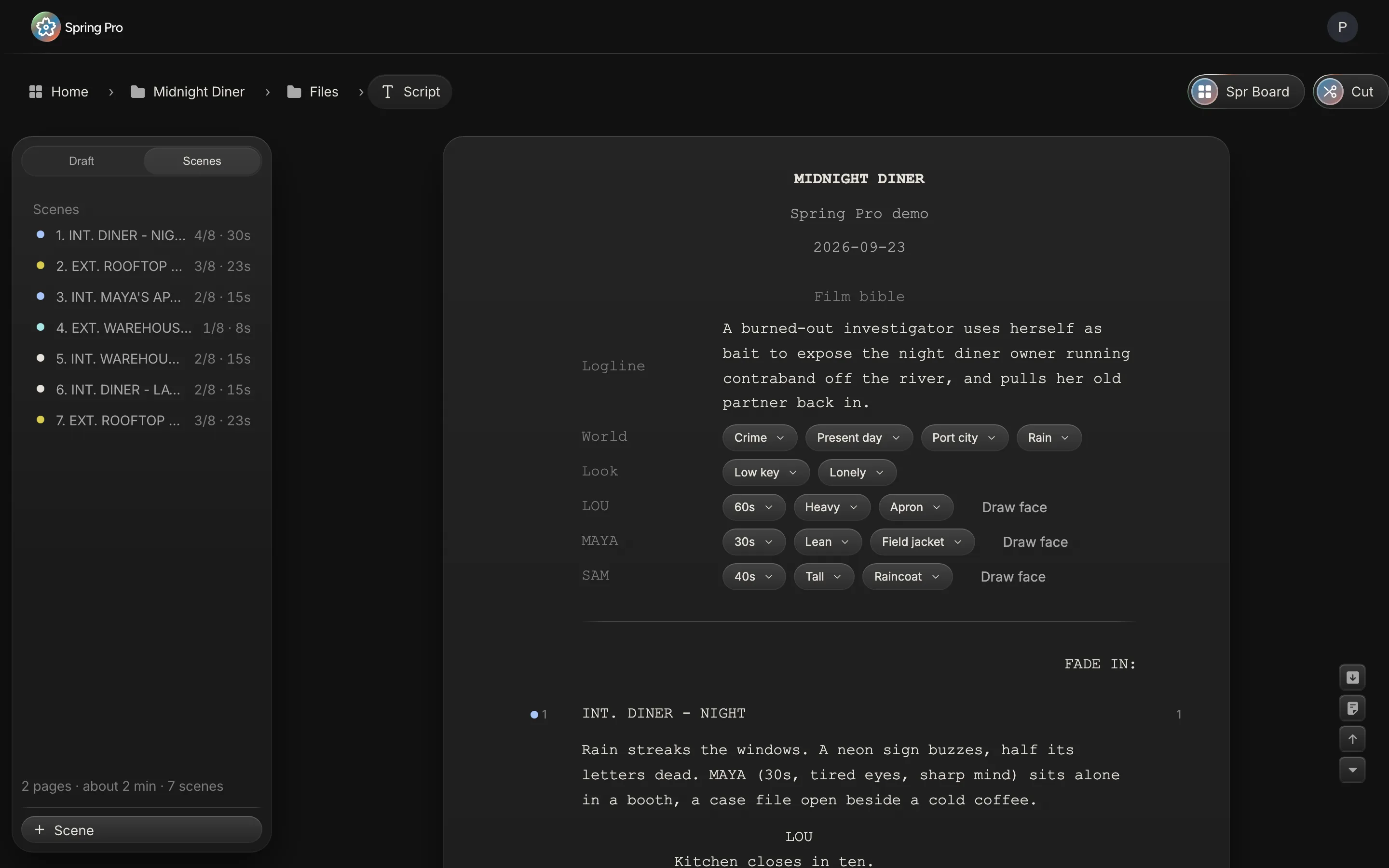
Real screen: Midnight Diner, our demo production, in Spring Pro.
The short answer. Write a short film script around one idea and one turn. Budget about a page a minute, then time a read aloud to check it. Keep to a few places, people and nights. Plan on each set, and each change between day and night, needing a shoot day of its own, and every extra day is more crew, cast and kit.
Much advice on writing a short film script is about the story, and the advice about cost, such as use few locations, rarely shows what a place or a person adds to a shooting schedule. The choices that set the price are made on the page: how long it runs, how many places, how many people, which hours of the day. This guide follows them to the shoot on a demonstration production, Midnight Diner: 7 scenes, 4 sets, 3 speaking characters and 2 1/8 pages, with what each choice cost on its schedule and budget. It is the first step of making a film, and its numbers come from the project and its rules from sources read and dated below.
In this guide 13 sections
- Quick answers
- Why the script sets the cost, and the film we use
- Step 1: Set the page and the length
- Step 2: Build it around one idea and one turn
- Step 3: Count the places and the light
- Step 4: Count the people, speaking or not
- Step 5: Read the action lines for what you must hire
- Step 6: Know what cutting a scene saves
- How people write a short today, and one way to do it in Spring Pro
- The checklist
- How these numbers were made
- Questions people ask
- Sources
Quick answers
How long should a short film script be? As long as the runtime you want, at about a page a minute. Filmdaft says most shorts run 5 to 30 minutes and short scripts usually run 1 to 30 pages. The Academy counts a film of 40 minutes or less, credits included as a short, and festivals set their own limits.
How do you structure it? Around one idea and one turning point. Filmdaft advises getting the character into an unfamiliar situation within a one to two-minute window, and says a short should reach it in 3 minutes or less. Step 2 shows it on the seven scenes of a demonstration script.
What format does it use? The page a feature uses, 12 point, 10 pitch Courier, with six elements in fixed places. Step 1 has the basics, and the screenplay format guide has the rest.
What makes a short cheap or dear to shoot? Places, light and people, before page count. Midnight Diner is 2 1/8 pages and still needs 4 shoot days, because it has 4 sets. On its planned 11-hour day and a paid crew of about 33, each day costs between $21,733 and $26,247, and Step 3 says what those figures include.
Do you need software? No. A word processor and the habit of counting will do. Spring Pro is one optional tool, described near the end.
Where does it fit? Before everything else. The breakdown, the schedule, the budget and the call sheets all read the script.
Why the script sets the cost, and the film we use
Everything after the script reads from it. The breakdown lists what each scene needs, the schedule turns the lists into days, and the budget prices the days. So a choice on the page is already a choice about time, and time is what costs: a line producer interviewed by Film Independent in 2017 ties her examples, such as an untrained dog, child performers and special effects, back to time.
Two guides we read on this topic, Celtx's and Filmmaking Lifestyle's, cover the idea, the characters, the structure and the rewrite. As we read them, neither says what a script's choices cost on a schedule. That is the gap this guide tries to fill.
| Reader | What they take from it | What goes wrong if it is loose |
|---|---|---|
| Director and producer | The running time and the idea | It runs long, or the idea outgrows its length |
| Actors | Their scenes and days | A part of one line still needs a person and a day rate |
| The 1st AD | Each scene's set, light and length | Days are built from guesses, and overtime follows |
| Department heads | Every sentence of action | A sentence becomes a hire: a rain rig, glass, a van |
| The budget | The days and the people | The price is learned after the script is locked |
Midnight Diner is our sample, a short crime film. A burned-out investigator uses herself as bait to expose the night diner owner running contraband off the river, and pulls her old partner back in.
It has 7 scenes, 4 sets, 3 speaking characters and 2 1/8 pages. It is a demonstration production, not a real shoot, and every number about it below is computed from its project. The glossary entry on eighths explains how a scene is sized.
Step 1: Set the page and the length
Fix the runtime before the first scene, because it sets the page budget. The limits above are the wide ones, and festivals set their own, which we did not collect.
A page is about a minute, but only on average. Every standard page is laid out alike, and Final Draft says that is why page count became a clock. Stephen Follows matched 2,520 produced feature scripts to their runtimes and found about 55 seconds a page, with only 18.2% of scripts within 5% of a minute a page. His summary is a minute a page, give or take 20%.
The study has limits. It covers features, its runtimes include end credits, and Follows notes that his sample is not perfectly random and skews toward well-known titles. Final Draft adds that dialogue plays faster than it reads and action slower, and Wikipedia calls the rule a ballpark estimate that is widely contested.
The page is the one a feature uses: 12 point, 10 pitch Courier, with margins of at least an inch. It has six elements, shown here from the first page of Midnight Diner. The screenplay format guide has every rule.
- Scene heading. Where and when: INT. DINER - NIGHT.
- Action. What the camera sees and hears, in the present tense: "Rain streaks the windows."
- Character. The speaker's name: LOU.
- Dialogue. What is said: "Kitchen closes in ten."
- Parenthetical. How a line is said: (quietly).
- Transition. How the film moves on: FADE IN: opens the film and FADE OUT. closes it.
| Runtime | Pages at a page a minute | Pages at 55 seconds a page | Pages if a page runs 48 to 72 seconds (a minute, give or take 20%) |
|---|---|---|---|
| 3 minutes | 3 | 3.5 | 2.5 to 4 |
| 5 minutes | 5 | 5.5 | 4 to 6.5 |
| 10 minutes | 10 | 11 | 8 to 12.5 |
| 15 minutes | 15 | 16.5 | 12.5 to 19 |
| 20 minutes | 20 | 22 | 16.5 to 25 |
Read the table as a range, not a promise. On A4 paper the study's 351 scripts ran closer to a page a minute, and Spring Pro prints US Letter only.
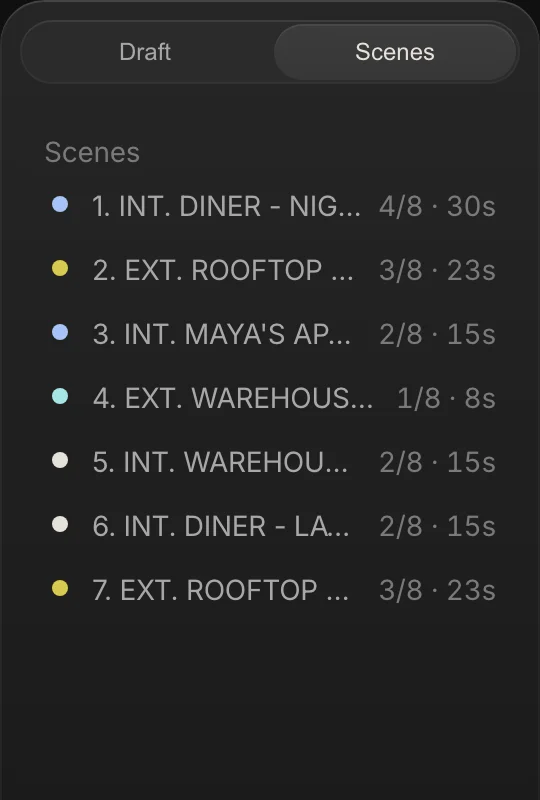
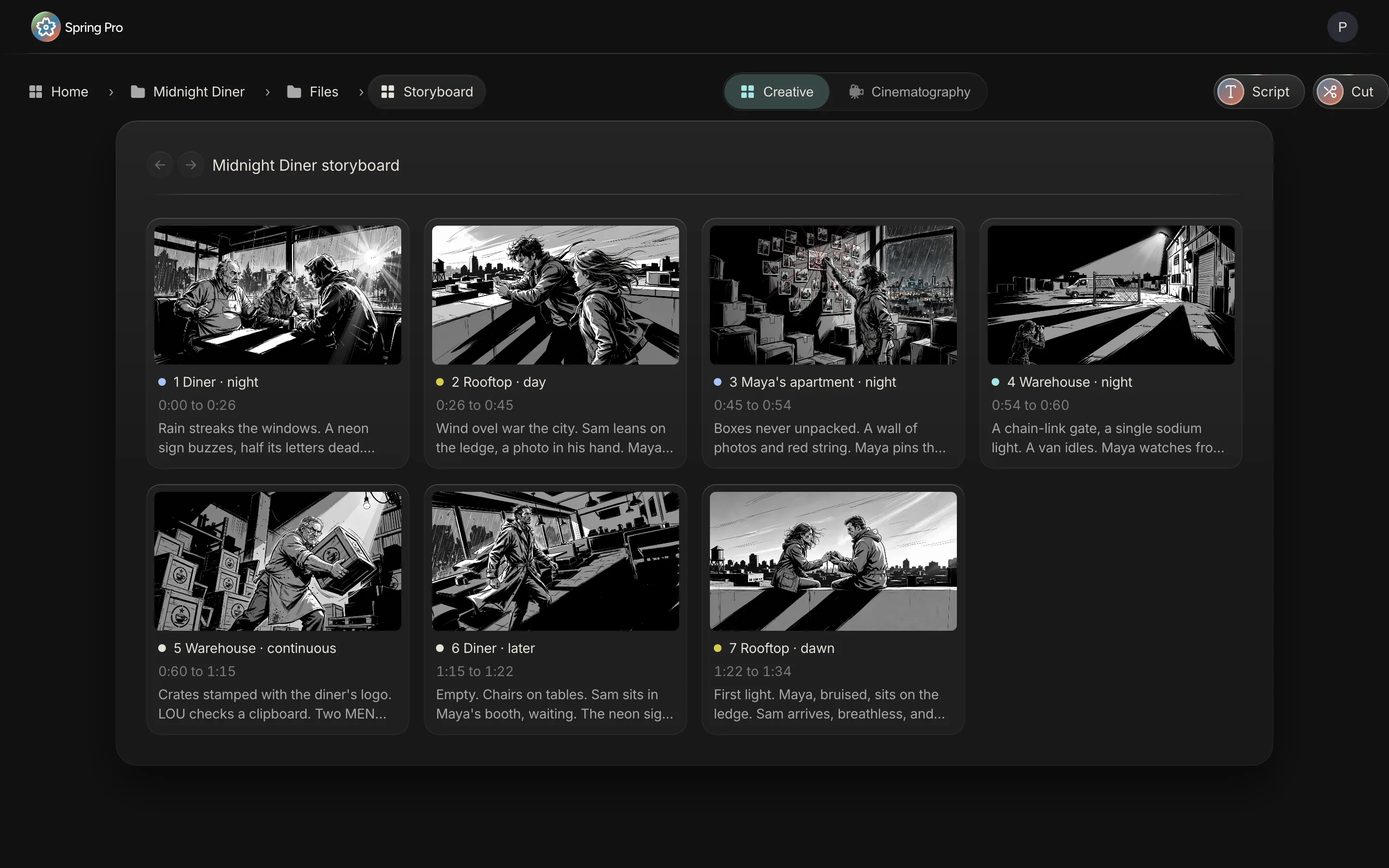
Midnight Diner puts three clocks on one script of 2 1/8 pages. The Scenes list shows each scene at a flat minute a page, and its seconds add up to 2:09. The study's 55 seconds a page gives 1:57. Spring Pro's estimate from the words counts speech at speaking pace and action at about three words a second, and the last storyboard card ends at 1:34.
That is a spread of 35 seconds, or 37%. A page count is where you start, and Filmdaft's view is that a timed table read is more reliable, so read yours aloud with a clock and cut or add until it matches your runtime.
Step 2: Build it around one idea and one turn
A short has room for one idea and one turn. Videomaker advises a simple plot built on a single moment, with one main character, and says a short is not a squeezed feature. Filmdaft puts numbers on it: where a feature may take up to 30 minutes to reach its unfamiliar situation, a short should get there in 3 minutes or less, with the character thrust into it within a one to two-minute window.
Filmdaft adds that the best shorts often set up what the character wants in the first 30 seconds. These are one guide's rules of thumb, not laws, so use them to check your own draft.
Midnight Diner has one idea, a burned-out investigator who makes herself bait, and one turn: in scene 5 a crate slips and Lou turns toward the corner where Maya hides. The table shows each scene and the share of the pages used by its end. It is our reading of a demonstration script, not a model.
| Sc | Set and light | Length | Pages used by the end | What it does |
|---|---|---|---|---|
| 1 | Diner, night | 4/8 | 24% | Two old partners meet in a booth. |
| 2 | Rooftop, day | 3/8 | 41% | Maya takes the warning as a plan: she will be the bait. |
| 3 | Maya's apartment, night | 2/8 | 53% | Maya pins the photo up and asks where Lou goes at night. |
| 4 | Warehouse, night | 1/8 | 59% | Maya watches the warehouse yard with a camera. |
| 5 | Warehouse, night | 2/8 | 71% | The turn: a crate slips, glass shatters, and Lou turns toward the corner where Maya hides. |
| 6 | Diner, night | 2/8 | 82% | Sam waits in the empty diner and calls her. |
| 7 | Rooftop, day | 3/8 | 100% | At dawn Maya hands Sam the camera: "It is all on there." |
The pact is struck by the end of scene 2, 41% of the way through the pages and 0:45 on the storyboard clock. The turn ends 71% through. Scenes 3, 4 and 6 do neither: they pin the evidence, watch the yard and wait. In a script this short each such scene should earn its seconds by setting up the turn or paying it off, so ask what every scene adds.
Step 3: Count the places and the light
This step sets the price, so do it before you fall for a location. A set is the place in a scene heading, and a planner gives each set, and each kind of light, a day of its own. Spring Pro's planner never puts two sets, or day and night, in one day. A real 1st AD can make a company move inside a day and pay for it in hours.
Spring Pro reads the set from the words of the heading, ignoring capitals, so "Diner" and "The diner" count as two sets. It reads the light from the time of day: night, evening and dusk are night, and day, morning, dawn, noon and afternoon are day. The times "later" and "continuous" take the light of the scene before.
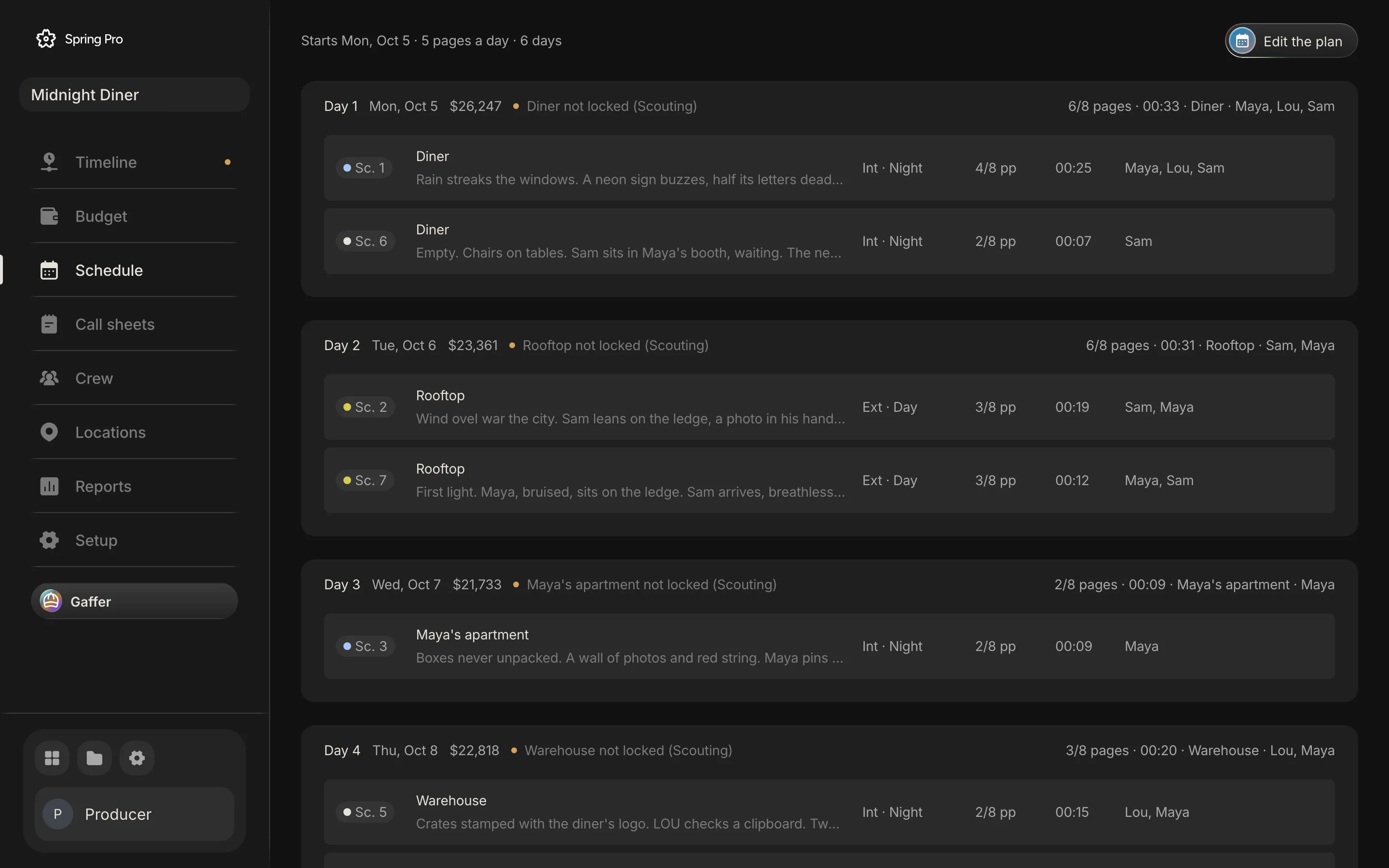
Midnight Diner is 2 1/8 pages, which by page count fits in one day at the planner's default of 5 pages a day. It has 4 sets, and 5 of its 7 scenes play at night, so the planner makes 4 days. The table runs the same film through the same planner and cost engine with a few headings changed.
| Version | Headings changed | Sets | Shoot days | Planned cost of the days | Against as written |
|---|---|---|---|---|---|
| As written | 0 | 4 | 4 | $94,159 | Baseline |
| Scene 7 plays at night, not at dawn | 1 | 4 | 5 | $117,521 | +$23,361 |
| Scene 3 is in the diner, not Maya's apartment | 1 | 3 | 3 | $72,427 | -$21,733 |
| Scenes 3, 4 and 5 are in the diner | 3 | 2 | 2 | $49,608 | -$44,551 |
| Every scene is in the diner, at night | 5 | 1 | 1 | $26,247 | -$67,913 |
Change one word in scene 7, from dawn to night, and the rooftop needs a night of its own: the film takes 5 days and costs $23,361 more. Move the apartment scene into the diner and a whole day goes, saving $21,733. The calculator above is the same rule on your own numbers, and it counts only pages and sets, so light can add days it does not show.
On the sample's planned day, each of the 4 days costs between $21,733 and $26,247, though they hold from a quarter of a page to three quarters, so the number of days is the lever. Day 3 holds a quarter of a page and costs $21,733, about two and a half times the diner's cost per page. This is the price of each place, not advice to rewrite your story, because a film set in one diner is a different film.
The cost is the planned cost of the days: the people working each day, with overtime, fringes and kit at a planned 11-hour day, plus day-priced lines such as the camera package. Flat-priced lines and the rest of the budget come on top, so the 4 days are about 26% of the sample's $358,654 budget. The sample's 32 to 34 paid people a day make it a paid crew, and a crew of friends costs a fraction, but the rule that sets and light make the days does not change. Figures are rounded to the dollar, so a difference can be $1 off the subtraction.
The day figures and what-ifs here are the project's own, and they carry one quirk. The sample's two silent loaders work only in scene 5, but the engine prices them on every shoot day (Step 4), at $679 a day for the pair. With them on day 4 alone, days 1 to 3 would each cost about that much less. Each what-if that adds or drops a day moves the total by a day that includes them.
Outside advice agrees on the direction, not on a number. Videomaker advises one or two locations if possible, InkTip says a handful, and another Videomaker piece says to write as few as you can. The InkTip and second Videomaker pieces are about low-budget scripts in general, not shorts, and InkTip is a script-marketing service. A night followed by an early call is the trap the turnaround guide covers, and the guides on scheduling a night shoot and on scouting a location go further.
Step 4: Count the people, speaking or not
Count everyone who appears, not only those who speak. InkTip's point, made about low-budget scripts in general, is that a cast limit covers every character, bartender and patrons included, and Videomaker advises one main character and few others.
In Midnight Diner the engine prices an actor on the days their character is in a scene, at the planned 11-hour day with overtime after hour 10 and 18% fringes. Maya works 4 days, Lou 2 and Sam 2.
| Part | Scenes | Days worked | Planned cost |
|---|---|---|---|
| Maya | 6 | 4 | $6,514 |
| Lou | 2 | 2 | $2,171 |
| Sam | 4 | 2 | $3,257 |
| The three speaking parts | 7 | 8 actor days | $11,942 |
| Two silent loaders, as the sample prices them | 1 | 4 days each | $2,714 |
| The same loaders, one day each | 1 | 1 day each | $679 |
The three speaking parts cost $11,942, 12.7% of the $94,159 the 4 days cost. The rest is crew, silent parts, kit and rentals, which are there whether the speaking cast is large or small. A part gets dear when it adds an actor day, not a line.
The two silent loaders in scene 5 are a quirk of the sample, and they sit inside every day figure on this page. They are listed as cast with no character linked, and the engine prices an actor with no linked character on every shoot day, so each carries 4 days though they appear in one scene. Linked to a character in scene 5, each would work one day, so link every cast member to a character when you cost your own list.
Step 5: Read the action lines for what you must hire
Action lines are a shopping list. A sentence that needs something you cannot borrow, such as weather, glass or a vehicle, becomes a vendor or a specialist. In Midnight Diner each sentence below is a breakdown element and a line in the sample budget, as the breakdown guide explains.
| The script says | The breakdown lists | The budget carries | Planned |
|---|---|---|---|
| Rain streaks the windows. (scene 1) | Rain rig outside the windows (special effects) | Rain Makers Ltd: rain rig and towers | $4,800 |
| A van idles. (scene 4) | White panel van, engine idling (vehicles) | City Van Hire: white panel van, two nights | $900 |
| Glass shatters. (scene 5) | Breakaway glass bottles (special effects) | Breakaway FX: breakaway glass bottles | $1,200 |
These are flat-priced lines on top of the day costs, so none is in the $94,159. The three tied to one sentence each come to $6,900, and the two men loading the van are priced in Step 4.
Night work brings flat lines of its own, here Night Owl Catering's hot meals for 32 crew ($6,400) and Northside Security's yard security ($1,600). The planner reads day or night from the scene heading, not from a breakdown element. The labels on the sample's lines, such as "two nights" for the van and the security, are the project's own wording: its schedule has 3 night days and the warehouse scenes fall on one of them, so count yours from your own schedule.
Some sentences add a specialist instead of a rental. InkTip lists animals and child actors among the expensive things, with added safety specialists, prep and restricted hours. The line producer in the Film Independent interview adds that child performers need a paid studio teacher, and advises cutting effects scenes where you can.
Videomaker adds three cheaper habits: write around the props and gear you have, keep stunts simple, and plan around the weather. The guide on scheduling around the weather covers the last.
Step 6: Know what cutting a scene saves
When a script is too dear, the first move is to cut a scene. A scene's planned cost is its own items plus its share of its day by page length, so the figure does not say what a cut would save. The table gives each scene of Midnight Diner, its planned cost, and how much less the days would cost if only that scene were taken out. Spring Pro's own per-scene figure is on the forecast, which can differ from the plan, so this table uses the plan to match the days above.
| Sc | Set and light | Day | Planned cost of the scene | Day costs saved if it is cut |
|---|---|---|---|---|
| 1 | Diner, night | 1 | $17,498 | $2,714 |
| 2 | Rooftop, day | 2 | $11,681 | $0 |
| 3 | Maya's apartment, night | 3 | $21,733 | $21,733 |
| 4 | Warehouse, night | 4 | $7,606 | $0 |
| 5 | Warehouse, night | 4 | $15,212 | $1,086 |
| 6 | Diner, night | 1 | $8,749 | $0 |
| 7 | Rooftop, day | 2 | $11,681 | $0 |
Scene 3 is a quarter of a page and cutting it saves $21,733, because it is the only scene on its day. Scene 6 is given $8,749 and cutting it saves nothing, because Sam is still called for scene 1 that day. Scene 1 saves only the day rates of Maya and Lou, $2,714. Scenes 2 and 7 save nothing alone, but cut both rooftop scenes and the day goes, saving $23,361.
These savings count the days and day rates only. They leave out flat-priced lines, such as the $1,200 of breakaway glass for scene 5, and the silent loaders, whom the sample prices on every day whatever is cut.
The lesson from this table is to look at days before scenes. A cut pays most when it takes the last scene off a day, or when it is the only reason an actor is called. Read the schedule beside the script before you cut, and see how to make a shooting schedule for how days are built.
How people write a short today, and one way to do it in Spring Pro
Most shorts are written in a word processor or screenwriting software, and costed afterwards in a spreadsheet. The ways differ in what you redo when a place, a time of day or a cast list changes. This is our view, not a test of products.
| Way of working | Good for | When a place or a time changes you must |
|---|---|---|
| A word processor and a template | One place and one or two people | Retype the heading, recount the pages, and update your own list of places and cast |
| Screenwriting software that formats as you type | A clean page and a page count | Let it recount, then carry the change to the schedule and budget by hand if they live in other files |
| One project where script, schedule and budget read the same scenes (Spring Pro) | A script that changes often, read by several people | Edit the scene. The schedule shows its pages, warnings and planned cost again, and you decide whether to re-plan the days |
Some screenwriting vendors, Celtx among them, also sell scheduling and budgeting tools, which we did not test. Spring Pro is one optional way, and every step above works in a word processor and a spreadsheet.
Write by picking. In the scene you are editing, you can pick the heading instead of typing it: inside, outside or both, a place from the places already in the script, and a time of day. Naming a place once and picking it after keeps the set count honest, and renaming a place changes every heading that uses it.
Scenes in eighths. Every scene is sized as you write and listed with its seconds, and the status line counts pages, minutes and scenes. A scene's size, set and light feed the schedule, and its elements feed the breakdown and the budget. See script breakdown software, shooting schedule software and production budget software.
Draft to scenes. In the Draft tab you write the idea in any shape. Convert to scenes asks Gaffer to turn the draft into screenplay scenes: it writes the headings, the action lines and the key dialogue, and gives each scene shot direction for the storyboard (shot, angle, lens, move, light and composition). Update scenes does the same after a rewrite, and each proposal is new, changed, removed, split or merged, with a reason. Nothing changes until you tick it and apply it, a scene you edited by hand is marked Your edit and starts unticked, and one Undo last update puts the scenes back.
The guides on rewriting a script mid-schedule and on the production assistant go further into both.
What it does not do yet: it has no beat sheet or outline tool, no coloured revision pages and no locked scene numbers. Gaffer's scenes are a first pass for you to rewrite, not a finished script. We have not shown a run of Convert to scenes here, because it needs Gaffer to read a draft, so read every proposal before you apply it. The storyboard software page and the guide on storyboards and shot lists cover what comes after the script.
From a short to a feature the method does not change. What grows is the number of people who read the script and the price of each day, and Celtx puts a feature at 90 to 120 pages.
The checklist
Copy this. Tick it before you hand the script to anyone who will cost it.
- The runtime is fixed, with room for credits, and checked against any festival's rules
- The pages match the runtime at about a page a minute, and a timed read aloud agrees
- There is one idea and one turn, and the situation is clear early
- Every place is counted, spelled the same way each time, and you know you can get it
- Every change between day and night is counted, and each is worth a day
- Every person is counted, speaking or not, and each has days, not just lines
- Every action line that needs something you cannot borrow has a price or a plan
- You know which scenes are the last on their day before you cut any
- The page is in standard format, so the people who read it can count it
How these numbers were made
Every number about Midnight Diner comes from the project, computed with the app's own code: the screenplay layout for the eighths, the shoot planner for the days, and the budget engine for the planned cost of a day. The scene costs in Step 6 share each day over its scenes by page length, as the app's own scene figure does, but at the plan. The five versions run the same planner and engine with the headings changed, and the build stops if the data changes so that the story no longer holds.
Midnight Diner is a demonstration production, not a case study of a real shoot, and its crew list is a paid crew. The seconds in the Scenes list, the storyboard clock and the planner's days are Spring Pro's own estimates, not measurements of a finished film.
The outside claims come from the sources below, read on 2026-10-12. The page-a-minute figures come from a study of features, and we found no source that measured shorts. We found no source that measures what a place or a character adds to the cost of a short, only advice, so the costs here come only from the sample.
Questions people ask
How long should a short film script be?
As long as your runtime, at about a page a minute. Filmdaft says short scripts usually run 1 to 30 pages and most shorts 5 to 30 minutes. Check the length rules of any festival you want to enter.
How many pages is a 10 minute short film script?
About 10 to 11 pages, and anywhere from 8 to 12.5 if a page runs 48 to 72 seconds, a minute give or take 20%. Time a read aloud, because a page averages about 55 seconds and varies widely, per Stephen Follows' study.
How do you write a script for a short film?
Fix the runtime, build one idea toward one turn, put it in standard format, then count the places, nights and people. Read it aloud with a clock and cut until it fits. The next step is the breakdown, in how to break down a script.
What is the format of a short film script?
The same as a feature: 12 point, 10 pitch Courier with scene headings, action, character names, dialogue, parentheticals and transitions in fixed places. The screenplay format guide has every rule.
How many locations and characters should a short film have?
No source we read measures it. Videomaker advises one or two locations and one main character for a short. InkTip, writing about low-budget scripts in general, says a handful of locations and that a cast limit covers every character, speaking or not.
Is one page of script really one minute of film?
Only on average. Stephen Follows' study of 2,520 features found about 55 seconds a page and suggests a minute a page, give or take 20%, and Final Draft notes that dialogue plays faster than it reads and action slower.
What makes a short film script cheap or expensive to shoot?
The number of days, which comes from the number of places and the changes between day and night. Then the number of people, and the sentences that need a vendor or a specialist. See how to budget a short film for the budget side.
Is film script writing different from movie script writing?
No, the two terms name the same screenplay and the same page. What changes with length is scale: Celtx puts a feature at 90 to 120 pages, against the 1 to 30 pages Filmdaft gives for a short.
Can Spring Pro write my short film script?
Partly. You write the draft in any shape, and Gaffer, the AI in Spring Pro, turns it into screenplay scenes: headings, action lines, key dialogue and shot direction for the storyboard. You tick the proposals you accept, nothing changes until you apply them, and one undo puts the scenes back. Treat it as a first pass to rewrite, and read every scene before you keep it.
Sources
Every outside claim that names a source comes from one of these, read on the date shown. Standard conventions, such as the eighths rule and the usual specialist cases, are common practice. Figures from agreements and summaries change at each negotiation, so check the current text before you rely on a number.
- Academy of Motion Picture Arts and Sciences, 99th Academy Awards complete rules, Rule Seventeen: Live Action Short Film (PDF). Checked 2026-10-12.
- Stephen Follows, does one page of a screenplay really equal one minute of screen time? (a study of 2,520 feature screenplays, March 2026). Checked 2026-10-12.
- Final Draft, does one page equal one minute of screen time? (a screenwriting software vendor, July 2026). Checked 2026-10-12.
- Wikipedia, screenplay. Checked 2026-10-12.
- Filmdaft, how to write a short film script (a screenwriting site, published 2020, updated October 2026). Checked 2026-10-12.
- Videomaker, practical advice for writing a short film script (Nicole LaJeunesse). Checked 2026-10-12.
- Videomaker, rules of no-low budget scripts (Sean Berry, advice on low-budget scripts in general). Checked 2026-10-12.
- InkTip, 5 InkTIPS for writing low-budget scripts (a script-marketing service, by its marketing manager; advice on low-budget scripts in general). Checked 2026-10-12.
- Film Independent, a line producer on building a better budget (an interview, August 2017). Checked 2026-10-12.
- Celtx, how to write a movie script (a screenwriting software vendor, updated December 2025). Checked 2026-10-12.
- Filmmaking Lifestyle, how to write a script for a short film (November 2021). Checked 2026-10-12.
More about script and screenplay
The script is the root. Every revision starts a ripple, and most tools make you retype it.
- Movie script format, shown on a real page, and how a scene is sized. The complete guide