Turnaround and meal breaks on a film shoot: the rules and a calculator.
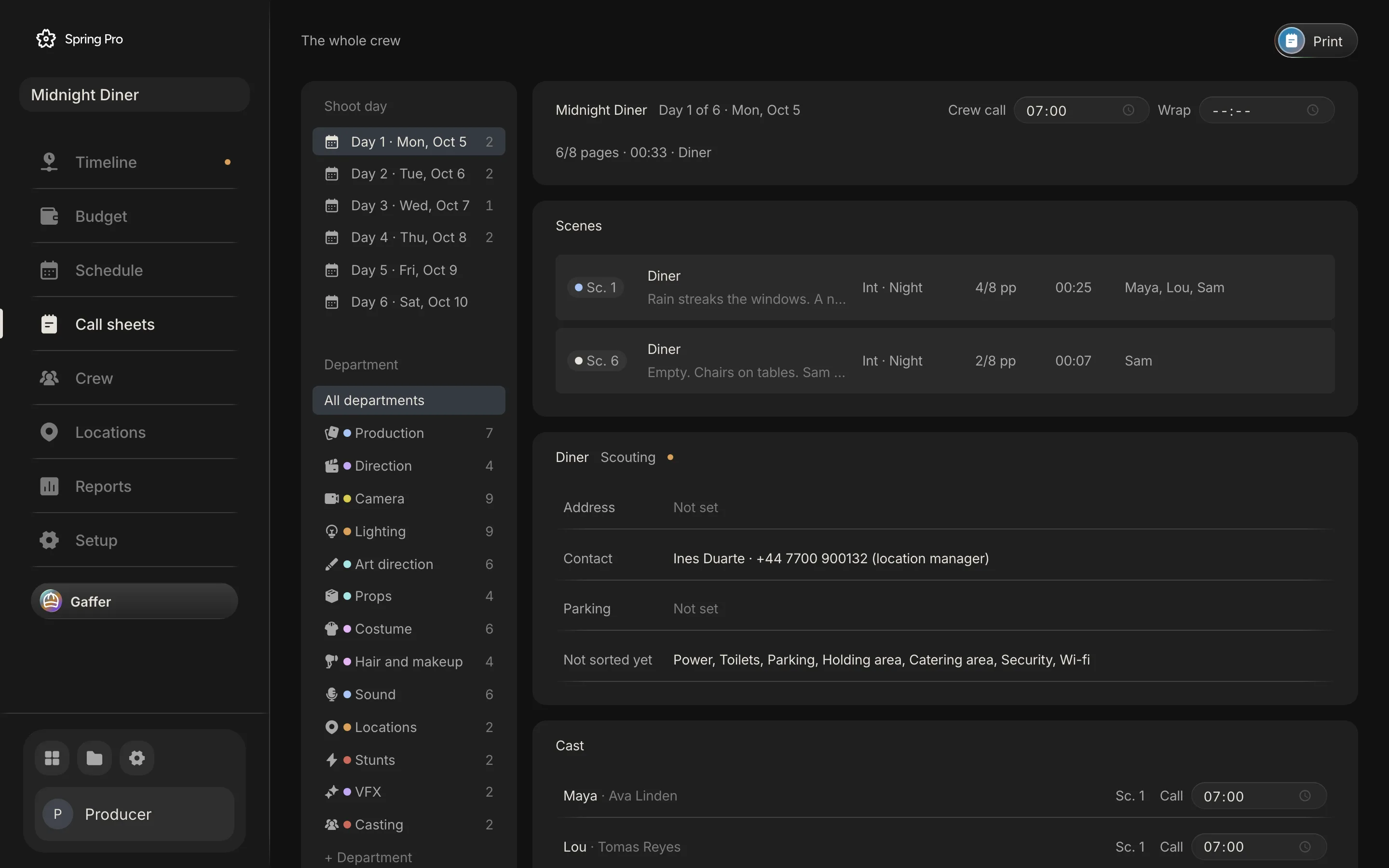
Real screen: Midnight Diner, our demo production, in Spring Pro.
The short answer. Turnaround is the rest between wrap on one day and the next call, and a meal break is the pause that must come within a few hours of call. Both are set by your agreement, not by the schedule, and breaking either one is paid per person. Check the earliest legal call before you fix a call time.
A schedule can look perfect and still be illegal. The usual cause is a night day followed by an early call: nobody counted the hours between wrap and the next call. This guide sets out the rules from real agreement documents, shows the check on Midnight Diner, and gives you a calculator for your own days. It sits inside film production scheduling, and the method is in how to make a shooting schedule.
In this guide 9 sections
Quick answers
What is turnaround? The rest between wrap on one day and the next call. It is a minimum number of hours, set by your agreement. The turnaround glossary entry has the plain definition.
What is a meal break? A pause for food that has to start within a set number of hours of call. In US film practice that is about six hours, with a meal of at least 30 minutes.
What is a meal penalty? A payment owed to each person when the meal runs late. It grows every half hour until the meal is served.
Who sets the numbers? Your union agreement or your contracts. The figures below are examples from summaries, and the contract text controls.
Where does the schedule come in? The schedule decides the call times, so it decides whether the rest between two days is long enough. The check takes a minute and has to be done for every pair of days. Cover every company move too, because the drive eats the rest.
Turnaround: the rule and the check
Turnaround is simple arithmetic. Take the wrap time, add the minimum rest, and you have the earliest legal call. Any call before that is a short turnaround.
The trap is a night day followed by an early call. In Midnight Diner, Day 1 is a night diner and Day 2 is a rooftop that opens at first light. The sample's call times are placeholders, so here is a plausible night: a 17:00 call, an 11-hour day and a 05:00 call the next morning.
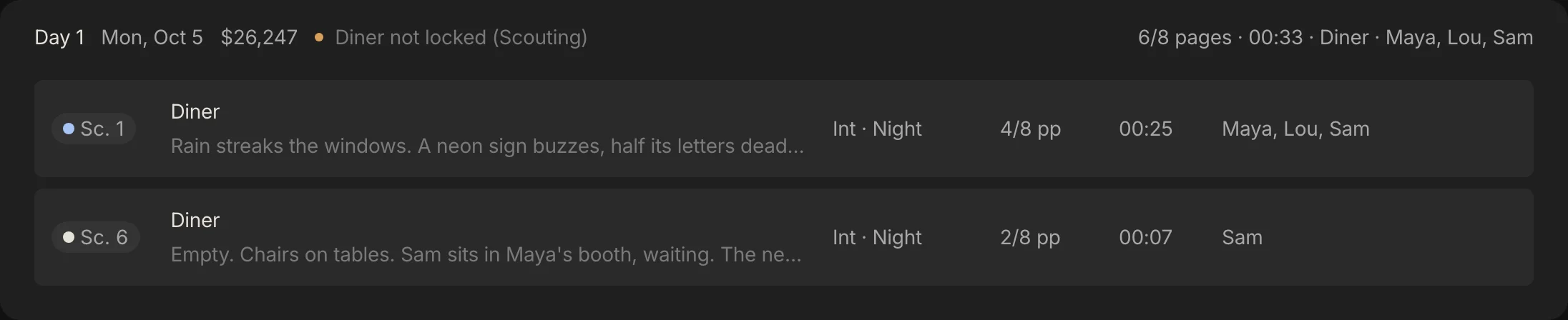
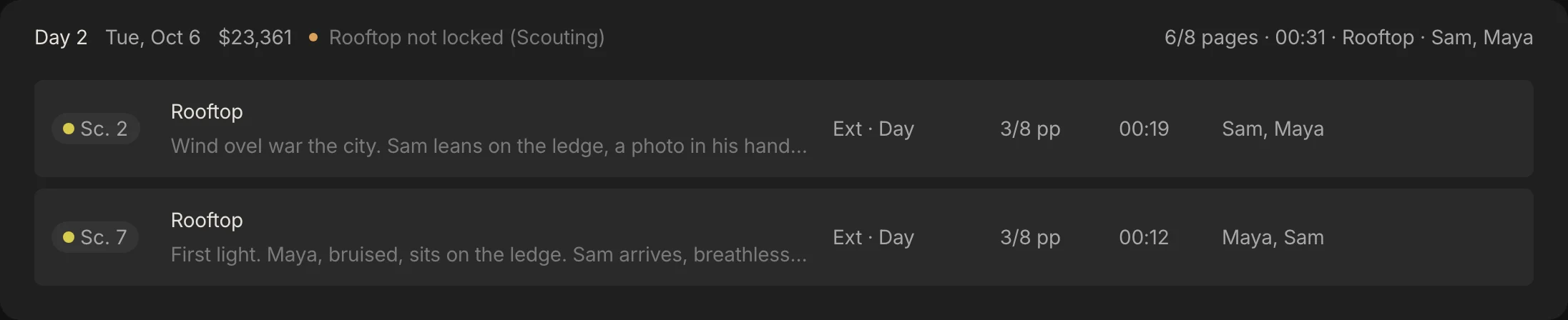
On those times the day wraps at 04:00, and the earliest legal call is 14:00 the next day. The planned 05:00 call is 1 hour after wrap, which is 9 hours short of 10 hours. Change the numbers to your own and the answer updates.
The 10 hours here is a default, not a rule. Your agreement may say more, and a day off or a weekend asks for longer rest, as the table below shows.
What two agreements say
These are the rest and meal rules from three documents, read on 2026-10-12. They are examples, not advice for your production: both are summaries, agreements change at each negotiation, and the contract text controls.
| Rule | IATSE Basic Agreement (2021 summary, 2024 memorandum) | Australian agreement (summary) |
|---|---|---|
| Rest between days | 10 hours minimum for productions with established terms; 9 hours for distant hires | 10 hours between consecutive days |
| After a day off or a weekend | 54 hours of weekend rest after a five-day week; 32 hours after a six-day week | 34 hours after one day off; 58 hours after two (54 in some cases) |
| If rest is broken | Additional double time for all invaded time on productions that start principal photography after the 2024 effective date; it was additional straight time before | Double time until the rest is provided |
| Meal break timing | Not stated in the summary | No later than 5 hours from the start of the work session, or 6 by agreement |
| If a meal is late | $25 for the fifth and each later half hour of delay in a day; after 20 penalties in a workweek, one hour of pay per half hour | Double time from when the meal falls due until it starts |
| Overtime | Not covered in the summary | After 8 hours on ordinary days: time and a half for 2 hours, double time up to 12, triple after |
Read the IATSE 2021 summary, the 2024 memorandum and the Australian summary for the full text of each rule. Your own agreement, or the contracts you issue, are what apply to you.
Two things to notice. Rest rules grow with a day off, so a Friday night shoot followed by a Saturday call is tighter than it looks. And broken rest is paid on the hours invaded, which is why one short turnaround repeated across a large crew gets expensive fast.
Meal breaks and penalties
A meal break is the other half of the same problem. In US film practice, Wrapbook explains, meals are scheduled around six-hour labour periods, a meal is at least 30 minutes, and wrap cannot fall more than six hours after the crew returns from lunch.
Penalties are owed per person and rise with every half hour the meal is late. Wrapbook gives SAG-AFTRA amounts of $25 for the first half hour, $35 for the second and $50 for each half hour after that, and says other unions set their own. These figures are as that page states them on the date we read it.
- A short grace. Production can run up to 12 minutes past the meal time with crew approval. One minute beyond that owes penalties.
- A second meal. The crew can work another six hours after lunch, after which another 30-minute meal is owed. Miss a second meal by more than 30 minutes and each person incurs two penalties.
- A walking meal. Everyone is fed while working, which avoids meal penalties, but the crew stay on the clock and are paid for that time.
- Placement. Put the meal where the day breaks naturally, between setups, not in the middle of a scene.
Where a schedule trips these rules
The same few patterns cause almost every short turnaround. Look for them on every pair of days.
- Night, then dawn. A night day wraps in the small hours, and the next day opens at first light. This is the Midnight Diner trap, and the calculator above is built for it.
- Friday night, Saturday call. A late Friday wrap leaves little rest before an early Saturday, and the weekend rules ask for more after a full week.
- Travel in the gap. A company move or a drive between days eats the rest. Count it from wrap to the new call, door to door.
- A day that runs long. A planned 11-hour day that runs 14 hours moves the wrap three hours later and the earliest legal call with it.
- Holds and split days. A person on hold can work a different pattern from the crew, so check cast separately. The day out of days shows who works when.
When a turnaround is short, there are four fixes: a rest day between the two, a later call for the second day, a different order of days, or a shorter first day. Each has a price. The guide to overtime and day cost shows what an hour costs on a real day: $26,247 planned for Midnight Diner's costliest day, and about $2,993 for each extra hour.
In Spring Pro
Spring Pro holds the crew call and the wrap for every day on its call sheet, with each actor's own call below them. It does not check turnaround or meal breaks. The schedule's warnings cover three things: too many pages, more than one set, and day and night mixed.

So the check in this guide is yours to run, on the call times you set. It takes one line per pair of days, and we say plainly that the app does not do it yet. The day-level view is in call sheet software, the whole schedule is in shooting schedule software, and the free call sheet template has a column for each call.
How these numbers were made
The earliest legal call and the gap are computed by the formula in this page, the same function the schedule guide uses. The rest and meal figures come from the three sources below, read on 2026-10-12, and the amounts a union pays change at each negotiation. Midnight Diner is a demonstration production, and its night-then-dawn pattern is real while the clock times are illustrative.
Questions people ask
What is turnaround on a film set?
Turnaround is the rest between wrap on one day and the call on the next. Your agreement sets the minimum, and a day off or a weekend usually asks for longer. See the turnaround entry.
How many hours of rest does a film crew need between days?
It depends on the agreement. The IATSE 2021 summary sets 10 hours minimum for productions with established terms, and the Australian agreement summary asks for 10 hours between consecutive days and 34 after one day off. Check your own contract.
What is a meal penalty?
A payment owed to each person when a meal runs late. In US practice it grows every half hour until the meal is served, and Wrapbook lists SAG-AFTRA amounts. Each union sets its own.
Does a walking meal avoid a meal penalty?
It avoids the penalty because everyone is fed, but the crew stay on the clock and are paid for the time. It is a way to avoid a penalty and overtime in a tight day, not a way to save the hours.
Can I schedule a night shoot before an early call?
Only if the rest between wrap and the early call meets your agreement. Run the earliest legal call for the pair of days with the calculator above, and if the planned call is earlier, add a rest day or move the call.
Does Spring Pro check turnaround?
No. It shows each day's call and wrap on the call sheet and warns on pages, sets and mixed light. The rest check is yours to run until it is built.
Sources
Every outside claim that names a source comes from one of these, read on the date shown. Standard conventions, such as the eighths rule and the usual specialist cases, are common practice. Figures from agreements and summaries change at each negotiation, so check the current text before you rely on a number.
- IATSE Basic Agreement, 2021 negotiations summary (Editors Guild, a union summary). Checked 2026-10-12.
- IATSE Basic Agreement, 2024 memorandum of agreement (a copy held by the Berkeley Labor Center). Checked 2026-10-12.
- Motion Picture Production Certified Agreement, summary (MEAA, Australia). Checked 2026-10-12.
- Wrapbook, meal penalties: a producer's guide (a payroll vendor). Checked 2026-10-12.
More about shooting schedule
A schedule is a labour bill. The cost of an error is paid in hours.
- Film production scheduling: the whole picture. The complete guide
- Scenes become strips. Strips become shoot days. The tool
- A film shooting schedule template, laid out as a stripboard.
- How to make a shooting schedule for a film, with a real sample.
- What a day out of days report is, and how to read one.
- One line schedule vs stripboard: the same four days, three ways.
- How to schedule a night shoot for film: the calls, the meals, the rest and the loadings.
- Film weather cover day: how to swap a rain day, with worked costs.
- Scheduling through script revisions: the colours, the routine and what each change costs.
- What is a stripboard?
- What is a day out of days?
- What is turnaround on a film set?