How to make a short film, step by step, on a worked two-minute example.
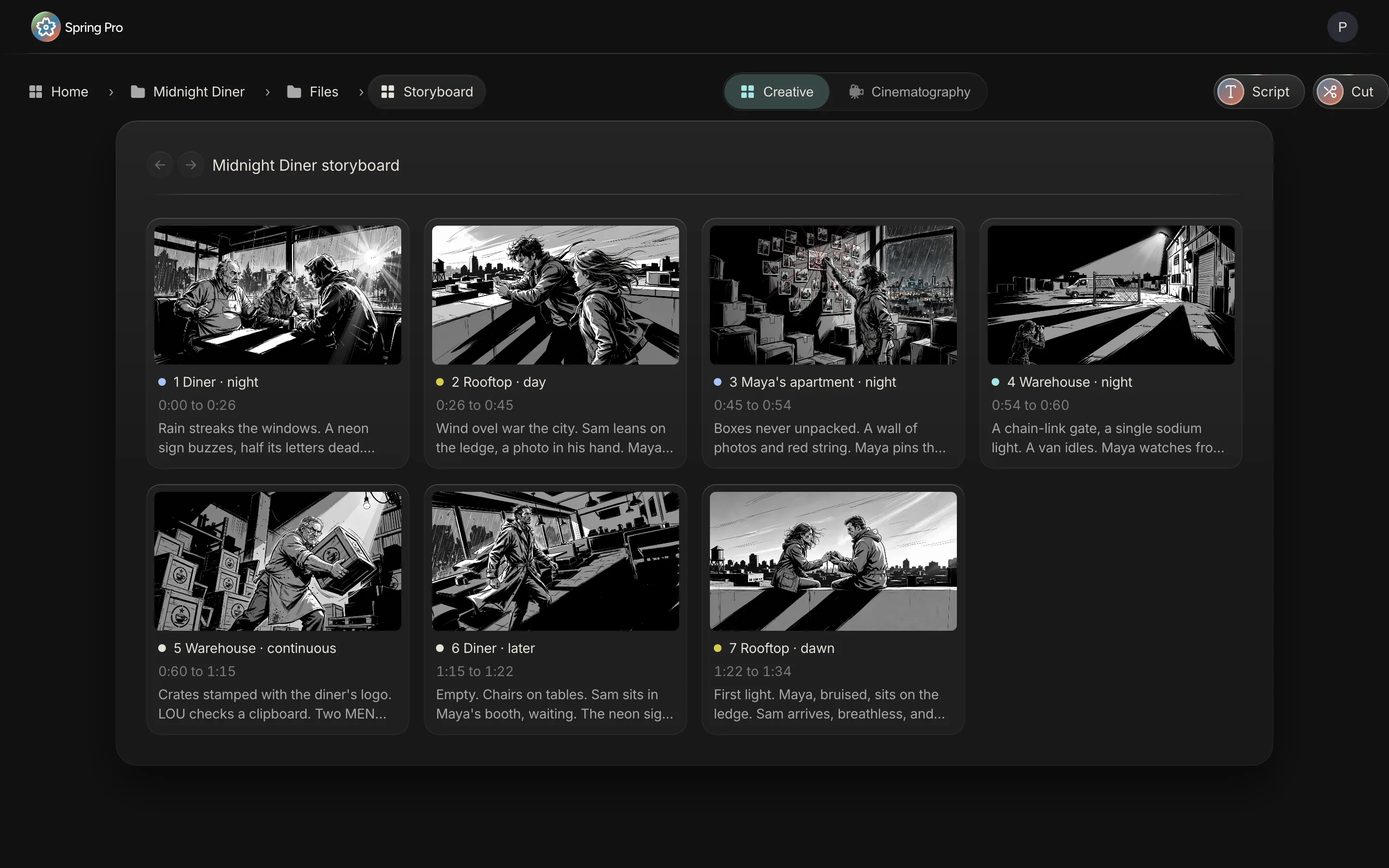
Real screen: Midnight Diner, our demo production, in Spring Pro.
The short answer. To make a short film, pick a story you can finish with the people and places you have, and write it short: about a page a minute. List what each scene needs, plan the shots, fit the scenes into shoot days and price them. Get permission to film, send a call sheet for each day, shoot, edit, clear the music and share.
Making a short film is mostly planning. In our view a first short is lost in the plan more often than on the shoot day: a story too big for the money, a day nobody planned, a call time nobody sent. This guide follows every step on one sample short, Midnight Diner: seven scenes, about two minutes, four shoot days and three named actors. It is a demonstration project that was never shot, and every number about it is computed from its files. The guide says what a two-minute film can skip and what it cannot. Spring Pro is one way to do the work, and a word processor and a spreadsheet are another, because the steps are the same.
In this guide 23 sections
- Quick answers
- Why a first short film stalls, and where
- The sample short film this guide follows
- Step 1: Pick a story you can finish
- Step 2: Write it short, and time it
- Step 3: List what each scene needs
- Step 4: Plan the shots with a shot list and a storyboard
- Step 5: Fit the scenes into shoot days
- Step 6: Find your cast and crew, and decide who produces
- Step 7: Price it, on a low budget or a micro budget
- Step 8: Get permission to film
- Step 9: Send a call sheet for every shoot day
- Step 10: Shoot, and keep a record of the day
- Step 11: Edit, and clear the music
- Step 12: Share it, and read the rules first
- What a two-minute short can skip, and what it cannot
- How people plan a short film today, and what breaks when the script changes
- From a short to a feature: what changes
- Doing it in Spring Pro
- The checklist
- How these numbers were made
- Questions people ask
- Sources
Quick answers
What are the steps? Idea, script, breakdown, shot list, schedule, cast and crew, budget, permission, call sheets, shoot, edit, share. StudioBinder's guide has twelve steps and puts the breakdown and the storyboard before the shoot. Where a deeper guide exists, the step links to it.
How long should a short film be? For its short film award the Academy defines a short as 40 minutes or less, credits included, and AFI FEST also says 40 minutes or less for its shorts. The Filmdaft guide expects its footage to come in under 20 minutes, in passing, and sets no limit. Our advice is as short as the story allows, because every minute is a page to shoot, cut and clear.
How many pages is that? About a page a minute. StudioBinder and Robin Piree both use it, and Stephen Follows measured about 55 seconds a page on 2,520 feature scripts, with no short films in that data. For a two-minute short, plan on about two pages.
How much does it cost? We found no reliable average for a short film, so we quote none. The cost follows who is paid. Midnight Diner below is a paid shoot at $358,654, and that is not what a first short has to cost.
Do you need software? No. A word processor, a spreadsheet and a notes app will get a short made. Software earns its place when the script keeps changing and the schedule, the budget and the call sheets all depend on it.
Where does this guide fit? It walks one short film through every step, from the idea to sharing. For the wider view of making an independent film, see the independent filmmaking guide, and for the script, the guide to writing a script for a short film. The guides linked here cover one stage each in full: the script breakdown, the schedule, the call sheets and the budget.
Why a first short film stalls, and where
A short is small enough for one person to hold in their head, so its failures are small things nobody wrote down, and it has no spare days to absorb them. On Day 1 of Midnight Diner, one more hour of crew and cast labour is $2,993 (see film production scheduling). On an unpaid crew the hour costs goodwill instead.
| Step | What goes wrong | What a miss does |
|---|---|---|
| Idea | More places, nights and effects than the money allows | The film is never finished, or finished thin |
| Script | The running time is a guess | A film that runs long |
| Breakdown | What each scene needs is not written down | A missing prop stops the day |
| Schedule | Scenes are shot in script order | Extra moves and long days |
| Permission | No permit for a place, no release from a person | A fine or a stopped shoot, for a missing permit |
| Sound | The camera microphone is the plan | Dialogue nobody can use |
| Music | A song used with no licence | Infringement liability, and a film that may not be sold or uploaded |
The permit and music rows rest on the sources named in steps 8 and 11, and the camera microphone point on Celtx in step 6. The rest is our view.
The sample short film this guide follows
Midnight Diner is a short crime film. A burned-out investigator uses herself as bait to expose the night diner owner running contraband off the river, and pulls her old partner back in.
Be clear about what it is. It is a demonstration production built like a paid shoot: 44 people on its list, most on day rates, a generator, a crane and a rain rig, and a budget locked at $358,654 on 4 October 2026. Your first short will be smaller. We use it because every number is computed from the project and can be checked, not because it is a model to copy.
Its daily reports show no pages shot, and its four shoot days are dated 5 October to 8 October 2026, before the project's own date of 12 October 2026. Read them as a plan, not as days that happened.
| What | Number | Where it comes from |
|---|---|---|
| Scenes and pages | 7 scenes, 2 1/8 pages | The script, in eighths of a page |
| Running time | 1:34 to 2:08 | Two clocks, explained in step 2 |
| Places | 4 | Diner, rooftop, Maya's apartment and warehouse |
| Shoot days | 4 | The schedule (two more days are empty) |
| Named actors | 3 | The crew list (plus two non-speaking loaders) |
| Crew and vendors | 32 and 7 | The crew list |
| Locked budget | $358,654 | The budget |
Step 1: Pick a story you can finish
Start with the film you can finish, not the one you would like to make. The Filmdaft guide calls this rule number one of low budget filmmaking: keep the screenplay simple and the production inexpensive. Its author's first independent short had one location, which saved money and time. StudioBinder has a step for it too, finalising the scope.
- One place if you can. Every extra place is another day or another move. Midnight Diner has four.
- Two or three people on screen. Each needs a call, a costume and a rehearsal. Midnight Diner has three named actors.
- Daylight and dry weather. Night work, rain and generators cost people and time. Five of Midnight Diner's seven scenes play at night, and scene 1 has a rain rig and a generator.
- A reason to finish. A festival date, a showreel or a screening for friends. It decides how much you spend.
That scope check is our advice. Midnight Diner breaks most of it, which makes it a hard case and a useful one. Shrink every number and the steps stay the same.
Step 2: Write it short, and time it
The usual conversion is a page a minute, which StudioBinder and Robin Piree both use. It is rough: Stephen Follows compared 2,520 feature scripts with their running times and found about 55 seconds a page. He calls the rule very imprecise but not a bad starting point, a midpoint more than a rule. His data has no short films, so it cannot say how a two-page script plays.
Midnight Diner shows the gap. The script page counts each scene in eighths of a page, the way a breakdown writes length (see script eighths), and its seven scenes add up to 17 eighths, or 2 1/8 pages. The page rule turns that into 2:08. The reading-pace clock, which times spoken lines and action by their words, reads the same script as 1:34, 26 per cent shorter.
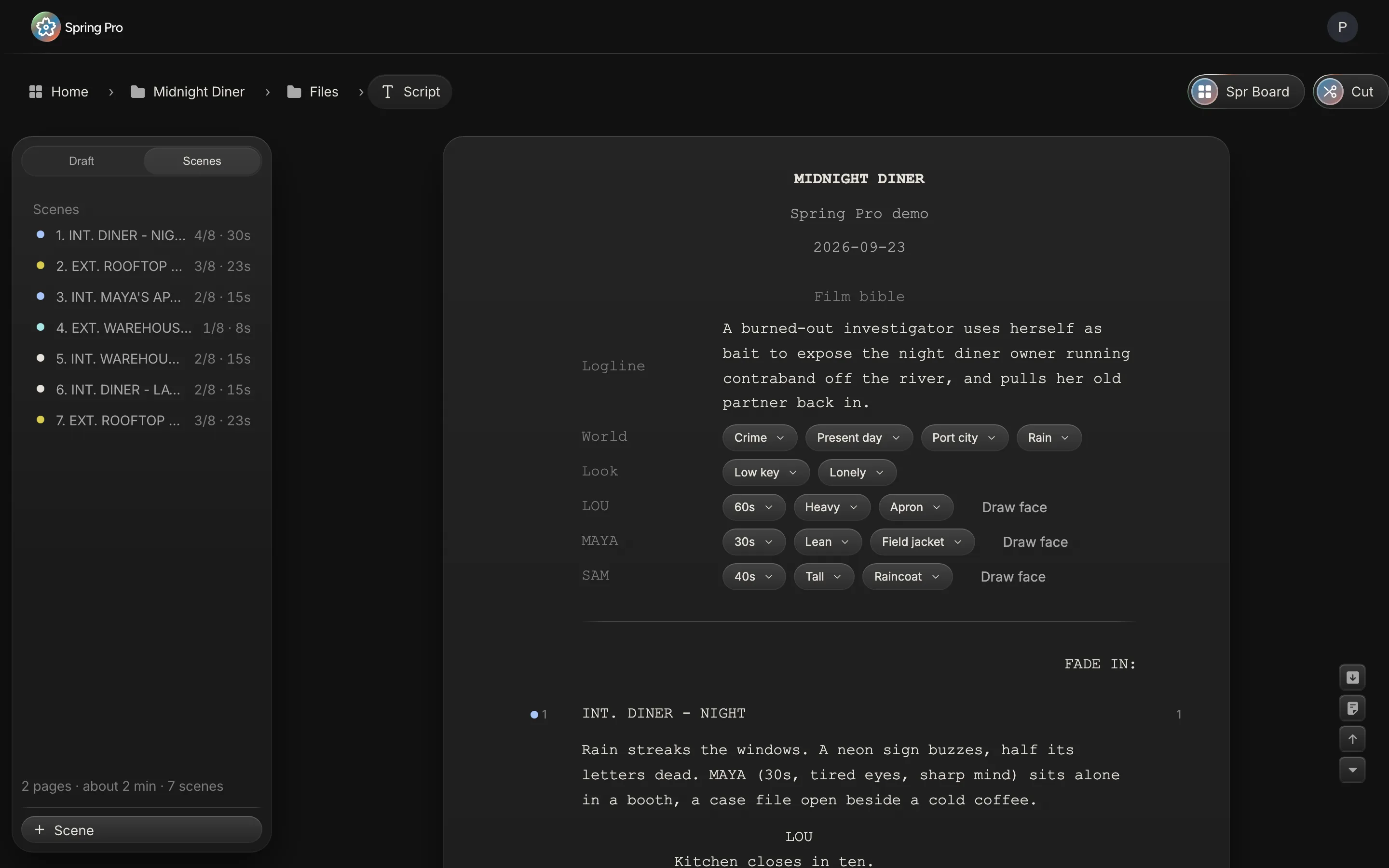
So time your script by reading it aloud with a stopwatch, and trust that over the page count. That is our advice, not a rule from a source. Format and scene headings are covered in the screenplay format guide.
Step 3: List what each scene needs
A breakdown is a list, scene by scene, of everything the scene needs: cast, extras, props, set dressing, wardrobe, hair and makeup, vehicles, effects, sound and equipment. Everything after it reads from it. StudioBinder puts it fourth, right after writing the script.
Scene 1 of Midnight Diner has 21 elements in nine categories: cast 3, extras 2, props 3, set dressing 3, wardrobe 3, hair and makeup 2, special effects 1, sound 2 and equipment 2. The whole film has 84 entries, 72 of them different. It is where the budget starts: the rain rig and the 100 kVA generator in scene 1 became two vendor deals, $4,800 for the rain rig and towers and $7,200 for the generator and lamps.
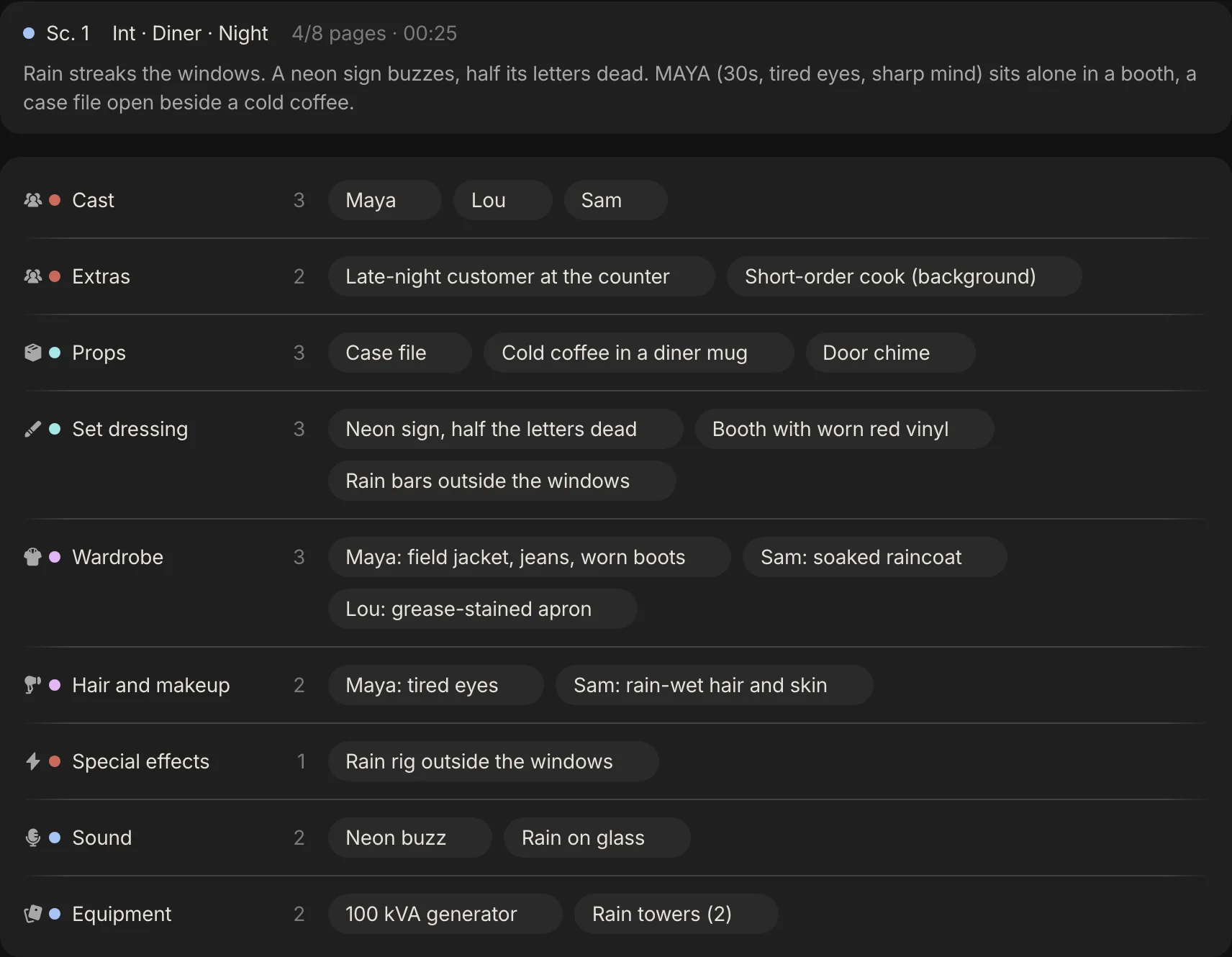
A two-minute short with a friend crew will have far fewer. Make the list anyway, because it is what stops a missing coat from stopping the day. See how to do a script breakdown and the script breakdown template.
Step 4: Plan the shots with a shot list and a storyboard
A shot list says how each scene will be filmed: the size of the shot, the angle, the lens, the move. A storyboard draws the same plan. StudioBinder says to always have your shot list and to check shots off through the shoot.
Midnight Diner's list is thin: one shot size, angle, lens, move and style for each of its seven scenes, plus a few lighting choices. A scene you care about will want more rows. Its storyboard has one frame for each scene, with the dialogue in balloons, and it keeps every version of a frame and stars the one in use.
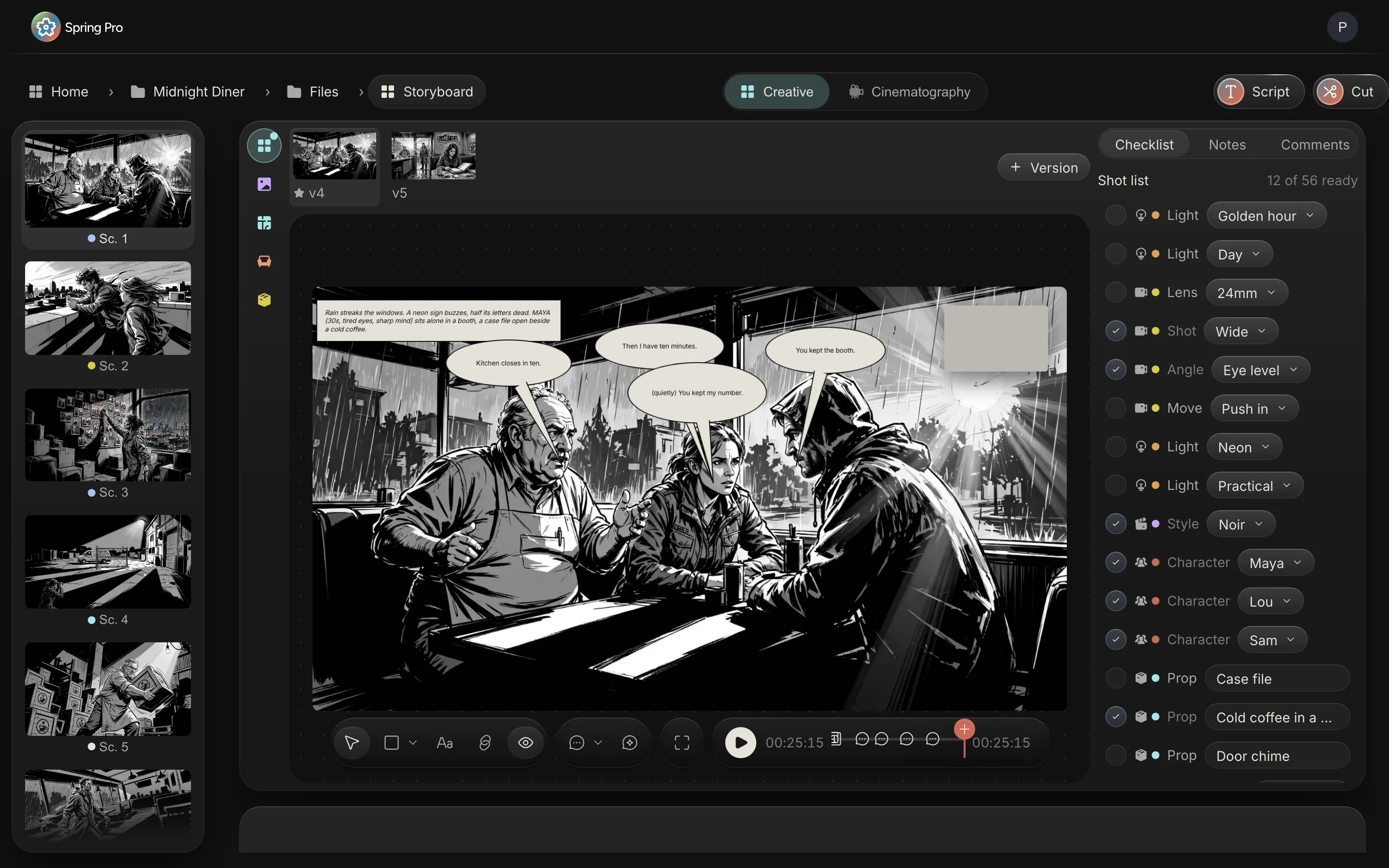
A two-minute short can skip the drawings and keep the list. What it cannot skip is deciding, before the day, what the camera will do in each scene. See the shot list template, storyboard software and the shot list and storyboard guide.
Step 5: Fit the scenes into shoot days
A schedule is the scenes sorted into days, by place first and then by day or night, because moving a crew between places is the expensive part. StudioBinder says to set up a production calendar so you can stick to a timeline.
Midnight Diner has seven scenes in four places. Shot in script order, the crew would move between places five times. Grouped by place, it needs four days and three moves.
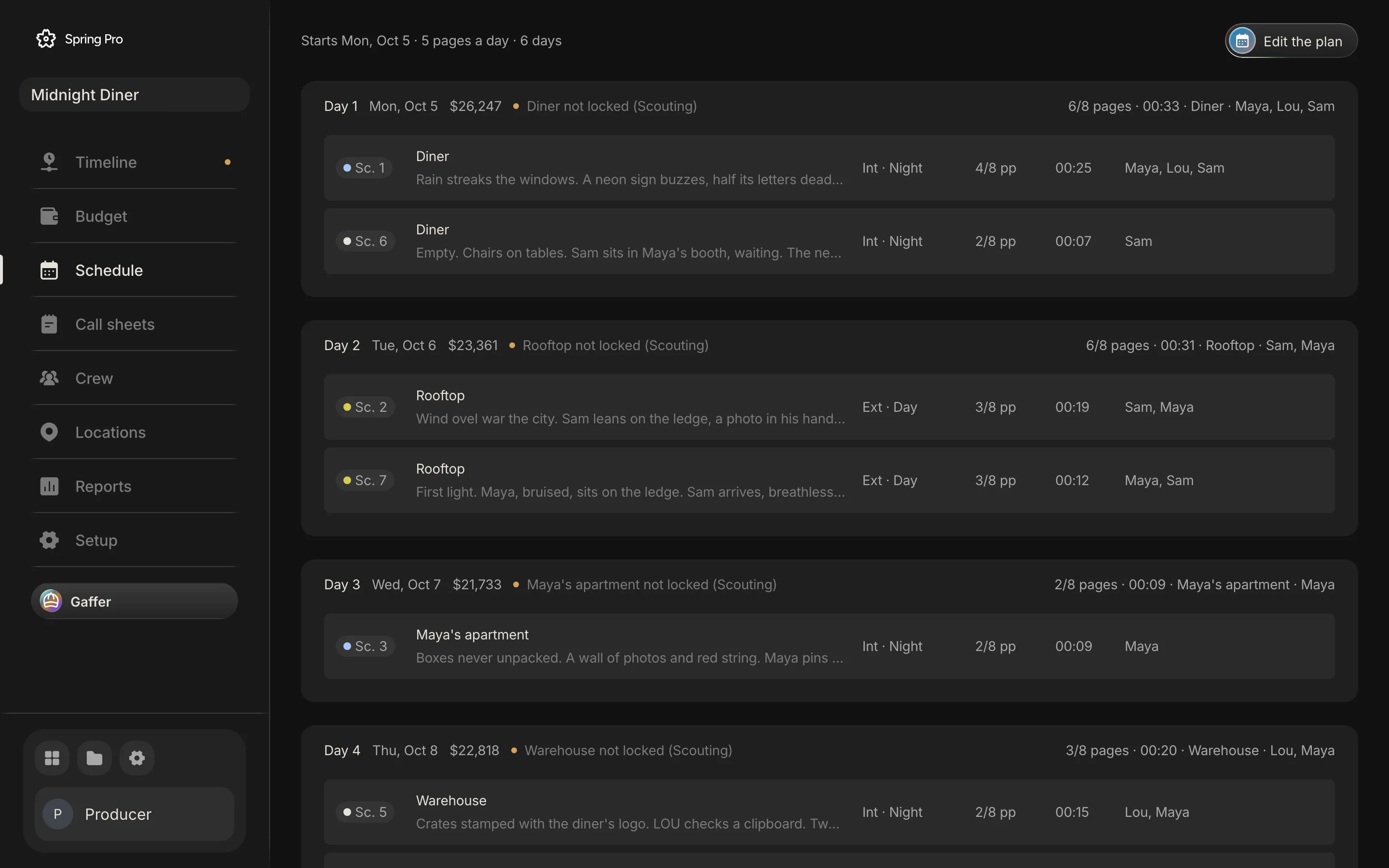
Pages and places each set a floor. At the app's default of five pages a day, 2 1/8 pages fit in one day, but four places need four. Try your own numbers below.
| Day | Date | Scenes | Pages | Place | Planned cost |
|---|---|---|---|---|---|
| 1 | 5 October | 1, 6 | 6/8 | Diner | $26,247 |
| 2 | 6 October | 2, 7 | 6/8 | Rooftop | $23,361 |
| 3 | 7 October | 3 | 2/8 | Maya's apartment | $21,733 |
| 4 | 8 October | 5, 4 | 3/8 | Warehouse | $22,818 |
Scene 3 shows why places matter. Each scene carries its share of its day, and scene 3 is a quarter page that carries the whole of Day 3. Its forecast cost is $22,183, more than the half-page scene 1 at $17,798, which shares Day 1 with scene 6. Scene costs are forecasts, which use what was logged for days that have passed, so scene 3 reads $450 above Day 3's planned cost in the table.
Watch who waits. Lou works on Day 1, waits through Days 2 and 3, and works again on Day 4, so a four-day short with three named actors still has two hold days. The budget prices him for two working days, so ask whether his deal pays for the wait.
The method is in how to make a shooting schedule, and the wider picture is in film production scheduling. The day out of days guide explains the hold chart, and the film schedule template is a start in a spreadsheet. A two-minute short can use a one-line list of days instead of a stripboard, and night shoots, rain days and script changes each have a schedule guide of their own.
Step 6: Find your cast and crew, and decide who produces
Celtx lists a director, a producer, a camera operator, a sound recordist and a runner for an ultra low budget crew, with a first assistant director optional on a simple shoot. It warns that small crews double up, and says to avoid pairing two jobs that both need full attention at once.
Do not skip sound. Celtx says to use a dedicated recordist and that the camera microphone is not a plan. The Filmdaft guide adds that the director will probably also be the first assistant director, the script supervisor and the producer.
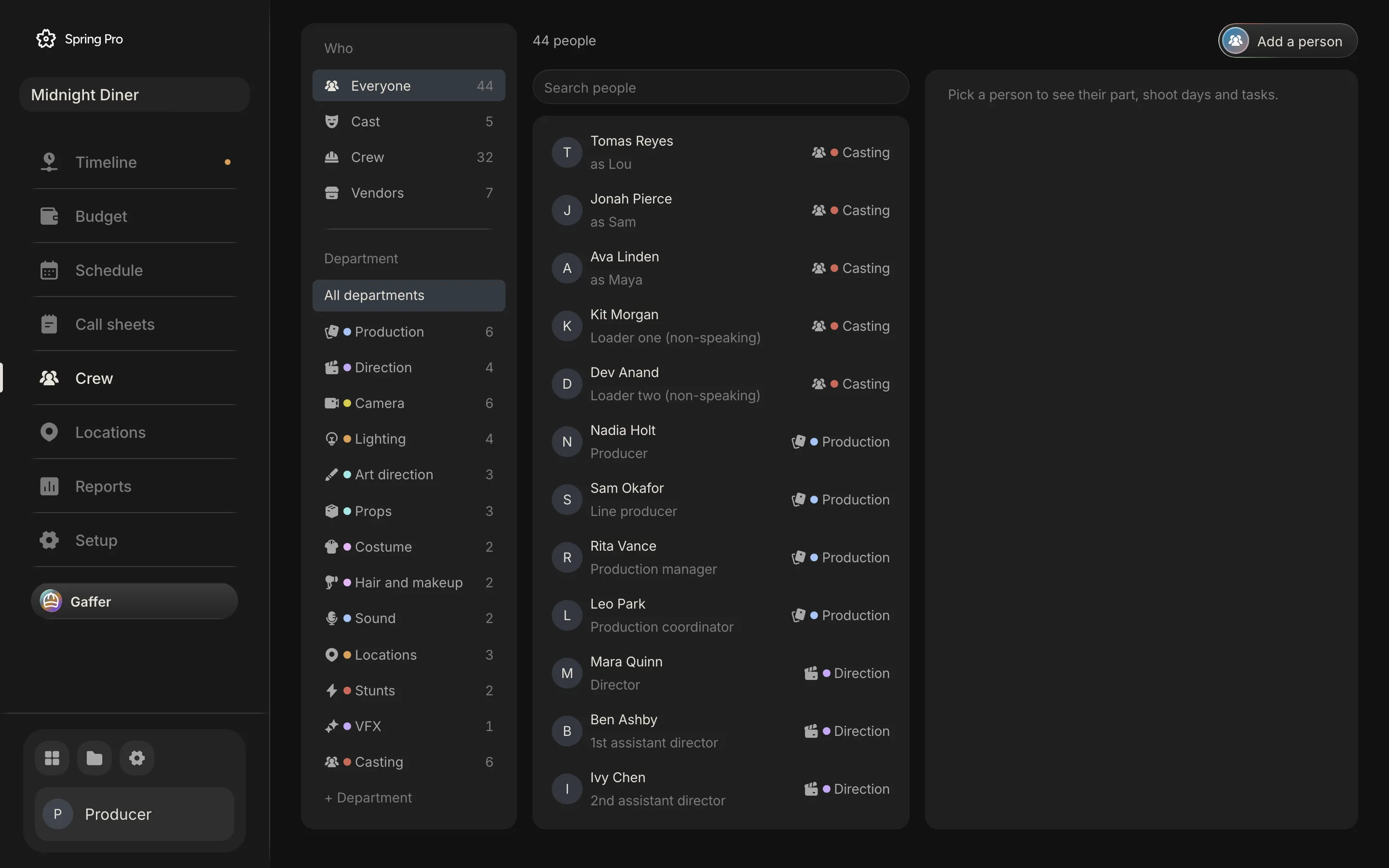
Midnight Diner's list has 32 crew, 5 cast and 7 vendors in 13 departments, against the five to seven crew that Celtx gives for an ultra low budget short. Write yours as roles first and names second, and mark who doubles.
Step 7: Price it, on a low budget or a micro budget
A budget is the schedule and the people, with prices on them. Build it after the breakdown, the schedule and the cast and crew, so every cost has something under it. The full method is in how to budget a short film.
Midnight Diner's budget was locked on 4 October 2026 at $358,654: $326,049 of costs plus $32,605 of contingency, which is 10 per cent. It is a paid shoot, so at the plan's prices 76% of the cost is cast, crew and vendors.

The screen above shows a forecast final cost of $334,626 and $192,446 spent, not the $326,701 used below. The $326,701 is the plan's estimate. The forecast uses what was logged for days that have passed, and the sample's shoot days are dated before its project date, so the app counts them as shot.
| Where | Share | Amount | What it is |
|---|---|---|---|
| On the shoot days | 29% | $94,159 | Cost that falls on one of the four days |
| Flat fees | 26% | $84,140 | People and vendors paid one fee, such as the director and the rain rig |
| Prep and wrap days | 23% | $76,101 | Days before and after the shoot, for people on a day rate |
| Fixed lines | 22% | $72,300 | Costs tied to no day, such as post, music, insurance and festival fees |
That table is the lever on a short. Flat fees and prep and wrap days are decisions about who is paid and for how long, and together they are 49% of the cost here. A short where friends work for credit and a meal has none of those fees. Each amount is rounded on its own, so the four rows add to $326,700 against a total of $326,701.
The fixed lines are the ones tied to no shoot day, so they are easy to leave out. Midnight Diner budgets $9,000 for the sound edit and mix, $7,000 for a composer and licences, $6,500 for insurance, $3,500 for clearances and $1,500 for festival fees.
"Low budget" and "micro budget" have no agreed ceiling. In 2014 Stephen Follows asked 542 film professionals who had attended Cannes, AFM or Berlin the most a micro-budget film could cost. The trimmed average answer was $396,000, and views differed by region. The survey does not mention short films, so do not read it as a short film budget.
Start in the film budget template. Once the budget is locked, tracking the spend against it is a job of its own.
Step 8: Get permission to film
Permission is a step of its own, and an easy one to leave too late. A Cal State LA film department guide says most public locations need some kind of permit, that a permit does not give you permission to film the people there, and that a permit is not the same as the insurance a location may ask for. For private property you need written permission from the owner, unless it is your own home.
So for each place, write down who gives permission, what paper they want and by when. For each person on camera, get a signed release: StudioBinder says to read up on actor release forms if you hire actors. Robin Piree made his location deal by mail and says to always have agreements in writing.
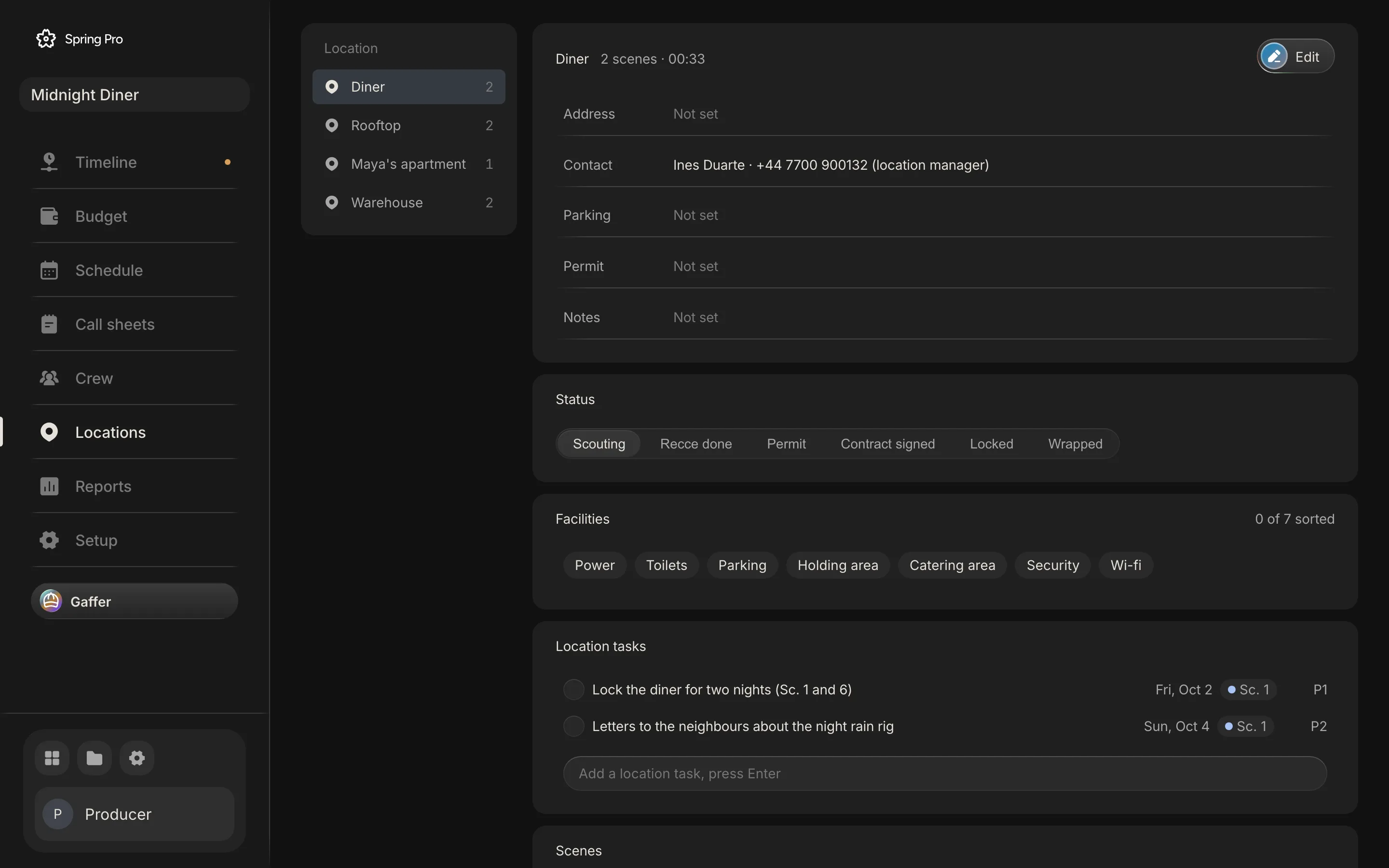
Midnight Diner keeps this on the scenes as to-dos: a night shoot permit for the street rain rig, rooftop access and insurance, a parking permit for one night and a yard permit for two nights. In the sample none of the four is ticked, and all four places are still at scouting, so the schedule says so on every day. Scouting and locking a place has a guide of its own.
Step 9: Send a call sheet for every shoot day
A call sheet tells everyone where to be and when, for one day. A short with four shoot days needs four sheets, each built from the schedule so the scenes and the cast cannot drift apart.
Day 1 of Midnight Diner carries scenes 1 and 6 at the diner, three cast, 21 distinct elements to have on set and 29 to-dos still open. Day 3 has 7 elements and 7 to-dos.
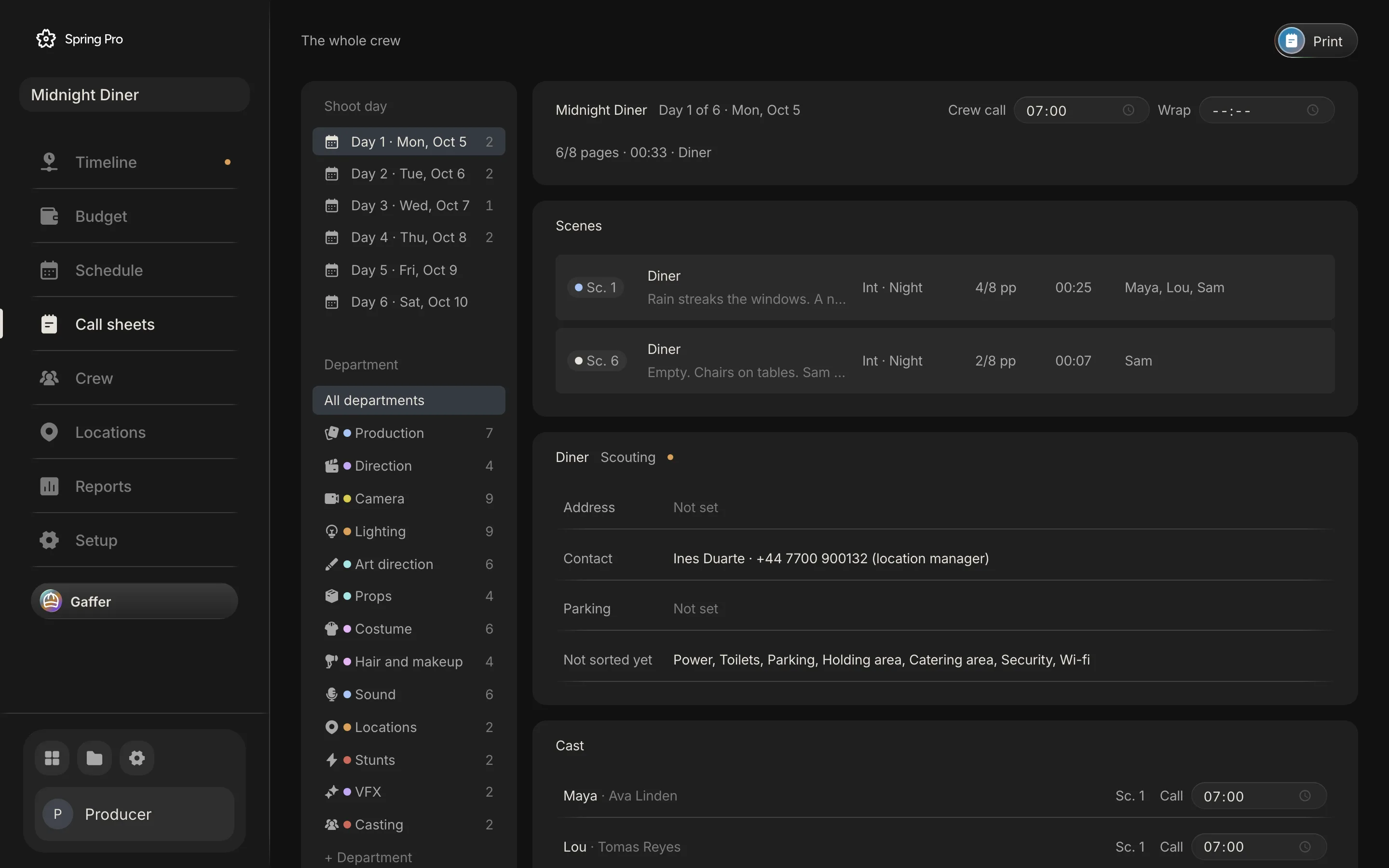
One honest note about the sample. Every call on every day is 07:00 and no actor has a call of their own, though Day 1 is a night day. That is a placeholder, not a plan. A real night day calls later, and the rest between days needs checking: see turnaround and meal breaks.
The call sheet guide builds one field by field, and the call sheet template is a filled-in start.
Step 10: Shoot, and keep a record of the day
On the day the plan meets the clock. StudioBinder says to show up prepared, and the shot list is what you tick off. Keep a plain record of what was shot, what was not and when the day ended. A daily production report is that record: first shot, lunch and wrap times, scenes completed and delays. The daily production report guide lists the fields.
On a paid crew the clock is money. Midnight Diner plans an 11-hour day with overtime after hour 10, paid at 1.5 times. One extra hour of crew and cast labour on Day 1 is $2,993, and a 14-hour day instead of the planned 11 adds $8,979.
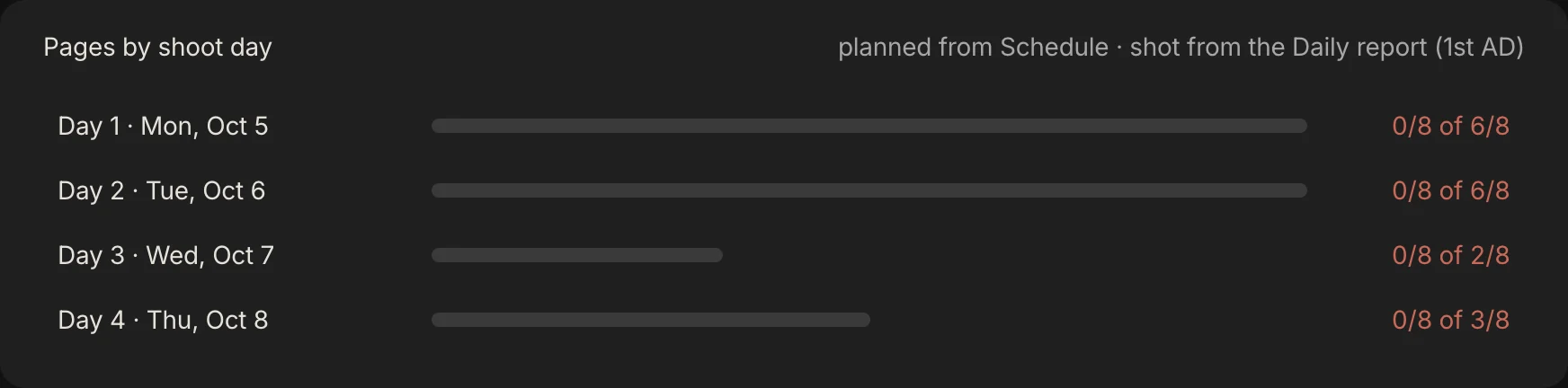
On an unpaid shoot the hour costs goodwill, and a night shoot followed by an early call is how it runs out. That is our view. Plan the rest between days before you plan the days.
Step 11: Edit, and clear the music
A first cut can be made before the shoot, from the storyboard frames at their planned times, and it shows the pace while a change is still cheap. In Spring Pro the Cut button makes it, and you add your footage to the same timeline yourself.
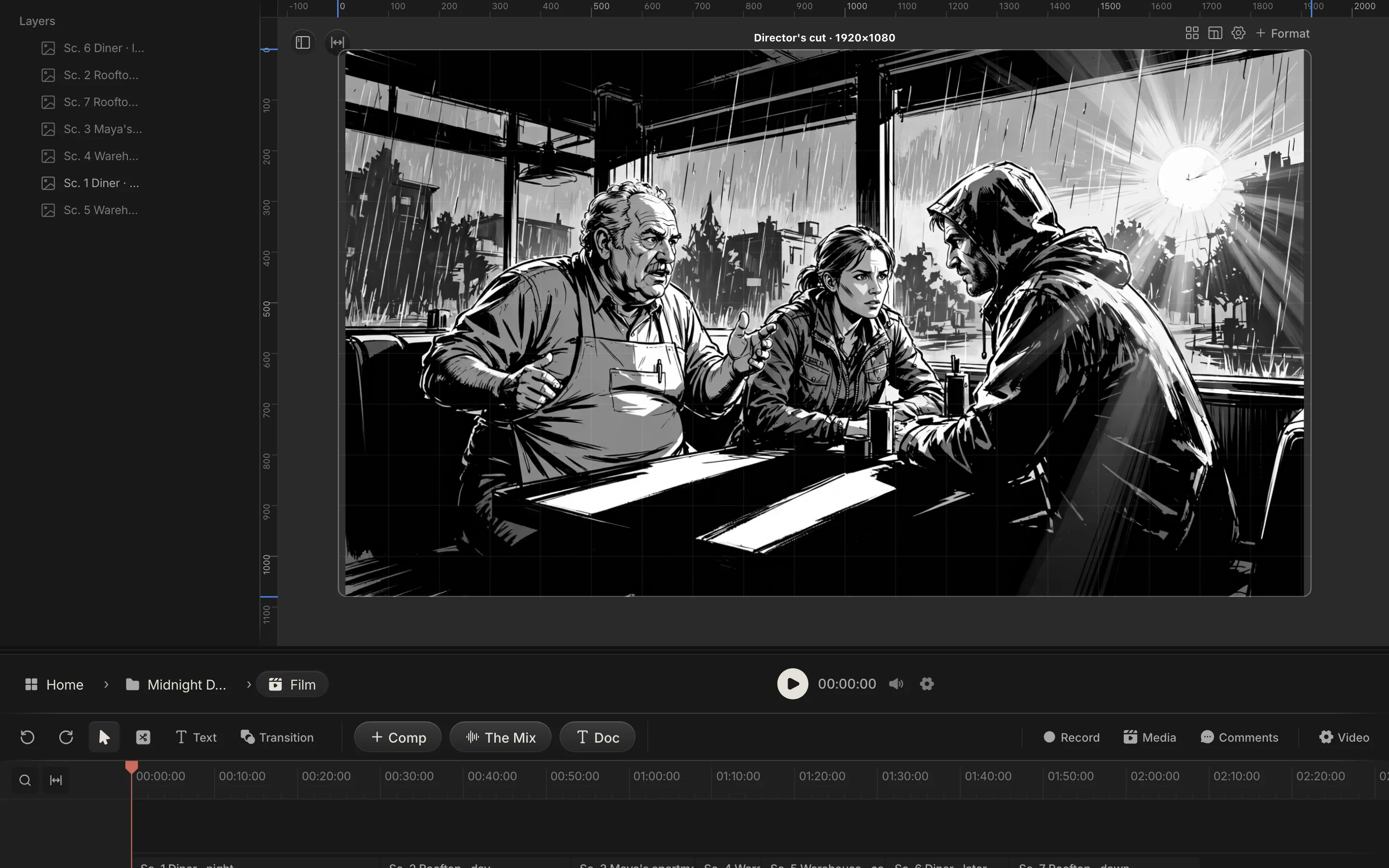
Plan the sound and the music while you edit, not at the end. Midnight Diner's budget carries $9,000 for the sound edit and mix and $7,000 for a composer and licences. Music needs permission.
Show Me Shorts publishes a guide, written by the co-founder of a Squarespace plugin company, that says any music in a short needs a licence from its owners, YouTube uploads included. It warns that without rights across all places and media you may be unable to sell the film in some countries or put it on video on demand platforms. A song often needs two: sync rights for the composition and master rights for the recording. The alternatives it lists are public domain music, production libraries or a composer.
Step 12: Share it, and read the rules first
Decide where the film goes before you finish, because a film that is public online may not suit some festivals, and the rules differ. The Atlanta Film Festival does not require a world premiere but considers premiere status, and it decides case by case whether to programme shorts that are already online. AFI FEST says shorts are eligible regardless of online availability and have no geographic premiere requirement.
Length rules differ too. The Academy's rule for its short film award is 40 minutes or less, credits included, and AFI FEST also says 40 minutes or less. StudioBinder adds that you do not need to aim for Sundance or Cannes, because there are thousands of smaller festivals.
The music licence from step 11 has to cover where you share. The Show Me Shorts guide calls a limited festival-only licence a trap, because it can give the rights owner leverage on price when you later want a wider release. Robin Piree released the film on an online short film platform and also entered festivals, and says it makes no sense to keep a finished film to yourself, because people's attention is what a short film earns.
Midnight Diner's budget carries $1,500 for festival fees. In Spring Pro the editor exports MP4, WebM or a single PNG frame, and the Share for review panel gives you a link to copy. How the cut, the export and the link fit together is in the guide from the plan to the cut.
What a two-minute short can skip, and what it cannot
Not every step earns its place on a film this small. This is our view. A No row means we would not skip it: permits, releases and music have a source in steps 8 and 11, and sound has one in step 6, but the timed script and the call sheet are our judgement.
| Step | Can it skip it? | What to do instead |
|---|---|---|
| A timed script | No | Read it aloud with a stopwatch |
| A breakdown sheet | The sheet, not the list | A list of needs for each scene, in any app |
| Storyboard drawings | Yes, with a shot list | One row for each scene: size, angle, lens, move |
| A stripboard | Yes | A list of days with the scenes, place and cast |
| A day out of days chart | Mostly | Still look for an actor who waits, as Lou does |
| A locked budget and change log | Yes | One sheet of costs and one person who approves spending |
| Permits and releases | No | Written permission for each place, a signed release for each person |
| A call sheet for each day | No | One page for each shoot day, even for friends |
| A dedicated person for sound | No | Someone whose only job is sound |
| Music licences | No | Cleared or library music, in writing |
The Yes rows are about size, not laziness: a two-minute film has too few days and people for a stripboard to earn its place. When the script grows past a few days, bring them back.
How people plan a short film today, and what breaks when the script changes
Many first shorts are planned in a word processor, a spreadsheet and a notes app. That works for a short with one place. The cost shows up when the script changes. This is our view, not a test of products.
| Way of working | Good for | When the script changes you must |
|---|---|---|
| A word processor, a spreadsheet and a notes app | A short with one place and a few people | Retype the scenes into the schedule, the call sheets and the budget |
| A separate app for each job | A team with a specialist for each job | Export and import between them, and check each still matches |
| One project where the script, schedule and budget read each other (Spring Pro) | A plan that changes weekly and is read by many people | Check the new numbers. It prints call sheets but does not email them |
From a short to a feature: what changes
The steps do not change with size. What grows is the number of people and the cost of a mistake. These sizes are rough labels, not industry definitions, and the last column is our view.
| Size | The plan | What to add |
|---|---|---|
| A phone film with friends | A list: scenes, who, where, when | Sound, permission and music |
| A short with a small crew | These steps, a page each | Releases and a sheet of costs |
| A short like Midnight Diner | The full chain in this guide | A locked budget and a daily report |
| A feature | The same chain at a larger scale | A line producer, union rules and several units. Spring Pro holds one unit and one script for now |
The scheduling side of that jump is in film production scheduling, and the money side is in how to budget a short film.
Doing it in Spring Pro
In Spring Pro the steps above are pages of one project, in a web browser with nothing to install. The script page counts scenes in eighths and seconds, and each scene has a breakdown, a storyboard frame and a shot list. The schedule builds days from the scenes, and the call sheets, locations, budget and reports read the same scenes and days. The budget prices the people on the crew list.
Gaffer, an assistant that reads the whole production, answers with real names and numbers and changes nothing unless asked. There is a guide to the AI production assistant for film.
What it does not do yet: it does not email call sheets (they print), it does not check rest between days or meal breaks on the schedule, it has no payroll or timecards, everyone on a project can approve, and a project holds one unit and one script. It does not record cameras on set, which is coming in a desktop app. It will not make the film for you.
The tools by job are script breakdown software, storyboard software, shooting schedule software, call sheet software and production budget software.
The checklist
Copy this. Tick it before you shoot, and again before you share.
- The story fits the money, the people and the places you have
- The script is timed by reading it aloud
- Every scene has a list of what it needs and a row in the shot list
- The scenes are grouped into days by place, and you know who waits
- Every cost has an owner, and one person approves spending
- Each place has permission, and each person on camera has signed a release
- One person does only sound
- Each shoot day has a call sheet, and the rest between days is checked
- The music is cleared or from a library, in writing
- You have read the rules of each festival you want before the film goes online
How these numbers were made
Every number about Midnight Diner is computed from the project with the app's own engines for the screenplay layout, the schedule and the budget, and the build stops if the project changes so that the story no longer holds. The hour costs cover crew and cast labour on a planned 11-hour day.
Midnight Diner is a demonstration production, not a case study. The outside sources were read on 2026-10-12. Some are vendors or competitors and are labelled, several show no year, the page-a-minute data is about features, and Celtx's crew sizes are one vendor's advice. We found no reliable average cost for a short film and quote none.
The screens are captures of the sample as it stands, so they show its small flaws: a typo in a scene's text and scene times that round to 0:60. The numbers in this guide are computed from the project, not read off those screens.
Questions people ask
How do you make a short film step by step?
Pick a story you can finish, write it short, list what each scene needs, plan the shots, fit the scenes into days, find your cast and crew, price it, get permission, send a call sheet for each day, shoot, edit and share.
How long should a short film be?
For its short film award the Academy defines a short as 40 minutes or less, credits included. For a first film, make it as short as the story allows. Midnight Diner runs about two minutes.
How many pages is a short film script?
About a page a minute, which StudioBinder and Robin Piree both use. Stephen Follows found about 55 seconds a page on feature scripts, so time yours by reading it aloud.
How much does it cost to make a short film?
We found no reliable average, so we quote none. The cost follows the days and who is paid: on Midnight Diner, a paid shoot, 76% of the cost is cast, crew and vendors. Start with how to budget a short film.
What is the difference between low budget and micro budget filmmaking?
There is no agreed line. In a 2014 survey of 542 film professionals, Stephen Follows found the answers differed by region, and the survey does not mention shorts. Treat both labels as loose.
What does it mean to produce a short film?
Producing is the plan that lets the film get shot: the money, the people, the places, the days and the paper. The Filmdaft guide says that on a short the director often ends up as the producer too.
Can you make a short film with no budget?
You can keep spending very low with a small story, but music, food and permission usually cost something. The steps are the same. Start in the film budget template.
Do I need permission to film in public?
Often yes. A Cal State LA film department guide says most public locations need some kind of permit, and that a permit does not cover the people you film. Rules differ by place, so ask the local authority before the day.
Can I put my short on YouTube before festivals?
It depends on the festival. AFI FEST says shorts are eligible regardless of online availability, and the Atlanta Film Festival decides case by case. Read each festival's rules first.
Sources
Every outside claim that names a source comes from one of these, read on the date shown. Standard conventions, such as the eighths rule and the usual specialist cases, are common practice. Figures from agreements and summaries change at each negotiation, so check the current text before you rely on a number.
- StudioBinder, how to make a short film (a competitor's guide, 30 March 2025). Checked 2026-10-12.
- Filmdaft, my eight steps to making a short film (a filmmaker's guide, originally 2019 and updated October 2026). Checked 2026-10-12.
- Robin Piree, how to make a short film (a filmmaker's blog post about one of his own films, on a site that promotes his services, no year shown). Checked 2026-10-12.
- Academy of Motion Picture Arts and Sciences, 99th Academy Awards rules, rule seventeen: the live action short film award (PDF). Checked 2026-10-12.
- Stephen Follows, does one page of a screenplay really equal one minute of screen time? (a data study of feature films, 30 March 2026). Checked 2026-10-12.
- Stephen Follows, the average budget of a low or micro-budget film (a survey of 542 film professionals, 2014). Checked 2026-10-12.
- Celtx, film crew size breakdown (a screenwriting software vendor, 20 May 2026). Checked 2026-10-12.
- Cal State LA, department of television, film and media studies, guide to permits, insurance and legal procedures (a university department, no date shown). Checked 2026-10-12.
- Show Me Shorts, licensing music for short films (a guide on the filmmaker resources page of a short film festival, written by the co-founder of a Squarespace plugin company, dated 2 September with no year shown). Checked 2026-10-12.
- Atlanta Film Festival, film submission FAQ (a festival, the 2027 edition). Checked 2026-10-12.
- AFI FEST, submit your film (a festival, the 2026 edition, submissions closed). Checked 2026-10-12.
More about making a film, start to finish
A beginner or an independent filmmaker needs the whole path in order, and a way into each stage.