What a day out of days report is, and how to read one.
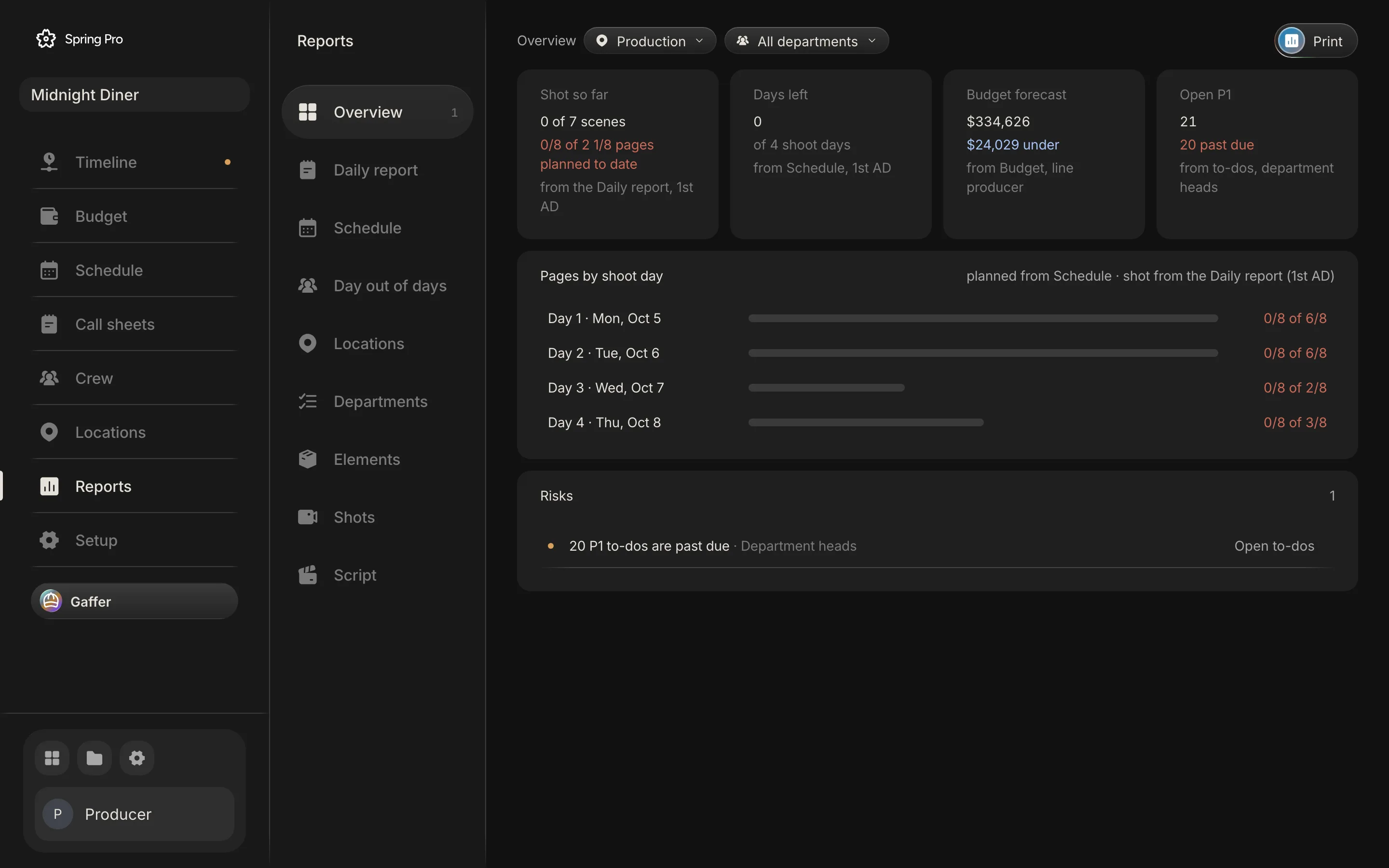
Real screen: Midnight Diner, our demo production, in Spring Pro.
The short answer. A day out of days report is a grid with cast down the side and shoot days across the top. Each cell shows whether an actor works that day: SW start work, W work, WF work finish, SWF one day only, H hold. It shows each actor's total days, holds and finish date.
The day out of days is the report that tells you who you are paying to wait. It is a small grid and one of the most useful pages in production. This is the real one for Midnight Diner, with what its holds cost set against what fixing them costs. It is one report inside film production scheduling, and it is built from the schedule in how to make a shooting schedule, using the cast listed per scene in the script breakdown.
In this guide 11 sections
The codes
Five codes cover almost everything. Some productions add more, for travel or rehearsal, and codes vary between productions, so check the key on the report you are handed. The glossary entry has the short definition.
- SW: start work, the actor's first day
- W: work, a day they are working
- WF: work finish, their last day
- SWF: start work finish, an actor who works one day only
- H: hold, a day between their first and last in which they do not work but are still paid
| Code | What it means | What to check |
|---|---|---|
| SW | The first day | The contract start date, travel, and the call time |
| W | A working day | Their call time and the scenes they are in |
| WF | The last day | The wrap, and the release date in the deal |
| SWF | A one-day actor | Book them tight and keep their scenes together |
| H | A hold | Whether it is paid, and whether they can take other work |
The real one, for Midnight Diner
The grid runs across the 4 shoot days that carry scenes. Each line is a character, the actor, and the codes for Days 1 to 4:
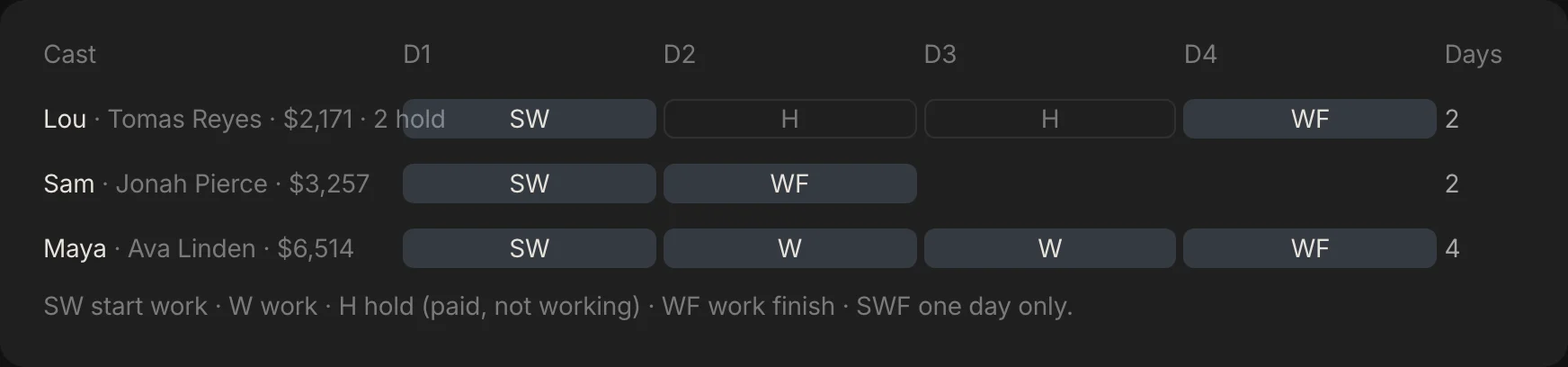
- Maya (Ava Linden): SW, W, W, WF. 4 days.
- Lou (Tomas Reyes): SW, H, H, WF. 2 days, 2 hold days.
- Sam (Jonah Pierce): SW, WF, -, -. 2 days.
Why the holds matter
Maya works every day: four days, no holds. Sam works Days 1 and 2 and is finished.
Lou is the interesting one. He works Day 1, waits Days 2 and 3, then works Day 4. Those two holds are days he cannot take other work and, depending on his deal, may be paid for.
If his deal pays holds, that is $1,600 at $800 a day. The fix is a schedule change, which is why you read this report while you can still move strips.
Four questions to ask of the grid
You do not read a day out of days top to bottom. You interrogate it.
- Who has holds, and how many? Any hold is money or a lost booking.
- Who works the first day, and who works the last? Those dates go in their contracts.
- Who works only one or two days? Book them tight, and keep their scenes together.
- Who works every day? They are your constraint. Everyone else is scheduled around them.
What moving one scene would do
Lou's scenes are 1 and 5. Scene 1 is on Day 1, with the diner. Scene 5 is the warehouse, on Day 4. Move that scene up to Day 2 and both of Lou's holds disappear.
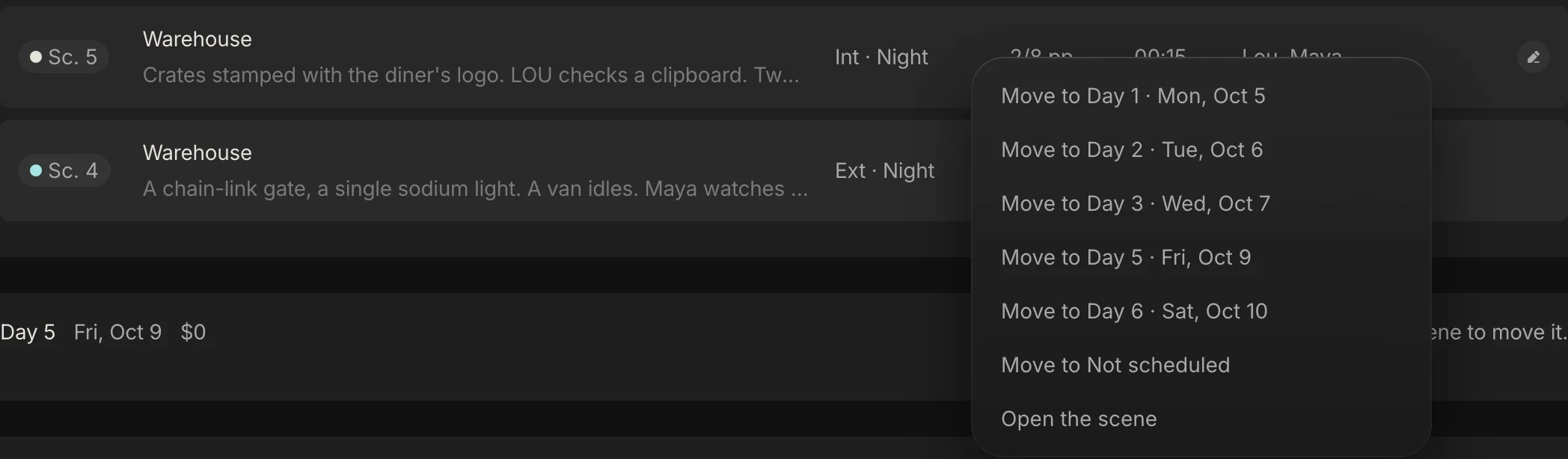
The cost is that Day 2 now has two sets, the rooftop and the warehouse, which is a company move, and it mixes day and night. The schedule flags both.
Day 4 is left with a single one-eighth scene. A change that fixes one report breaks another, and that is why you read them together.
What a hold costs against what a move costs
Tidying the report is not the goal. The goal is the cheaper problem, so put a price on both. A hold costs the actor's day rate. A company move costs hours, and an hour costs the whole crew.
| The choice | What it costs | How it is worked out |
|---|---|---|
| Pay the two holds | $1,600 | Lou's $800 day rate twice, if holds are paid |
| Move the scene and run one extra overtime hour on Day 2 | $2,851 | Overtime for the whole crew at 1.5 times, 18% fringes |
| The break-even | about 34 minutes | If the move makes Day 2 run longer than that, paying the holds is cheaper |
So the answer depends on the move. If the warehouse is next door and the day does not run over, the move wins. If it costs half an hour or more, pay the holds and keep the schedule simple. Both numbers come from the app's own cost engine, and the shooting schedule guide shows the calculator.
What to do about a hold
There are three honest options, and the report cannot choose between them for you:
- Move the actor's scenes closer together, which may split a location day
- Accept the hold and budget for it
- Release the actor and bring them back, if their agreement allows it
Whichever you choose, check the rest between days for the actor and the crew in turnaround and meal breaks, because a new order of days can create a short turnaround.
Do it in Spring Pro
In Spring Pro the day out of days is one of the reports and it is built from the schedule, so it is current the moment you move a strip. Each actor line also shows their name, what they cost across the schedule and how many holds they have.
Because the budget reads the same schedule, a changed hold shows up in the cost, not in a separate calculation. See shooting schedule software for the whole tool, and the call sheet software for the day each actor is called. You can start from the free schedule template.
How these numbers were made
Every number about Midnight Diner comes from the project, computed with Spring Pro's own schedule and budget engines. The planned day is 11 hours and overtime starts after hour 10 at 1.5 times. Whether a hold is paid depends on each actor's deal, so the costs above are for the case where it is. Midnight Diner is a demonstration production, not a case study of a real shoot.
Questions people ask
What does DOOD stand for?
DOOD stands for day out of days: a report that lists, for each cast member, the days they work and the days they do not.
What is a hold day?
A hold day is a day between an actor's first and last working days on which they do not work. They are usually still paid, so holds cost money.
When do you make a day out of days?
As soon as the schedule exists, and again after every change to it, because the schedule decides every actor's days. It is prepared after the shooting schedule, and the budget work follows from it.
Are hold days always paid?
A held actor is paid and a dropped actor is not, as Wikipedia describes, and there are union rules on when an actor can be dropped. What applies to your actor is in their deal, so check it before you count a hold as a cost or as free.
Can I make a day out of days in a spreadsheet?
Yes, for a short with a few actors. You have to rebuild it by hand after every change to the schedule, which is the part software saves. The free schedule template is a start.
How is a day out of days different from a stripboard?
The stripboard arranges scenes into days. The day out of days reads that arrangement and shows what it does to each actor.
Sources
Every outside claim that names a source comes from one of these, read on the date shown. Standard conventions, such as the eighths rule and the usual specialist cases, are common practice. Figures from agreements and summaries change at each negotiation, so check the current text before you rely on a number.
More about shooting schedule
A schedule is a labour bill. The cost of an error is paid in hours.
- Film production scheduling: the whole picture. The complete guide
- Scenes become strips. Strips become shoot days. The tool
- A film shooting schedule template, laid out as a stripboard.
- How to make a shooting schedule for a film, with a real sample.
- Turnaround and meal breaks on a film shoot: the rules and a calculator.
- One line schedule vs stripboard: the same four days, three ways.
- How to schedule a night shoot for film: the calls, the meals, the rest and the loadings.
- Film weather cover day: how to swap a rain day, with worked costs.
- Scheduling through script revisions: the colours, the routine and what each change costs.
- What is a stripboard?
- What is a day out of days?
- What is turnaround on a film set?