Filmmaking for beginners: how to make your first short film, step by step.
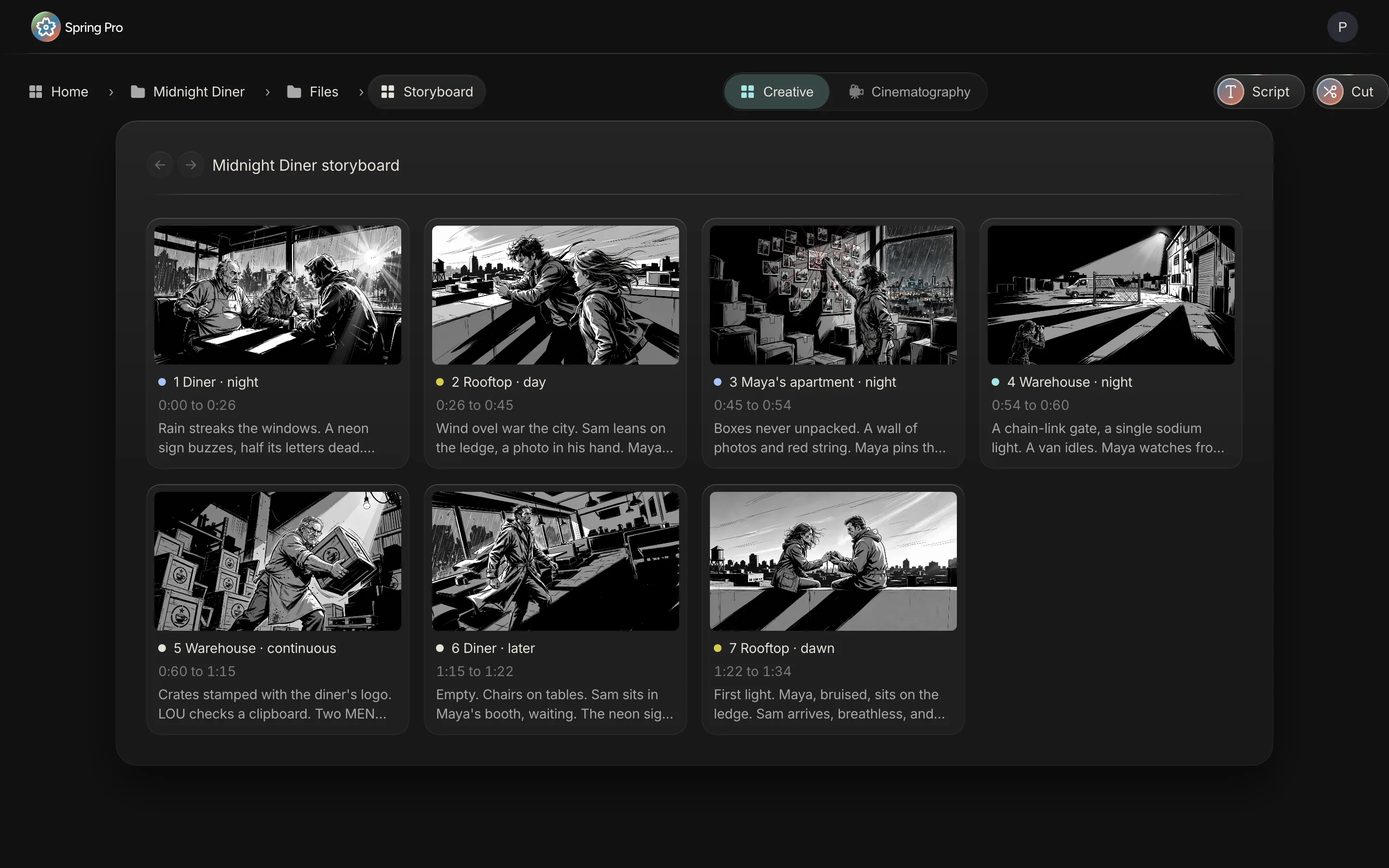
Real screen: Midnight Diner, our demo production, in Spring Pro.
The short answer. Start with a short script you can shoot in a day or two, then work in order: script, plan, shoot, edit. Spend on sound before the camera, staff the jobs rather than a headcount, group scenes by location where you can, and copy every card to two drives. A notebook and a spreadsheet can carry the schedule and budget.
You do not need much to start: a story you can shoot, a few people, clean sound and a plan. This page puts the skills in order. It says what to learn first, what to buy, who you need and which five mistakes are worth avoiding. It also gives the one planning-time rule of thumb we found, because no source gives a standard number. It links on to deeper guides for the planning skills. The examples come from Midnight Diner, a demonstration short film with 7 scenes, 2 1/8 pages and 4 shoot days. Its logline: A burned-out investigator uses herself as bait to expose the night diner owner running contraband off the river, and pulls her old partner back in. Spring Pro is one optional way to do the planning. A notebook and a spreadsheet can carry the schedule and budget of a first short, and the page says where a tool helps and where it does not.
In this guide 21 sections
- Quick answers
- Filmmaking 101: the five stages, in order
- Step 1: Start with a script you can shoot
- Step 2: Picture it, then plan it
- Step 3: Get the gear you need, in order
- Step 4: Get the people you need
- Five mistakes to avoid on a first short
- Mistake 1: No script, or one that is still moving
- Mistake 2: No plan for sound
- Mistake 3: Shooting in story order without counting the moves
- Mistake 4: No schedule
- Mistake 5: No backup
- How long does making a short film take to plan?
- Do you need software? A notebook, a spreadsheet or one tool
- Doing it in Spring Pro, one optional way
- From a first short to a bigger film: what changes
- The checklist
- Where to go next, one skill at a time
- How these numbers were made
- Questions people ask
- Sources
Quick answers
What are the stages of making a film? Wikipedia lists five: development (the idea and the screenplay), pre-production (hiring cast and crew, selecting locations, preparing the shoot), production (recording the footage), post-production (editing it into the finished film) and distribution. A first short does all five, in small.
What should I learn first? The script, then the plan, then sound, then the camera. That order is ours, and the sources below back its parts.
What do I need to buy? Less than you might think, in our order: clean sound, storage for two copies, the look of the film and the camera last. No Film School says money meant for a fancy camera may be better spent on audio, and Wolfcrow puts production design, locations, costumes and makeup ahead of the camera, and says to think about the camera only if money is left. We name no prices, because they change.
How many people do I need? Celtx, a software vendor, puts a very simple short at 5 to 7 crew, not counting actors, and an ambitious one at 10 to 15.
How long does a first short take to plan? We found no standard number. Wolfcrow says a short might need a few weeks, with planning getting at least a third of your total timeline.
Filmmaking 101: the five stages, in order
Wikipedia says film production typically consists of five major stages, and even a phone short can pass through all five in small. A mistake made early is paid for late, so most of this page is about the first two. The same article calls the process generally nonlinear: the filmmaker typically shoots the script out of sequence and puts the film together in the edit.
| Stage | What happens | What a first short needs from you |
|---|---|---|
| Development | The idea is made and the screenplay is written | A script short enough to shoot in a day or two, with one spelling for every name |
| Pre-production | Preparations for the shoot: cast, crew, locations | A breakdown, a schedule, a budget, people who said yes, places you may use, a sound plan, a backup plan |
| Production | The footage is recorded | One or two shoot days, a call sheet sent ahead of each, two copies of every card |
| Post-production | Pictures, sound and effects are edited and combined | An edit, built from what you recorded |
| Distribution | The film is released and screened | A runtime that fits where you want to send it: under 15 minutes for festivals |
Step 1: Start with a script you can shoot
Start with something you care about, not with the camera. Wolfcrow's guide says to pick something you are passionate or curious about and put it in words. Write a script, and do not worry about Hollywood formatting yet: the script is what gets actors and film professionals interested.
Then rewrite it until you cannot improve it, and show it to people who understand scripts. Keep the film short: under 15 minutes if you want to send it to festivals, and a longer film costs more.
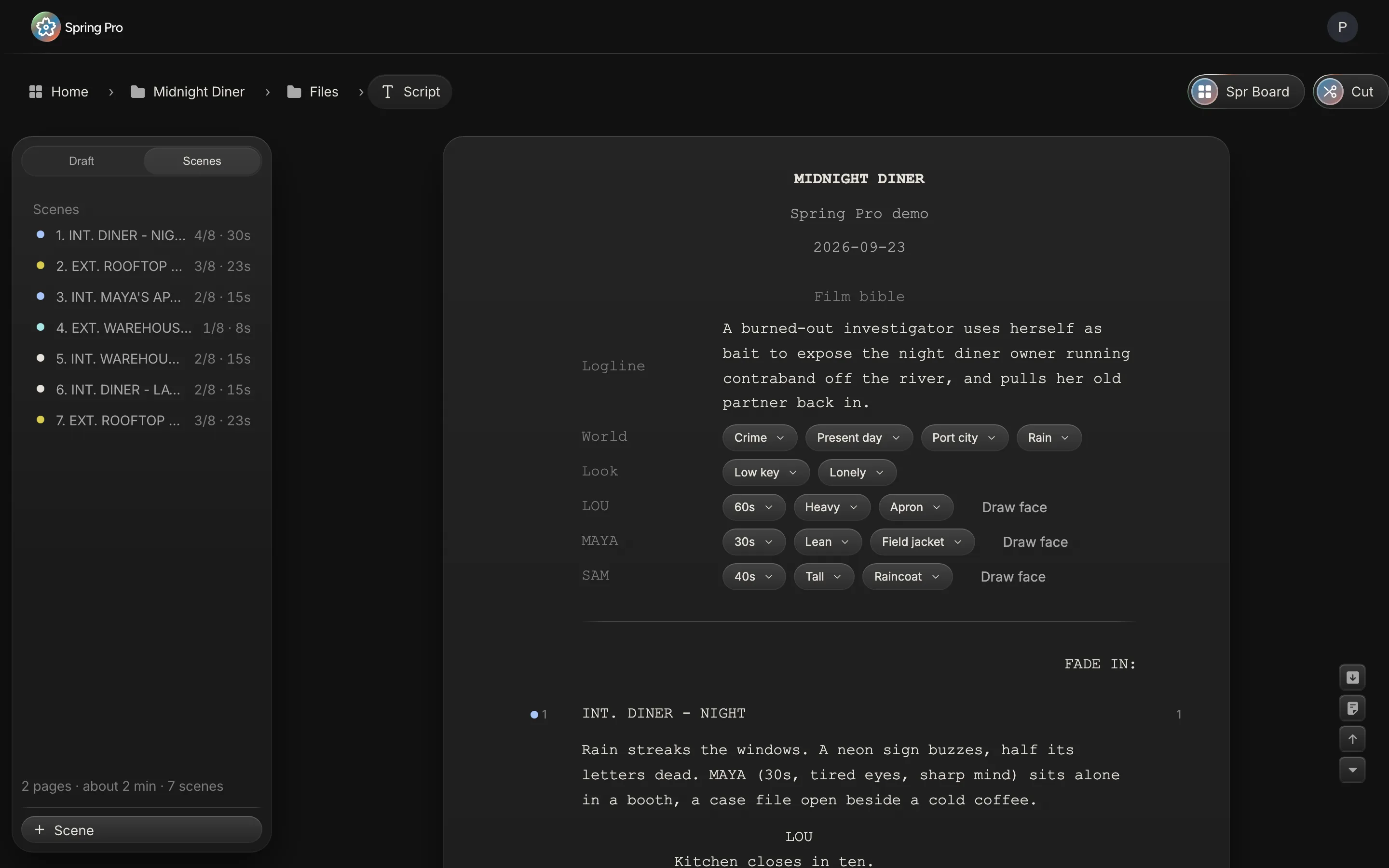
Pages are only a rough guide to minutes. Stephen Follows measured 2,520 feature scripts: one page averaged about 55 seconds, and only 18.2% of scripts came within 5% of a page a minute. Count your places and speaking parts too: in our view they shape the shoot more than pages do.
Midnight Diner shows the gap between pages and days. Its script is 2 1/8 pages with 7 scenes, 4 places and 3 speaking parts, and its schedule runs to 4 shoot days. The pages are few. The film still has rain rigs, night work and four places to cover.
Format matters once you plan, because a schedule sorts by what a scene heading says. The script eighths entry explains how a scene is sized.
Step 2: Picture it, then plan it
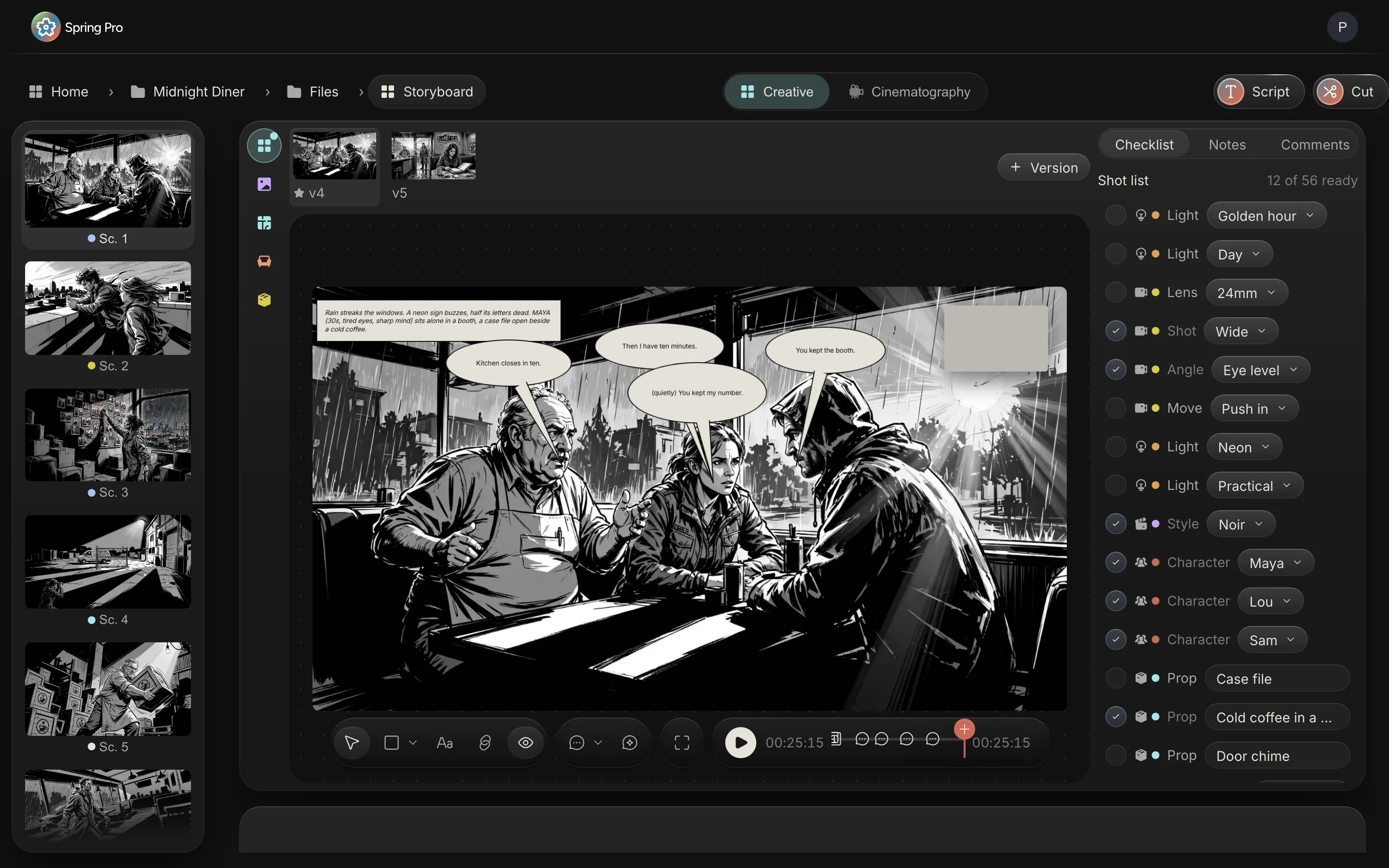
Before you book anyone, see the film. A storyboard is one drawing per scene, and a shot list says how each scene is filmed: shot size, angle, lens, move and light. Our view: stick figures on paper are enough, and they are cheap to change.
In Spring Pro each scene gets a frame with its dialogue in balloons, and a shot list picked from the standard choices. See storyboard software, or use the shot list template to start in a spreadsheet.
Then plan. StudioBinder, a software vendor, says the plan starts as three documents: the screenplay, the schedule and the budget, and that on a short you might be wearing all of those hats. Between the script and the schedule sits the breakdown, a list of what each scene needs.
Learn the breakdown first, because the schedule and the budget both read it: how to do a script breakdown, then how to make a shooting schedule, then how to budget a short film.
Count the work before you plan the time. Midnight Diner's breakdown holds 84 elements in 12 categories across 7 scenes, which is 12 a scene, and 90 department to-dos. That film has rain towers, a crane and stunts, so a quiet two-person scene will have far fewer.
Step 3: Get the gear you need, in order
Gear is easy to spend on and hard to choose. No Film School suggests putting audio ahead of a pricey camera, and Wolfcrow puts the camera after the money for the look of the film. The order below is ours. We name no prices, because they change by country and by month.
| Order | What | Why |
|---|---|---|
| 1 | A way to record dialogue clean: a microphone you can hold close to the actors, and headphones | No Film School ranks sound above picture and says a boom microphone helps. Celtx says the camera microphone is not a plan. Headphones are our addition |
| 2 | Storage: two drives, and enough cards that none is reused before it is checked | Larry Jordan copies each card to two separate storage systems and checks both before the card is reused. Spare cards are our addition |
| 3 | Costume, makeup and a location that looks right | Wolfcrow puts production design, locations, costumes, and hair and makeup ahead of the camera, because they are what the audience sees and judges |
| 4 | Light you can control, or the sense to use the light you have | No Film School lists lighting among the main things that give a film a cinematic look, and says many beginners neglect it |
| 5 | A camera: the one you have | Wolfcrow: think about the camera only once the other money is spent. No Film School: with no gear, start with a phone |
The rows draw on No Film School's mistakes list and beginner tips, Celtx, Larry Jordan and Wolfcrow. Our view: if you can only afford one thing on the list, make it the first.
Step 4: Get the people you need
A crew is a set of jobs, not a number of people. Film at Yale, a Yale student film guide, lists the usual roles and says that on low-budget student films the line producer's tasks may be split between the producer and the production assistant. Celtx puts a very simple short at 5 to 7 crew, not counting actors, and an ambitious one at 10 to 15. It says people can double up, but not in jobs that need full attention at the same time.
Celtx also says you need a sound recordist if anyone speaks, and that if you cannot afford a script supervisor, someone should be assigned to track props, wardrobe, blocking, eyelines and takes.
| Job | What it covers | On a small crew |
|---|---|---|
| Director | Visualises the script, directs the actors, makes the creative calls | May also help with props, wardrobe and the shot list |
| Producer | Resources, locations, schedules, permissions | May also do locations |
| Director of photography | Frames, lighting approach, visual style | Often operates the camera too |
| Sound recordist | Prepares and runs the equipment that captures sound | Recordist and boom operator may be one person |
| 1st assistant director | Keeps the day moving and runs the set | May be left out of a very simple shoot |
| Script supervisor | Continuity: props, wardrobe, eyelines, takes | Someone is assigned if you cannot afford one |
| Production assistant | Helps with everything, from kit to paperwork | Someone will always need something |
| Art, costume, hair and makeup | The look of the world and of each character | Added when the story needs them |
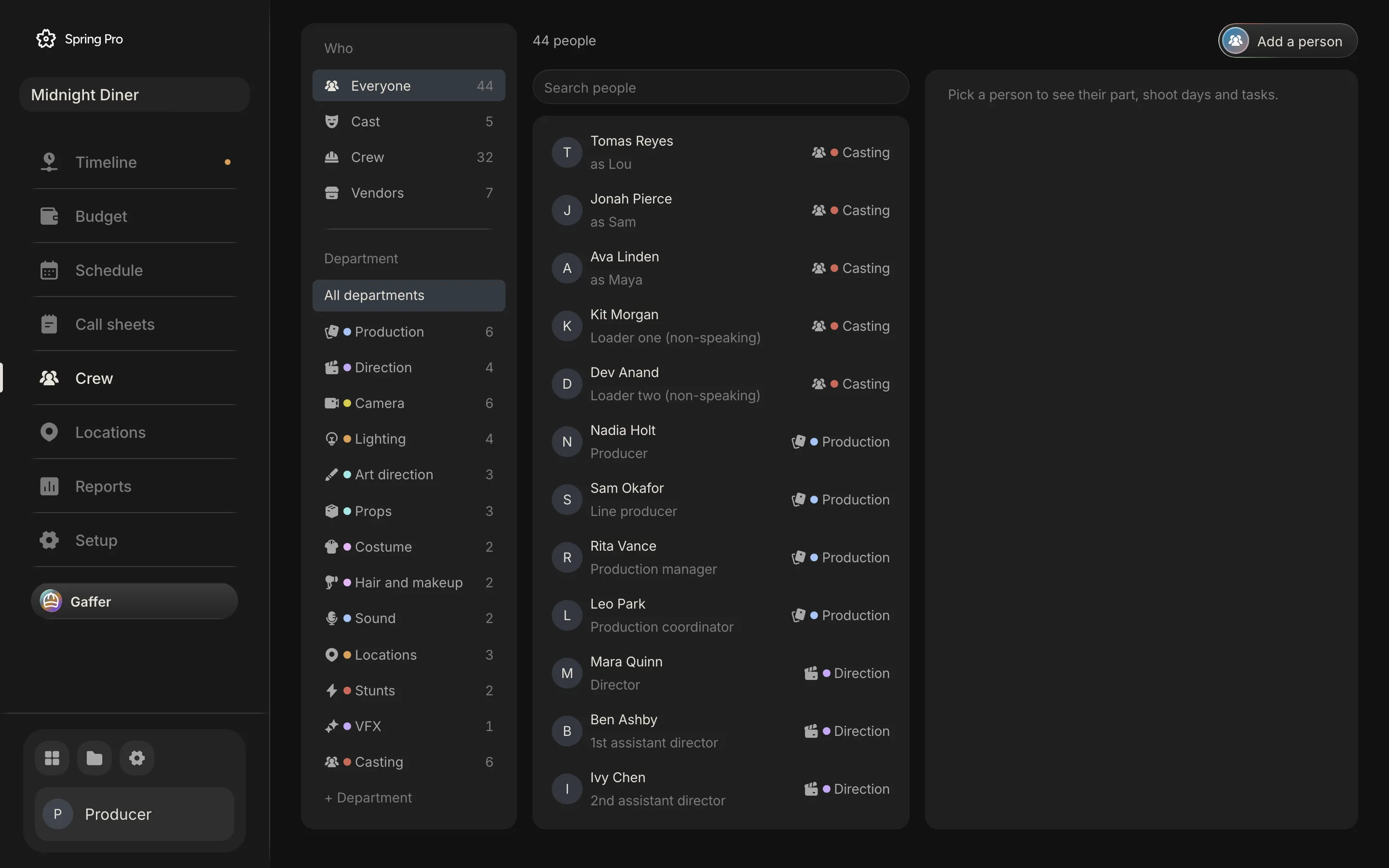
Midnight Diner's list is the other end of the scale: 32 crew in 13 departments, where Celtx calls 25 to 100 or more a standard production crew. Each department is a job a small crew must cover or do without. The jobs meet the day on the call sheet: see how to make a call sheet.
Five mistakes to avoid on a first short
These five are our pick, chosen from what the guides we read cover. No source ranks mistakes by how often they happen, and we found no survey of first shorts, so read the list as advice, not a measurement. Each section has what goes wrong, a real example from Midnight Diner and the fix.
- No script, or one still moving. Every other document rests on it.
- No plan for sound. Dialogue you may not be able to use, and a hard fix later.
- Shooting in story order without counting the moves. Every change of place costs the crew time.
- No schedule. Nobody knows who is needed when.
- No backup. One lost card can take a scene with it.
Mistake 1: No script, or one that is still moving
Everything rests on the script, so a script that is not finished moves every other document. Wolfcrow says you need a locked script before pre-production begins, and that the rewrites which happen anyway belong in the planning time. No Film School, writing up one filmmaker's video, lists an underdeveloped story among ten mistakes and says it should be number one.
Locking has a practical meaning. StudioBinder says to audit the script, then lock it, so that what is on page 4 stays on page 4 however much you add later. Its example is a character whose name was written three ways, which the software counted as three characters.
Midnight Diner's whole plan, from the schedule to the budget, is read from a script of 2 1/8 pages: 7 scenes, 4 places and 3 speaking parts. One spelling per name and one heading per scene, with the place and the time of day in it, are what make that work.
- Write until you cannot improve it, then show it to someone who reads scripts.
- Lock it before you plan, and note what each later change touches.
- Size it for your means. No Film School's advice is to stick to films within them.
Mistake 2: No plan for sound
No Film School says experienced filmmakers rank sound above picture. Its beginner tips add that noise can wreck sound, so solve it or pick a quieter location, and use a boom. Celtx frames it as a trade the audience makes: a picture that is a little off is forgiven faster than speech they cannot make out.
A plan for sound means reading each scene for what you will hear. Midnight Diner's breakdown lists 7 sound elements across 6 of its 7 scenes: a neon buzz and rain on glass in scene 1, city wind in scene 2, traffic through the window in scene 3, an idling van in scene 4, breaking glass in scene 5 and a phone tone in scene 6. It also has 7 sound to-dos, such as killing the fridge hum in the diner.
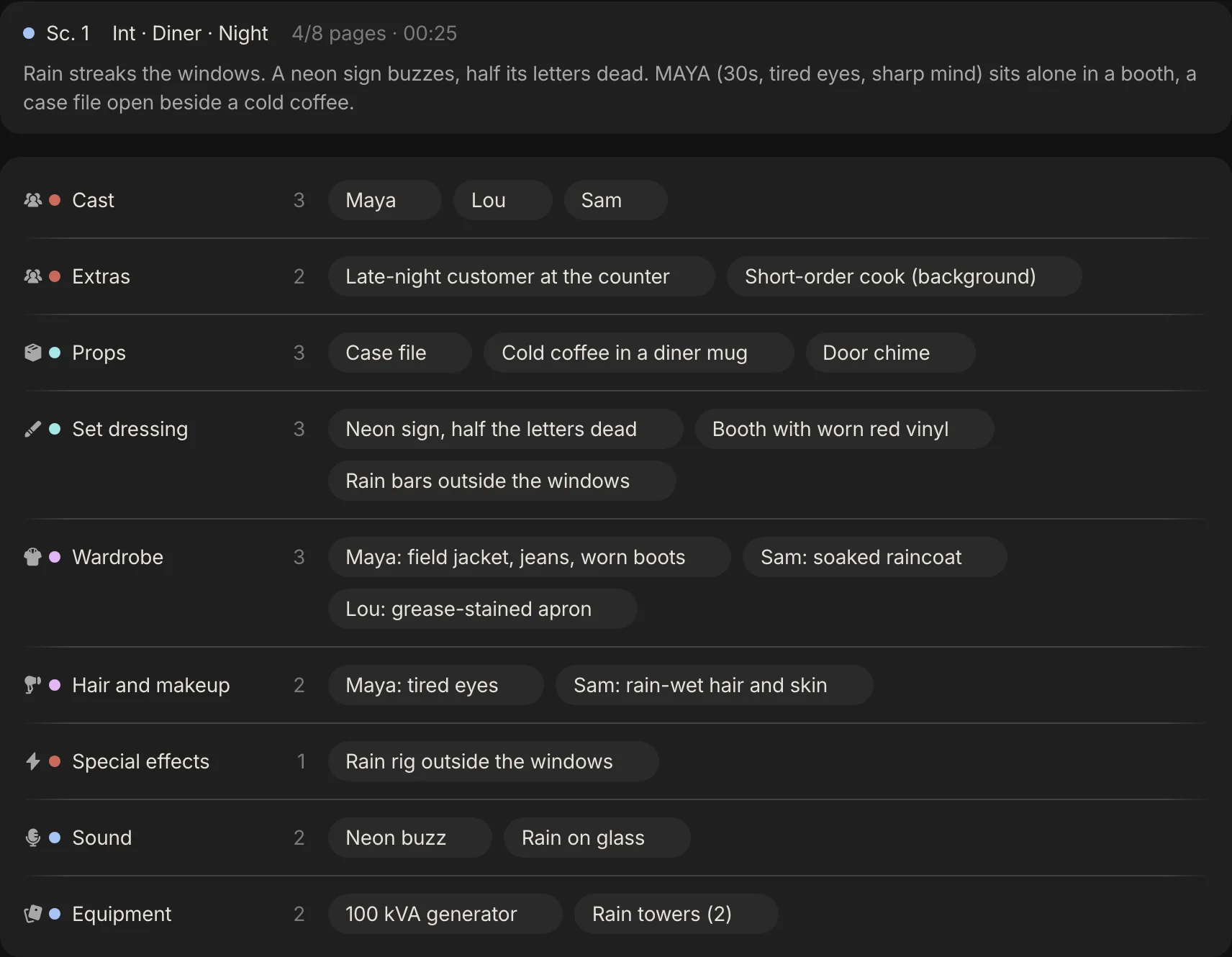
Room tone is the sound of a place with no one speaking. Wikipedia says it is intercut with dialogue to smooth out edit points, and is normally recorded with the microphone in the same position as for the dialogue. The apartment to-do asks for it twice, windows closed and open, which fits scene 3's traffic through the window.
- Listen at each location, at the time of day you will shoot.
- Write each scene's sounds into its breakdown: sound is one of the twelve categories in how to do a script breakdown.
- Give one person the job of sound, with headphones, and record room tone at every location before you leave it.
- Protect the microphone outdoors: the rooftop to-do asks for wind protection and lavalier microphones for both actors.
Mistake 3: Shooting in story order without counting the moves
Shooting in story order feels natural, and some directors choose it. The cost, once a story has more than one place, is moving the whole crew each time it changes. Wikipedia says filmmakers typically shoot the script out of sequence. No Film School gives the reason: grouping scenes by location can speed a shoot up, and every move between places during a day eats into it.
Count it on a real script. Midnight Diner has 7 scenes in 4 places. In script order the crew would go to the diner, the rooftop, Maya's apartment, the warehouse, the diner again and the rooftop again, which is 6 visits and 5 moves. Grouped by place, the schedule has 4 shoot days with one place each: the diner on Day 1 (scenes 1 and 6), the rooftop on Day 2 (scenes 2 and 7), the apartment on Day 3 (scene 3) and the warehouse on Day 4 (scenes 4 and 5).
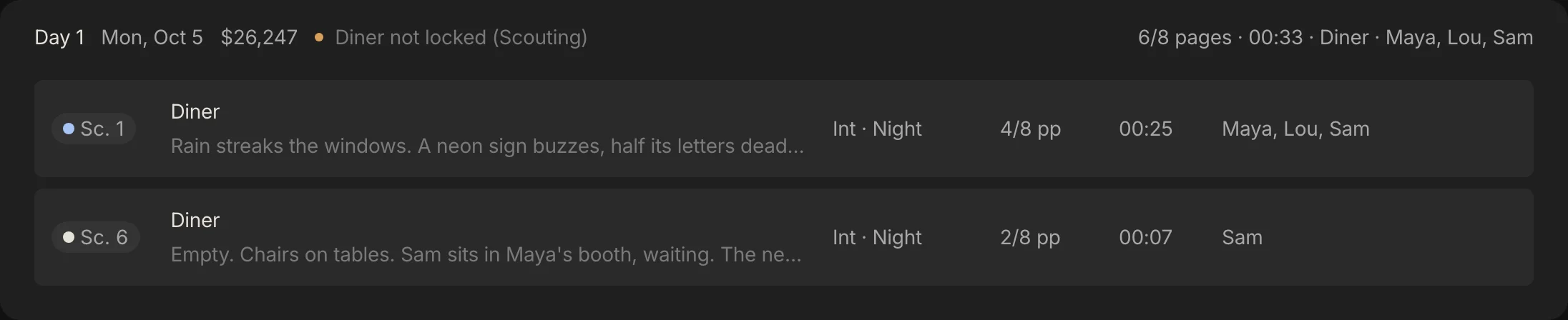
Going out of order has its own cost, and it is continuity. Scene 7 is the last scene of the film and shoots on Day 2. The to-do for Maya's bruise make-up in scene 7 points back to scene 5 for continuity, and scene 5 does not shoot until Day 4. So a look has to be matched to a scene that has not been filmed yet.
The fix is a continuity list and photographs. Midnight Diner's to-dos include continuity photos of Maya's tired-eyes look in scene 1 and bruise test photos signed off by the director. Celtx advises someone to track props, wardrobe, blocking, eyelines and takes, and how to do a script breakdown works through the check across scenes.
Mistake 4: No schedule
A schedule says which scenes shoot on which day, who is needed and how long the day is, and without it you cannot write a call sheet or a budget. StudioBinder counts it as one of the plan's three documents. No Film School says a notepad or a spreadsheet will do, and adds rules: avoid seven-day weeks, add extra time to every day, and keep spare days at the end for pickups or reshoots.
Pages are not days. Midnight Diner has 2 1/8 pages and is scheduled over 4 shoot days, about half a page a day, with rain rigs, night work, a crane and stunts in the mix. The same No Film School article says a major studio might get through about one page a day and an independent production could aim for five. What is in the pages sets the pace, not the count.
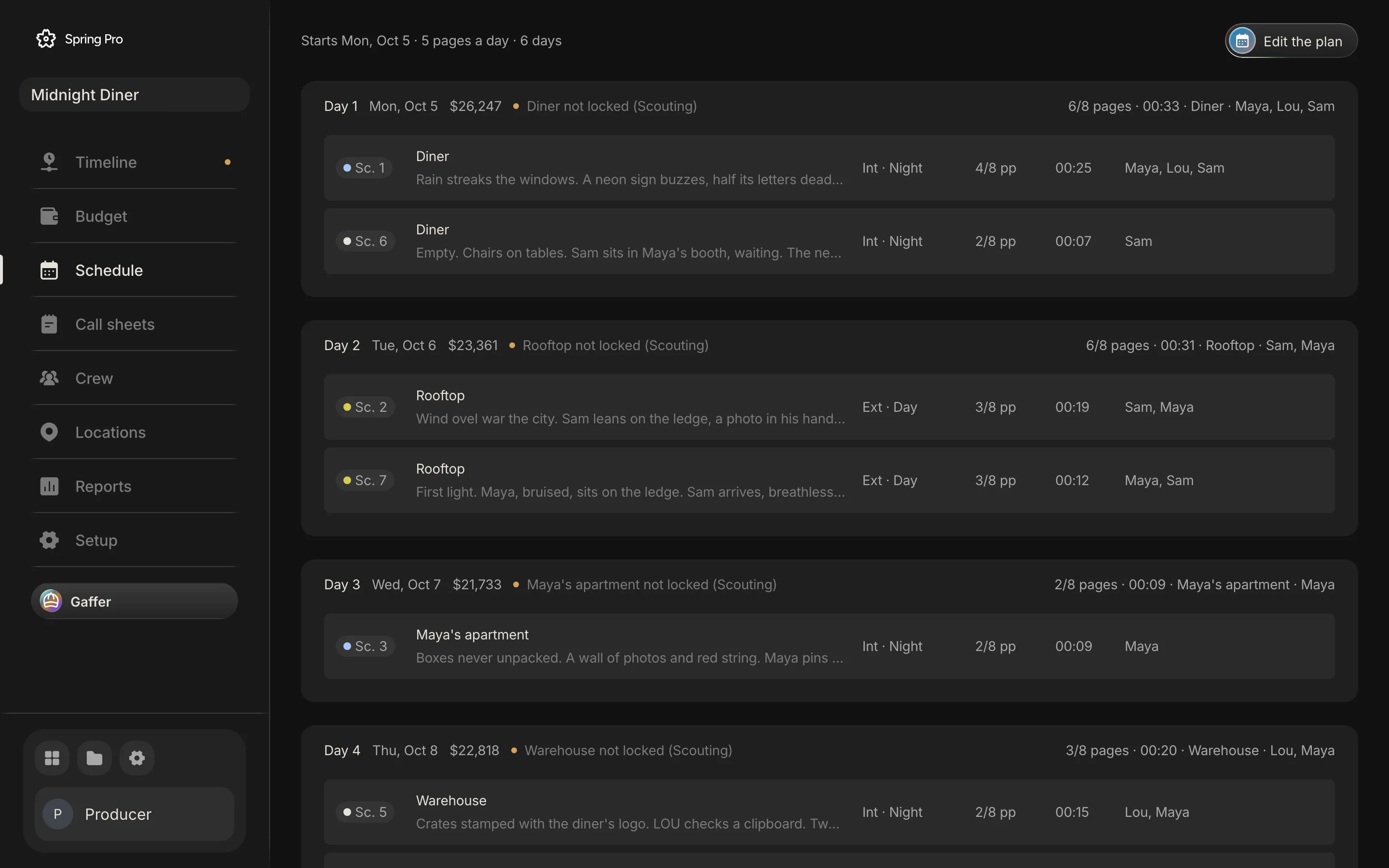
Hours cost money when people are paid. On Day 1 of Midnight Diner one extra hour of crew and cast labour is $2,993, on its rules of an 11-hour planned day with overtime after hour 10. If your crew is unpaid, the cost is goodwill and daylight, and both run out.
Put every scene on a dated day, grouped by place and by day or night, with a buffer. Ask for everyone's availability early: No Film School notes that on a low-budget film it is unlikely everyone will be available every day. Then build the call sheet from the schedule, not from memory. The film schedule template is the spreadsheet version.
Mistake 5: No backup
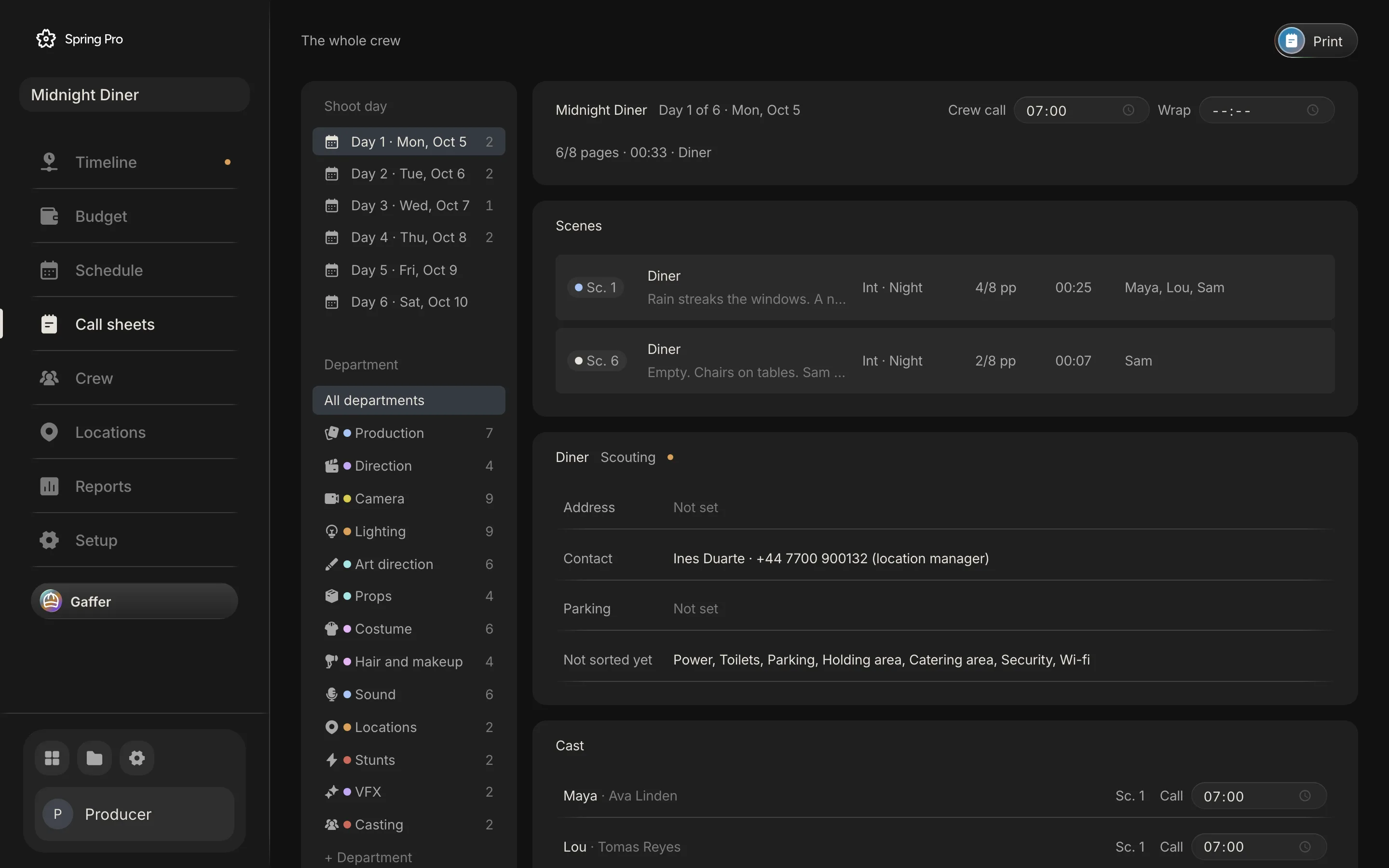
A card that fails or is formatted too early takes the scene with it. Larry Jordan's 3-2-1 rule is three copies of your data on two types of media, with one copy stored off site. On set he says one person should have backing up the camera cards as their top priority: copy each card's whole contents into its own folder on two separate storage systems, check both copies, and only then reformat the card. His argument is that extra storage is cheap next to reshooting what went missing.
Celtx says to add a data wrangler if losing the footage would be catastrophic. Our view: on a first short that is one person with a laptop, two drives and a checklist, and a rule that nobody reformats a card until they say so.
Midnight Diner budgets for the kit but not for the routine. Its budget has an account for it, Media and DIT (a DIT is a digital imaging technician, a camera department job that includes managing the footage workflow), described in the app as cards, drives and data. The account has one line, drives and cards, at $1,800 of $358,654, about half of one percent. The gap is in the people and the plan: none of its 90 to-dos is about backing up footage, and its crew list of 32 has no data wrangler or DIT.
Spring Pro does not run the card copies on set, so that routine is yours.
- One person owns the cards, and it is their first priority.
- Copy to two drives, check both, then reformat the card.
- Keep a third copy off site.
How long does making a short film take to plan?
We found no standard number for a first short, so here is what the sources say and how to work out your own.
| Question | What the sources say |
|---|---|
| How long is planning? | Wolfcrow: a short film might need a few weeks, a feature several months or a year |
| How much of the project? | Wolfcrow: at least one third of the total timeline, as a rule of thumb |
| When is the script done? | Wolfcrow: locked before pre-production begins, with later rewrites counted in the planning time |
| How long is the shoot? | StudioBinder: 1 to 2 days is typical for a short, and 3 to 5 is luxurious |
| How much spare money? | StudioBinder: a 10% buffer between what you expect to spend and the money you have available. Midnight Diner uses a 10% contingency rule too |
To work out your own, pick the date you want the film finished and count the weeks from today. Keep a third of them, at least, for planning: 12 weeks gives you 4. That is arithmetic on one author's rule of thumb, not a measurement, so treat it as a floor.
Then work back from the shoot date. Our view: a workable order is a locked script, the breakdown, schedule and budget together, people, places and permissions, the sound and backup plans with a check of every booking, and the call sheet ahead of the shoot day. Wolfcrow says the steps overlap, and ends with a re-check of everything. How to make a call sheet covers when to send the sheet.
What we cannot tell you is how many hours a first short takes. Nobody we read measured it, and a film with one place and two actors is a different job from Midnight Diner.
Do you need software? A notebook, a spreadsheet or one tool
No, not to start. A notebook can hold the plan for one person and a day. For the schedule and the budget, a spreadsheet per document can carry a few scenes: Wolfcrow says its author has finished two features and many smaller films using only spreadsheets for scheduling and budgeting, and No Film School says a notepad or a spreadsheet will do for a schedule. The templates are those sheets laid out with Midnight Diner's rows filled in: script breakdown, film schedule, call sheet, film budget and shot list.
| Way of working | Good for | When a scene changes you must |
|---|---|---|
| A notebook and printed sheets | One person, a day or two, one place | Rewrite the pages that changed and tell everyone |
| One spreadsheet per document | A short with a few scenes and a few people | Update each sheet by hand and check they still agree |
| A planning tool where the documents read the same scenes (Spring Pro is one) | A script that keeps changing, and several people reading the plan | Edit the scene. The schedule, call sheets and budget read it, and you still pick the elements by hand |
Our rule of thumb: start on paper, and switch when you type the same fact into a third place. StudioBinder and Celtx are tools too, and both publish guides we cite here, so read their advice as a vendor's. For a comparison, see the StudioBinder alternative page.
Doing it in Spring Pro, one optional way
Spring Pro is one project where the script, storyboard, breakdown, schedule, call sheets, crew and locations lists and budget all read the same scenes. It runs in a web browser with nothing to install.
- Script, board and shot list: each scene is sized in eighths of a page as you write, gets a storyboard frame with its dialogue in balloons, and has a shot list. Final Draft and Fountain files import.
- Breakdown: 12 categories to fill on each scene (the sheet shows the ones a scene uses), and to-dos with a department, a priority from 1 to 3, a due date and an owner. See script breakdown software.
- Schedule and call sheets: plan the shoot builds a first schedule by set and by day or night, each dated day shows its pages, cast, warnings and planned cost, and each day's call sheet fills in from it and prints. See shooting schedule software and call sheet software.
- Budget: built from the crew's deals and the schedule. See production budget software.
- Gaffer: an assistant that reads the whole project and answers with real names and numbers. It changes nothing unless you ask, and one undo reverts what it did.
What it does not do: copy or check your camera cards on set, run payroll, email call sheets (they print) or put several units or episodes in one schedule. There is no tag-the-script button, so you pick each scene's elements, or ask Gaffer to add them and check its work. Recording every camera on set is coming, not here. If a notebook and a spreadsheet work for you, keep using them.
From a first short to a bigger film: what changes
The method does not change with size. What grows is the number of people and the cost of a miss. The crew sizes are Celtx's, a vendor's rough guide and not a standard.
| Size | Crew (Celtx) | What changes |
|---|---|---|
| A very simple short | 5 to 7, not counting actors | Everyone doubles up, and sound and continuity still need an owner |
| A more ambitious short | 10 to 15 | Celtx says this size is more realistic for several locations, several actors or a stylised look |
| A small indie film | 10 to 20 | Roles separate: production manager, 1st AD, script supervisor, gaffer, sound recordist, boom operator |
| A standard production | 25 to 100 or more | More coordination: meals, paperwork, transport, communication |
| Midnight Diner (a sample) | 32 crew in 13 departments, plus 5 cast and 7 vendors | Rain rigs, a crane, stunts and night work in 4 days. Bigger than a first short needs |
For the next step up, film production scheduling covers a schedule at every size, and how to budget a short film covers the money.
The checklist
Copy this. Tick it before you shoot.
- The script is rewritten, read by someone who reads scripts, and locked
- Every name has one spelling and every scene has one heading
- Each scene's needs are listed, including what you will hear
- Every scene is on a dated day, grouped by place and by light, with a buffer
- Cast and crew availability is confirmed, and you have permission for every place
- Someone owns each job: sound, continuity, the schedule and the backup
- The sound plan is written: microphone, headphones, wind protection and room tone at each location
- You have storage for two copies of every card, and a person to make them
- Batteries are charged, the gear is counted, the permits are final and the weather is checked, the basics on No Film School's preparation list
- The call sheet is ready to go out ahead of the shoot day (the timing varies by source: see how to make a call sheet)
Where to go next, one skill at a time
This page is the first step of a path from script to shoot day. The guides below use the same real production, Midnight Diner.
- The script and its scenes: script eighths explains how a scene is sized.
- Picture it: storyboard software and the shot list template.
- List what each scene needs: how to do a script breakdown.
- Put scenes on days: how to make a shooting schedule, film production scheduling and the stripboard entry.
- Who is needed and when: day out of days, turnaround and meal breaks and how to make a call sheet.
- Money: how to budget a short film and the film budget template.
- The shoot day: the daily production report entry explains what to report each day.
- All of it: the templates, guides and glossary.
How these numbers were made
Every number about Midnight Diner is computed from the project's own data, and the build stops if the project changes so that the story no longer holds. The cost of an hour uses Spring Pro's cost engine with a planned 11-hour day and covers crew and cast labour only.
Midnight Diner is a demonstration production, not a case study of a real first short, and its 44 people and $358,654 budget are bigger than a first short needs. The five mistakes are our pick. No source gives a standard planning time for a first short, so we do not give one.
The outside facts come from the sources below, read on 2026-10-12. StudioBinder and Celtx are software vendors, Wolfcrow is a film education site that sells courses, and No Film School's two articles are write-ups of single filmmakers' videos.
Questions people ask
How do I start filmmaking as a beginner?
Write a short script you can shoot in a day or two, then plan it before you book anyone. Wolfcrow starts with something you care about and a script, not the camera. How to do a script breakdown is the first planning step.
What is filmmaking 101?
The five stages in order: development, pre-production, production, post-production and distribution, as Wikipedia lists them. For a beginner in film making the first two matter most, because the script and the plan decide the shoot.
How do I make a short film with no budget?
Choose a story you can shoot in one or two places with a few people, and put what you have into sound, location, costume and makeup before the camera. No Film School advises sticking to films within your means, and Wolfcrow says to get creative when money is short.
How many people do you need to make a short film?
Celtx puts a very simple short at 5 to 7 crew, not counting actors, and an ambitious one at 10 to 15. Sound is the job it says not to skip.
How long should a short film be?
Wolfcrow says under 15 minutes if you want to send it to festivals, and that a longer film costs more. A page is roughly a minute, but Follows's study found about 55 seconds a page across feature scripts.
How long does making a short film take?
No source we read gives a standard number. StudioBinder calls a shoot of 1 to 2 days typical for a short, and Wolfcrow's rule of thumb is to give planning at least a third of the total timeline.
Do you have to shoot a film in order?
No. Wikipedia says filmmakers typically shoot the script out of sequence, and No Film School says grouping scenes by location can make a shoot go faster. The cost is continuity, so keep a list of each look. See how to make a shooting schedule.
How do I back up footage on set?
Copy each card to two separate storage systems, such as two drives, check both, and only then reformat the card, as Larry Jordan describes. Keep a third copy off site, and give one person the job.
Sources
Every outside claim that names a source comes from one of these, read on the date shown. Standard conventions, such as the eighths rule and the usual specialist cases, are common practice. Figures from agreements and summaries change at each negotiation, so check the current text before you rely on a number.
- Wikipedia, filmmaking (the five production stages). Checked 2026-10-12.
- Wikipedia, room tone. Checked 2026-10-12.
- StudioBinder, making a short film: pre-production workflow step by step, by Arnon Shorr (April 2025; a software vendor). Checked 2026-10-12.
- Wolfcrow, how to make a short film for beginners, by Sareesh Sudhakaran (a film education site that sells courses; latest date on the page October 2024). Checked 2026-10-12.
- Wolfcrow, a quick guide to planning your pre-production schedule, by Sareesh Sudhakaran (a film education site that sells courses; latest date on the page June 2025). Checked 2026-10-12.
- Celtx, how big does your film crew need to be, by Natasha Stares (May 2026; a software vendor). Checked 2026-10-12.
- Film at Yale, production roles (a Yale student film resource, written for student films). Checked 2026-10-12.
- No Film School, 10 common mistakes made by new filmmakers, by V Renée, a write-up of a video by Marina Bruno of Indy Mogul (February 2017). Checked 2026-10-12.
- No Film School, 8 things new filmmakers should learn before making their first film, by V Renée, a write-up of a video by Sebastian Solberg (December 2016). Checked 2026-10-12.
- No Film School, how to design your film's shooting schedule, by Amy Clarke (November 2020). Checked 2026-10-12.
- Larry Jordan, 3-2-1 backup strategy (June 2020). Checked 2026-10-12.
- Wikipedia, digital imaging technician. Checked 2026-10-12.
- Stephen Follows, does one page of a screenplay really equal one minute of screen time? (a study of 2,520 feature scripts, March 2026). Checked 2026-10-12.
More about making a film, start to finish
A beginner or an independent filmmaker needs the whole path in order, and a way into each stage.