How to schedule a night shoot for film: the calls, the meals, the rest and the loadings.
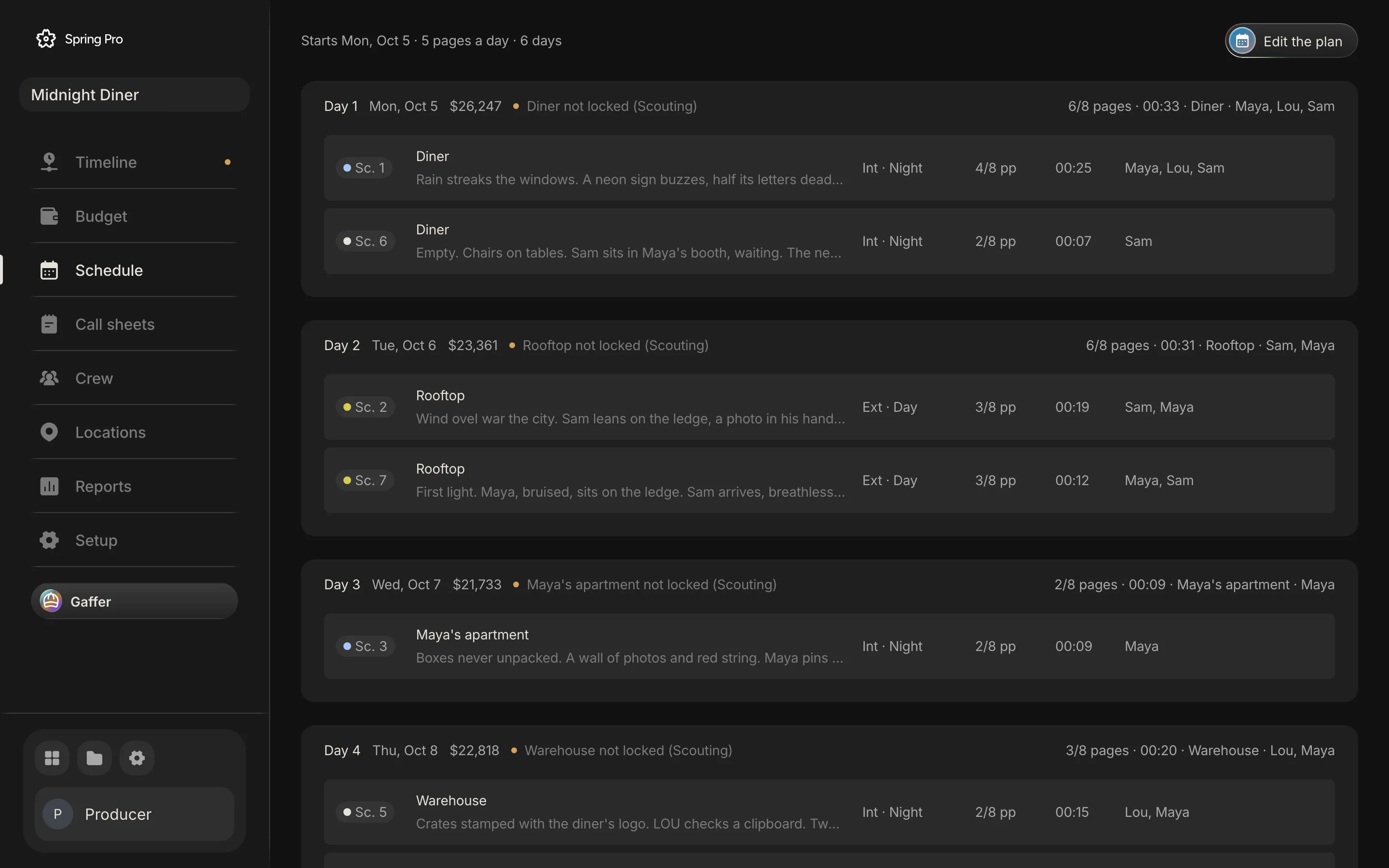
Real screen: Midnight Diner, our demo production, in Spring Pro.
The short answer. To schedule a night shoot, call the crew in the afternoon so the set is ready when the light goes, plan the first meal five or six hours in, and add your agreement's rest to the wrap to find the earliest legal call on the next day. Keep the nights in one block with a rest day after, and check whether night hours are loaded.
A night shoot looks like an ordinary schedule with later times, and that is the mistake. The call, the meals, the rest after the wrap and the pay all move with the clock, and the schedule's own warnings check none of them. This guide works a night out on a real production, Midnight Diner: three night days, a dawn scene, the earliest legal call for each pair of days and what the loadings add. The numbers come from the project and the rules come from sources read and dated below, most of them summaries.
In this guide 22 sections
- Quick answers
- Why a night day is a different kind of day, and where it goes wrong
- The film we are scheduling
- Before you start
- Step 1: Mark which scenes must be night
- Step 2: Set the call, and count the hours across midnight
- Step 3: Find the earliest legal call after each night
- Step 4: Keep the nights in one block
- Step 5: Plan the meal at night
- Step 6: Plan the dawn window
- Step 7: Price the night
- What the night adds on Midnight Diner
- When the night is a Friday
- Step 8: Get everyone home, and keep the neighbours
- Step 9: Put it on the call sheet, and send it before the night starts
- How people schedule nights today, and what breaks when a night moves
- From a short to a feature: what changes
- Doing it in Spring Pro
- The checklist
- How these numbers were made
- Questions people ask
- Sources
Quick answers
What call time does a night day have? One that has the set ready as the light goes. The worked day calls at 17:00 for 11 hours and wraps at 04:00. Those times are illustrative, because your sunset and your rig decide yours.
When is the meal? The Australian summary puts the first meal no later than 5 hours into the work session, or 6 by agreement, and US practice is about 6 hours from call. On a 17:00 call that is between 22:00 and 23:00.
How much rest after a night day? Your agreement sets it. The IATSE 2021 summary and the Australian summary both say 10 hours between consecutive days (the IATSE summary gives 9 to Distant Hires), so a day that starts Monday at 17:00 and wraps at 04:00 on Tuesday has an earliest legal call of 14:00 on Tuesday. The turnaround guide has the rules.
Do night hours cost more? In the Australian summary they do: a 25% loading from 8pm to 6am on Monday to Friday nights, and more at weekends. The IATSE summary and memorandum we read do not mention a night loading, so read your own agreement.
Does Spring Pro check any of this? Not on the schedule. It files each scene as night or day and flags a day that mixes them, but nothing there checks rest, meals or loadings. Gaffer, the assistant, applies a rule of thumb for rest and meals when you ask, which is guidance, not a check.
Why a night day is a different kind of day, and where it goes wrong
A night day is not a day shifted by ten hours. Every rule that hangs on the clock moves with it: when the first meal falls due, when the next call can be, which hours are loaded and how much dark is left. Miss one and the cost turns up in somebody's pay or on somebody's drive home.
The night guides we read leave out the arithmetic on a real schedule, which this guide works out. StudioBinder's night shoot guide, a competitor's, gives 14 tips. One says a make-up artist may charge double for night shifts, but in what we read it gives no rest hours, meal times or loading rates from an agreement. Its list of scheduling mistakes says SAG and the crew unions must have a 12-hour turnaround, where the two crew agreement summaries we read, one Australian and one IATSE, say 10, and we did not read a SAG agreement.
| What changes | Why | What a miss does |
|---|---|---|
| The call | The day starts in the afternoon and wraps in the small hours | A morning call leaves a crew on set with nothing to light |
| The meal | The first meal falls due in the evening, and a second can fall in the small hours | A late meal is paid per person |
| The rest | The wrap is late, so the next call has to be later still | A short turnaround is paid on the hours invaded |
| The pay | Some agreements load the night hours | The day costs more than the budget says |
| The light | Dawn comes at a fixed time and the night ends with it | A night that runs long ends in daylight |
| The way home | Tired people drive home in the dark, and sound carries at night | An unsafe drive, and complaints from neighbours |
This guide sits inside film production scheduling, and the day-by-day method is in how to make a shooting schedule.
The film we are scheduling
Midnight Diner is a short crime film. A burned-out investigator uses herself as bait to expose the night diner owner running contraband off the river, and pulls her old partner back in. It has seven scenes and 2 1/8 pages, and the planner files five of the scenes as night, which is 1 3/8 of its 2 1/8 pages.
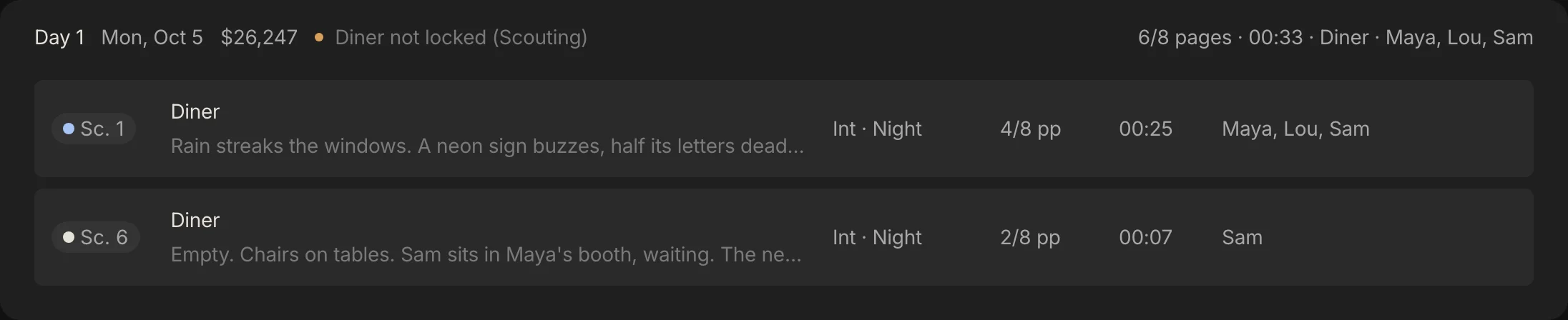
Only three scenes are headed night. Scene 5 is headed continuous and scene 6 is headed later, so the planner reads them as night because the scene before them is. Scene 7 is headed dawn, and the planner files dawn as day.
| Sc | Set | I/E | Heading says | Filed as | Pages | Day |
|---|---|---|---|---|---|---|
| 1 | Diner | INT | Night | Night | 4/8 | 1 |
| 2 | Rooftop | EXT | Day | Day | 3/8 | 2 |
| 3 | Maya's apartment | INT | Night | Night | 2/8 | 3 |
| 4 | Warehouse | EXT | Night | Night | 1/8 | 4 |
| 5 | Warehouse | INT | Continuous | Night | 2/8 | 4 |
| 6 | Diner | INT | Later | Night | 2/8 | 1 |
| 7 | Rooftop | EXT | Dawn | Day | 3/8 | 2 |
So the schedule has three night days (Days 1, 3 and 4), one day with a daylight scene and a dawn scene (Day 2), and two empty days after them, Friday and Saturday. Of the 11 eighths of night, 10 are interiors, and the one exterior night scene is scene 4, at 1/8 of a page.
Before you start
A night day needs facts a day shoot can skip. If you cannot fill this list, wait.
- Your agreement's rules, from the contract. The rest between days, when the first meal falls due and whether night hours are loaded. The figures here are from summaries.
- Sunset and sunrise for each night, for your place. Filmdaft lists them among the usual items on a call sheet. Spring Pro has no field for them, so they go in the day's Notes.
- Permits, neighbours and a way home. Tell the people nearby, and plan transport or a bed for tired people before the wrap.
Step 1: Mark which scenes must be night
Start from the breakdown: a night day is built from scenes whose light needs the dark, so check that each one does. Filmdaft notes that interior night scenes can be shot on a stage or with blacked-out windows, and StudioBinder describes day for night as a choice when night shooting is too costly or the people are not available at night. Each swap is for the director and the DP to decide.
In Midnight Diner, 10 of the 11 night eighths are interiors, and the one exterior is scene 4. The production's own to-dos plan a night shoot permit, letters to the neighbours and "Rain rig test through the diner windows", which reads as a plan for real night at the diner, though only the director can say so.
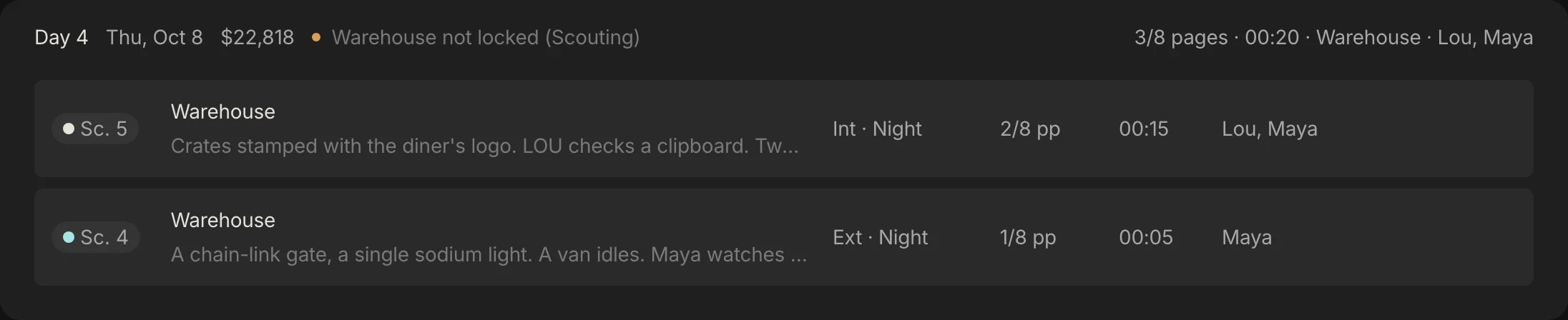
A stripboard colours strips by interior or exterior and by day or night, and Spring Pro files each scene's light from its heading. Night, evening or dusk is night. Day, morning, dawn, noon or afternoon is day, and any other time, such as continuous, later, sunset or twilight, takes the light of the scene before it. The coloured dot on a strip is simpler: it reads only the heading's own word and whether the scene is interior or exterior, so a strip headed continuous or later keeps a day colour even where the planner files it as night.
Step 2: Set the call, and count the hours across midnight
A night call starts in the afternoon: work back from the first shot that needs the dark. On the worked day the call is 17:00 and the day runs 11 hours, the length the budget plans, so the wrap is 04:00. Spring Pro keeps a crew call, a wrap and each actor's call on the call sheet, and a wrap earlier than the call reads as the next morning, so the budget counts 11 hours and the Daily report in Reports works out the same hours and the overtime in them.

The sample does not show this yet. Every day carries the default crew call of 07:00, no wrap and no call of its own for any actor, so its night days read as morning calls until someone sets them. Set the night calls first, then each actor's, as in how to make a call sheet.
Step 3: Find the earliest legal call after each night
The check is one line per pair of days. Wrap plus the minimum rest is the earliest call the agreement allows, which this guide calls the earliest legal call (legal here means within the agreement, not the law), and any planned call before it is a short turnaround. The rules and penalties are in the turnaround guide, so only the night cases are here.
The night days use the worked 17:00 call, and the dawn day uses the production's own dawn call of 05:00, from its to-do "Dawn call 05:00, sunrise 07:42". Each pair is checked against 10 hours of rest, the crew figure in both summaries, so check your cast agreements too. The sources also count the clock differently: the IATSE summary counts rest portal to portal for Distant Hires, and StudioBinder starts its 12 hours at the lodging. The tables here count from the wrap, so a long drive home can change the answer under your agreement.
| Pair | Wrap | Planned next call | Hours between | Earliest legal call (next day) | Verdict |
|---|---|---|---|---|---|
| Day 1 to Day 2 (night, then the dawn day) | 04:00 | 05:00 | 1 | 14:00 | 9 hours short |
| Day 2 to Day 3 (the dawn day, then night) | 16:00 | 17:00 | 25 | 02:00 | Clear, 15 hours to spare |
| Day 3 to Day 4 (night, then night) | 04:00 | 17:00 | 13 | 14:00 | Clear, 3 hours to spare |
The calculator opens on the first pair. Day 1 wraps at 04:00 and the earliest legal call is 14:00, so the dawn call is 1 hour after the wrap, 9 hours short. A 05:00 call needs the day before to wrap by 19:00, so no day that runs into the night can come before it.
Night to night is kinder: the next 17:00 call is 13 hours after a 04:00 wrap, 3 hours to spare. That is the room for an overrun. A 14-hour night wraps at 07:00 and still clears 10 hours, and a 15-hour night is 1 hour short. The three extra hours cost the people on Day 1 $8,979 (crew and cast, overtime after hour 10).
Step 4: Keep the nights in one block
One flip is a plan, and two flips in four days is an accident. StudioBinder's example runs three nights and then a day call straight after the last, about 24 hours of work by its count, and fixes it with a day off between. Midnight Diner as ordered flips from night to the dawn day on Day 1 to Day 2, 9 hours short, and back to night on Day 3.
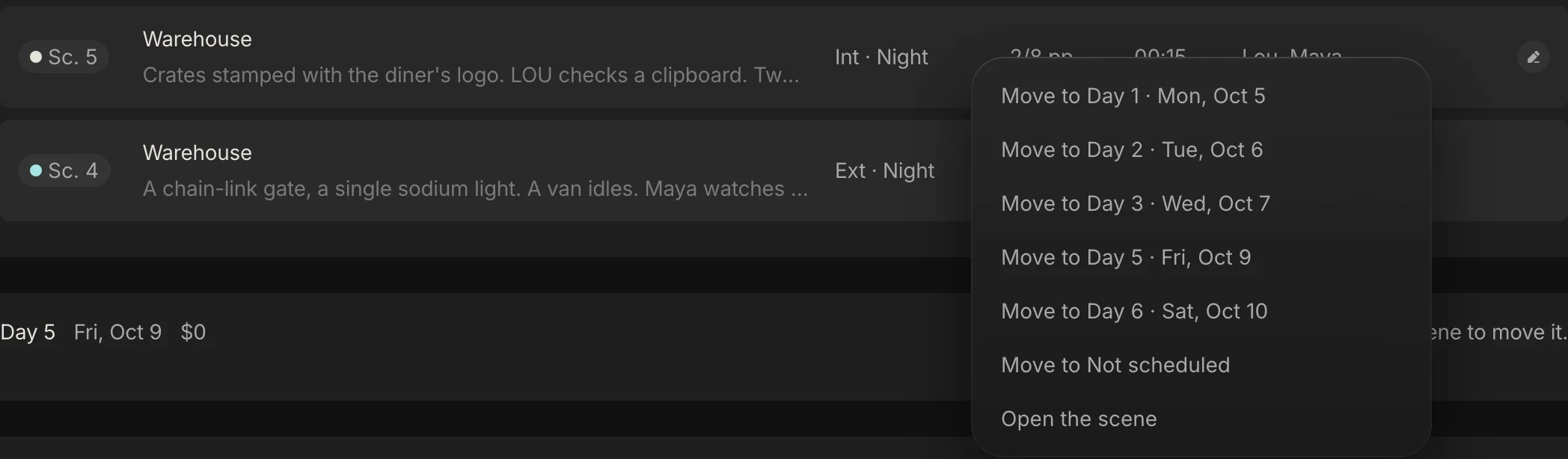
The cheapest fix is to swap the first two days. The dawn day goes first, the three nights follow, and the empty Friday and Saturday after Day 4 are the way back to days. In Spring Pro you move a scene from its menu, or ask Gaffer, the assistant, to swap two days: the dates stay with the positions, so after the swap the dawn day is Day 1 and the diner is Day 2, and the table below uses those numbers.
| Pair | Wrap | Planned next call | Hours between | Earliest legal call (next day) | Verdict |
|---|---|---|---|---|---|
| Day 1 to Day 2 (the dawn day, then night) | 16:00 | 17:00 | 25 | 02:00 | Clear, 15 hours to spare |
| Day 2 to Day 3 (night, then night) | 04:00 | 17:00 | 13 | 14:00 | Clear, 3 hours to spare |
| Day 3 to Day 4 (night, then night) | 04:00 | 17:00 | 13 | 14:00 | Clear, 3 hours to spare |
The money does not move. The same four days in a new order keep the engine's planned cost of $94,159 for the four shoot days, and the diner day's $26,247 and the rooftop day's $23,361 trade places. It helps the cast too: Lou, who is in scenes 1 and 5, goes from 2 hold days to 1 hold day, as counted in the day out of days guide. The engine prices cast on the days they work and has no hold pay, so that gain is not in its total, but where holds are paid it is one day saved for Lou.
The schedule's three rules (page target, one set, no day and night mixed) are quiet in both orders, so the short rest raised no flag. The one flag on each shoot day of the sample is that its set is not locked. A swap has a price too: the sample's to-do "Rooftop day two booked" says the rooftop is booked as day two, and a moved day is a booking to confirm again.
Step 5: Plan the meal at night
Meal rules run from the start of work, so they land at odd hours on a night day. The Australian summary says a meal must start no later than 5 hours from the start of the work session or the end of the last meal break, or 6 hours where those affected agree, and a late meal is paid at double time from when it falls due. In US practice, as Wrapbook explains, it is about 6 hours from call and 6 more after the return. The table assumes a 30-minute meal, the minimum Wrapbook gives, because the Australian summary states no length.
| Rule | First meal due by | Second meal due by |
|---|---|---|
| Australian summary, 5 hours | 22:00 | 03:30, 5 hours after the first meal ends |
| Australian summary, 6 hours by agreement | 23:00 | Not needed: it would fall due at 05:30, after the wrap |
| US practice (Wrapbook), 6 hours | 23:00, with a 12-minute grace to 23:12 | Not needed: it would fall due at 05:30, after the wrap |
The production plans its meal for 01:00: the to-do "Catering for 32 crew, night shoot (hot meal at 01:00)". The sample sets no night call, so it cannot be wrong, but on a 17:00 call 01:00 is 8 hours in, past both limits. A first meal at 01:00 needs a call of 20:00 or later under the 5-hour limit and 19:00 or later under the 6-hour limit, so the catering plan and the call have to agree. Nothing in the app compares them: the Daily report records the lunch you took and does not check it against the call.
Step 6: Plan the dawn window
A dawn scene is a window, not a time. Civil twilight is the period when the centre of the sun is up to 6 degrees below the horizon, and Wikipedia says it can last as little as 24 minutes at the equator and runs 33 to 48 minutes at Greenwich, depending on the time of year. The golden hour that follows has no clearly defined duration. Look up the light for your place and date, then work back from it.
The production's to-do for scene 7 reads "Dawn call 05:00, sunrise 07:42", which puts the call 2 hours 42 minutes before sunrise. That gap is rigging in the dark: the to-dos also book a crane for the dawn rise and plan a hidden safety line for the ledge. Put the dawn scene first on its day, with the daylight scene after it, as in how to make a shooting schedule. The sample does not do this yet: its Day 2 lists scene 2, a daylight scene, before the dawn scene 7.
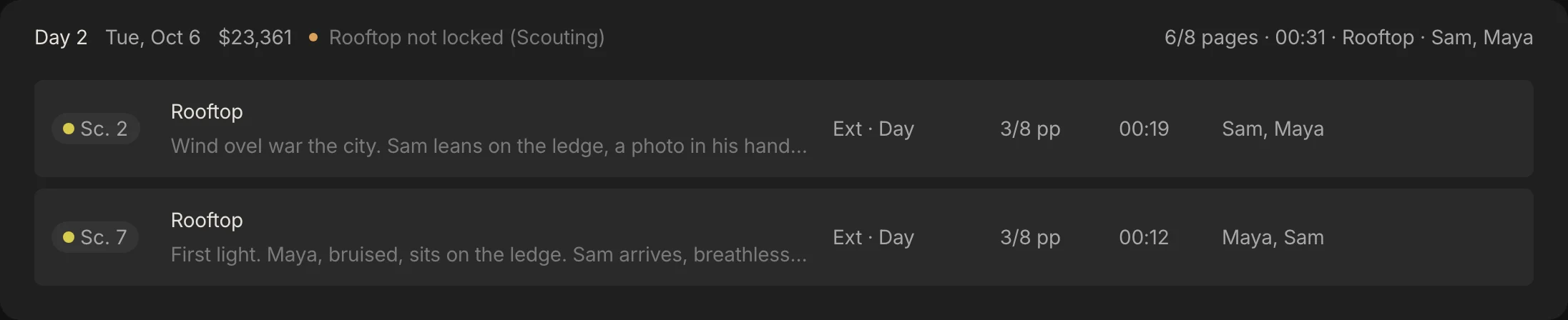
The call time also decides which meal rule applies. In the Australian summary a call before 5am brings a paid half hour breakfast break between 6.30am and 8am, and a 05:00 call sits exactly on the line. A night that runs long is a dawn problem too: a 14-hour night wraps at 07:00, 42 minutes before the 07:42 sunrise the project lists for the morning after Day 1.
Two limits in the app. If you plan a night scene and the dawn scene at one set in the same night, the planner warns that day and night are mixed, because it files dawn as day, so read that warning as a prompt to check. And the call sheet has no sunrise, sunset or twilight field, so put them in the day's Notes.
Step 7: Price the night
Some agreements pay more for night hours. The Australian summary has a table of night and Saturday loadings, copied below as it lists them, as of 1 January 2026. It is a summary: the agreement controls, and the figures change at each review.
| Time | Loading |
|---|---|
| 8pm to Midnight - Monday to Friday | 25% |
| 12.01 am to 6am - Monday to Friday | 25% |
| 6am to 8pm* - Saturday | 25% |
| 12.01am to 6am- Saturday | 50% |
| 8pm to Midnight- Saturday | 50% |
| 12.01am to 6am** - Monday | 100% |
The asterisks read: * unless contracted for a 6 day week, and ** where work commenced on Sunday. The summary does not say how a loading combines with overtime. It says only that penalties are calculated on gross agreed remuneration, the pay for the hours contracted that week, and not whether a loading counts as one, so read the agreement before you price a night.
Read against the worked day, a 17:00 call and a 04:00 wrap on a Monday to Thursday night has 4 hours from 8pm to midnight and 4 hours after midnight, all at 25%. That is 8 loaded hours, 2 ordinary hours of extra pay. On a Friday night the 4 hours after midnight fall on Saturday at 50%, which makes 3 ordinary hours.
What the night adds on Midnight Diner
Here is the size of it on the sample's real crew. The engine has no night loading, so this is an illustration and not a figure from any agreement. Midnight Diner's budget runs on an 11-hour planned day, overtime after hour 10 at 1.5 times and 18% fringes, where the Australian summary has overtime after 8 hours.
The summary's classification list names crew roles, not cast, so the sums count the 29 crew paid by the day. An ordinary hour of their pay is the engine's overtime hour divided by 1.5, fringes included, and a loading is read as a percentage added to the pay of those hours.
| What | Basis | Amount |
|---|---|---|
| An ordinary hour of pay for the crew paid by the day | The overtime hour divided by 1.5, with 18% fringes | $1,559 |
| A Monday to Thursday night, 17:00 to 04:00 | 2 ordinary hours (8 hours at 25%) | $3,118 |
| A Friday night over the same hours | 3 ordinary hours (4 at 25%, 4 at 50%) | $4,677 |
| The three night days in the sample, all Monday to Thursday | 6 ordinary hours | $9,354 |
| For comparison: Day 1 as planned, everything the engine puts on the day | People, kit, catering, transport and the location, for a planned 11-hour day | $26,247 |
If your agreement loads night hours, the day's price in the budget is short by about the loading until you add it as a line of its own: see how to budget a short film. One overtime hour on Day 1 is $2,993, so a night block is a labour bill with a premium on it.
When the night is a Friday
A Friday night is the costly place for a night day in two ways, from different agreements: in the Australian summary the hours after midnight fall on Saturday and are loaded at 50%, and in the IATSE 2021 summary, weekend rest is 54 hours after a five-day workweek for hourly and weekly employees. The same summary allows 50 hours in three cases when the fifth day runs 12 hours or less, and one is exterior night shooting called for in the script and scheduled for the fifth day. The summary limits how often any of them can be used, twice on a theatrical motion picture for example.
| Weekend rest | Earliest Monday call | A 07:00 Monday call |
|---|---|---|
| 54 hours (the standard rule) | 10:00 | 51 hours after the wrap, 3 hours short |
| 50 hours (exterior night on the fifth day) | 06:00 | 51 hours after the wrap, 1 hour to spare, if the exception is open to you |
So a Monday 07:00 call after a Friday night is short unless the exception applies, and the sample has one exterior night scene, scene 4. The loading and the weekend rest come from different agreements here, so read both in yours. The Australian summary frames weekend rest differently, 34 hours after one day off and 58 after two, and the full table is in the turnaround guide. The sample's last night is Day 4, a Thursday, with Friday and Saturday empty after it.
Step 8: Get everyone home, and keep the neighbours
A night day ends when tired people drive home. The IATSE 2024 memorandum requires the producer to offer courtesy housing or round-trip transport to an employee who has worked more than 14 hours in the studio zone and says they are too tired to drive safely, and to put the offer on the call sheet with a named contact. That is a rule of one agreement, not a general one. The sample plans night transport to the yard ("Night transport: minibus from base to the yard"), and the same planning should cover the way home.
Neighbours are part of the schedule. The Filming in England guidance on night filming in public recommends telling every local resident and business as soon as you know, by letter and in person, and informing the local authority and the police. It adds that most councils may have no list of hours they consider antisocial, so propose a time and ask. The sample has "Night shoot permit for the street rain rig" and "Letters to the neighbours about the night rain rig".
Count the nights you book. The sample's to-dos say "Lock the diner for two nights (Sc. 1 and 6)", "Warehouse yard permit, two nights" and "Security guard for the yard, both nights", but the schedule has the diner scenes on one night and the warehouse scenes on one night. Either a night of rigging is planned and missing from the schedule, or the bookings are a night too long, and whoever owns the to-dos should say which.
A night also leans on a few facilities, and the sample's to-dos include "Generator (100 kVA) and cable run from the street" and a hot meal for the crew.

Step 9: Put it on the call sheet, and send it before the night starts
The call sheet for the day after a night day goes out while the night crew is starting work. Filmdaft says a sheet should usually go out no later than 12 hours before the next work day starts, which for a 05:00 call is 17:00, the hour the worked night crew is called. The sample's to-do reads "Call sheet for day 2 out by 18:00 the day before", which is 11 hours ahead of that call, an hour short of that usual 12.
Put the night's facts on the sheet: the call, each actor's own call, the wrap, the meal time, the way home, and sunrise and sunset in the Notes. Spring Pro prints the sheet and does not email it, so see call sheet software and the call sheet template.
How people schedule nights today, and what breaks when a night moves
Most nights are scheduled on a stripboard, in a spreadsheet or in scheduling software, and they differ in what you redo when a night call moves. This is our view from our own work, not a test of products.
| Way of working | Good for | When a night call or a day moves you must |
|---|---|---|
| A paper stripboard or a spreadsheet | A short with one night and a patient crew | Recount the rest and the meal times by hand for every pair of days, and retype the call sheet |
| Scheduling software that colours night strips | A schedule that changes often | Read the strips for light, then check rest and meals yourself unless your tool does it |
| One project where the day, the sheet and the budget read each other (Spring Pro) | A night block that moves with the weather or the cast | Move the scene. The day, its cost, the cast days and the sheet follow, and the rest, meal and loading checks are still yours |
From a short to a feature: what changes
The method does not change with size. What grows is the number of nights and the cost of a short rest. These sizes are rough labels, not industry definitions.
| Size | What a night day looks like | What to add |
|---|---|---|
| Solo or YouTube video | A night with a camera and a car | The drive home, the neighbours and a place to sleep |
| Short film | One or two nights with a small crew | The wrap and the next call, a real meal, a way home, the neighbours told |
| Commercial | A night day with a client and a tight wrap | The agreement's rest and loadings, before you promise a morning call |
| Indie feature | A block of nights with loadings, rest rules and a weekend ahead | A rest check for every pair of days, a rest day after the block, courtesy transport |
| Series or episodes | Many nights across units and episodes | Not Spring Pro yet: one script and one unit per project |
Doing it in Spring Pro
Every scene is a strip filed as night or day from its heading. Plan the shoot groups strips by set and by light and never mixes day and night in one day. The call sheet holds the crew call, the wrap and each actor's call, and the budget and the Daily report count hours from call to wrap across midnight. See shooting schedule software for the tool.
You can ask Gaffer to set a day's crew call, lunch, wrap and each actor's call, or to swap two days. Its brief carries a rule of thumb of about 12 hours from wrap to the next call, never under 10, and a meal within 6 hours of call. That is guidance it applies when you ask, not a check on the page, so confirm any answer against your agreement.
What it does not do yet: it does not check rest between days, when a meal falls due or night loadings, and the cost of a day has no night loading. The call sheet has no sunrise, sunset or twilight field. Its clock arithmetic is plain clock time, so it does not know about a night when the clocks change, and it handles one unit and one script per project.
The checklist
Copy this. Tick it before you lock a night.
- Every night scene is night for a reason, and each interior has been asked whether it could be shot by day
- The nights sit in one block, with a rest day after the last one
- The crew call, the wrap and each actor's call are set for every night day
- The earliest legal call is worked out for every pair of days, from your agreement, and a Friday night is checked against the weekend rest
- The first meal falls due inside the limit, and the catering plan matches the call
- Night loadings are priced as a line, if your agreement has them
- Sunrise, sunset and the dawn call are on the sheet, and the dawn scene is first on its day
- Permits, neighbours and the way home are arranged, and the sheet for the next day goes out before the night begins
How these numbers were made
Every number about Midnight Diner is computed from the project and the app's own functions, and the build stops if the project changes so that the story no longer holds. The rest formula is the one behind the calculator, the hours across midnight use the app's own function, and the day's light uses its own planner.
Midnight Diner is a demonstration production, not a case study of a real shoot. The 17:00 night call and 11-hour day are the calculator's illustrative defaults and the 05:00 dawn call is the project's own, while the sample's real calls are still the default 07:00. The agreement figures come from the summaries below, read on 2026-10-12, and the Australian summary is dated 1 January 2026. They differ from each other and from your contract, which controls.
Questions people ask
How do you schedule a night shoot?
Call the crew in the afternoon, keep the nights in one block, plan the first meal five or six hours in, and add the minimum rest to each wrap to find the earliest next call. The turnaround guide has the rest rules and the calculator.
What time should a night shoot call be?
There is no standard. Set it so the set is ready when the light goes, from your sunset and your rig. The worked day in this guide uses 17:00 for 11 hours, which wraps at 04:00, as an illustration.
How much rest does a crew need after a night shoot?
Your agreement sets it. The IATSE 2021 summary and the Australian summary say 10 hours between consecutive days for crew (the IATSE summary gives 9 to Distant Hires), and StudioBinder says 12 for SAG and the crew unions. We did not read a SAG agreement, and weekends need more, so check your contract.
What is the earliest legal call after a night shoot?
The wrap plus the minimum rest, which means the earliest call your agreement allows, not a legal limit. A 17:00 call and an 11-hour day wrap at 04:00, so with 10 hours of rest the earliest legal call is 14:00 the next day, counting from the wrap. Work yours out with the calculator in the turnaround guide.
Do night shoots cost more?
It can. The Australian summary loads night hours by 25%, Saturday nights by 50% and some Monday morning hours by 100%. The IATSE summary and memorandum we read do not mention a night loading, so price it from your own agreement.
When is the meal on a night shoot?
By the same clock rules as a day. In the Australian summary the first meal must start within 5 hours of the start of work, or 6 by agreement, and Wrapbook describes about 6 hours in US practice. A 17:00 call puts the first meal at 22:00 to 23:00.
Can you shoot a night scene in the day?
Sometimes. Filmdaft notes that interior night scenes can be shot with blacked-out windows, and StudioBinder describes day for night as a choice when night work is too costly or the people are not available. It is a decision for the director and the DP.
How do you schedule a dawn scene?
Treat it as a short window. Civil twilight lasts as little as 24 minutes at the equator and 33 to 48 minutes at Greenwich, so look up the light for your place, call the crew well before it, and shoot the dawn scene first on its day. Do not put it straight after a night day.
Does Spring Pro check rest after a night shoot?
Not on the schedule. It files each scene as night or day and warns on pages, sets, mixed light and a set that is not locked, but it does not check rest, meals or loadings. Gaffer, the assistant, applies a rule of thumb for rest and meals when you ask, which is guidance, not a check. See shooting schedule software.
Sources
Every outside claim that names a source comes from one of these, read on the date shown. Standard conventions, such as the eighths rule and the usual specialist cases, are common practice. Figures from agreements and summaries change at each negotiation, so check the current text before you rely on a number.
- Motion Picture Production Certified Agreement 2010, summary as of 1 January 2026 (MEAA, a union summary). Checked 2026-10-12.
- IATSE Basic Agreement, 2021 negotiations summary (Editors Guild, a union summary). Checked 2026-10-12.
- IATSE Basic Agreement, 2024 memorandum of agreement (a copy held by the Berkeley Labor Center). Checked 2026-10-12.
- Wrapbook, meal penalties: a producer's guide (a payroll vendor). Checked 2026-10-12.
- StudioBinder, surviving a night shoot (a competitor's guide). Checked 2026-10-12.
- StudioBinder, shooting schedule mistakes (a competitor's guide). Checked 2026-10-12.
- StudioBinder, how to schedule day for night (a competitor's guide). Checked 2026-10-12.
- Filmdaft, what is a call sheet. Checked 2026-10-12.
- Wikipedia, twilight. Checked 2026-10-12.
- Wikipedia, golden hour (photography). Checked 2026-10-12.
- Filming in England, night filming in public guidance (a PDF guidance note). Checked 2026-10-12.
More about shooting schedule
A schedule is a labour bill. The cost of an error is paid in hours.
- Film production scheduling: the whole picture. The complete guide
- Scenes become strips. Strips become shoot days. The tool
- A film shooting schedule template, laid out as a stripboard.
- How to make a shooting schedule for a film, with a real sample.
- Turnaround and meal breaks on a film shoot: the rules and a calculator.
- What a day out of days report is, and how to read one.
- One line schedule vs stripboard: the same four days, three ways.
- Film weather cover day: how to swap a rain day, with worked costs.
- Scheduling through script revisions: the colours, the routine and what each change costs.
- What is a stripboard?
- What is a day out of days?
- What is turnaround on a film set?