Film weather cover day: how to swap a rain day, with worked costs.
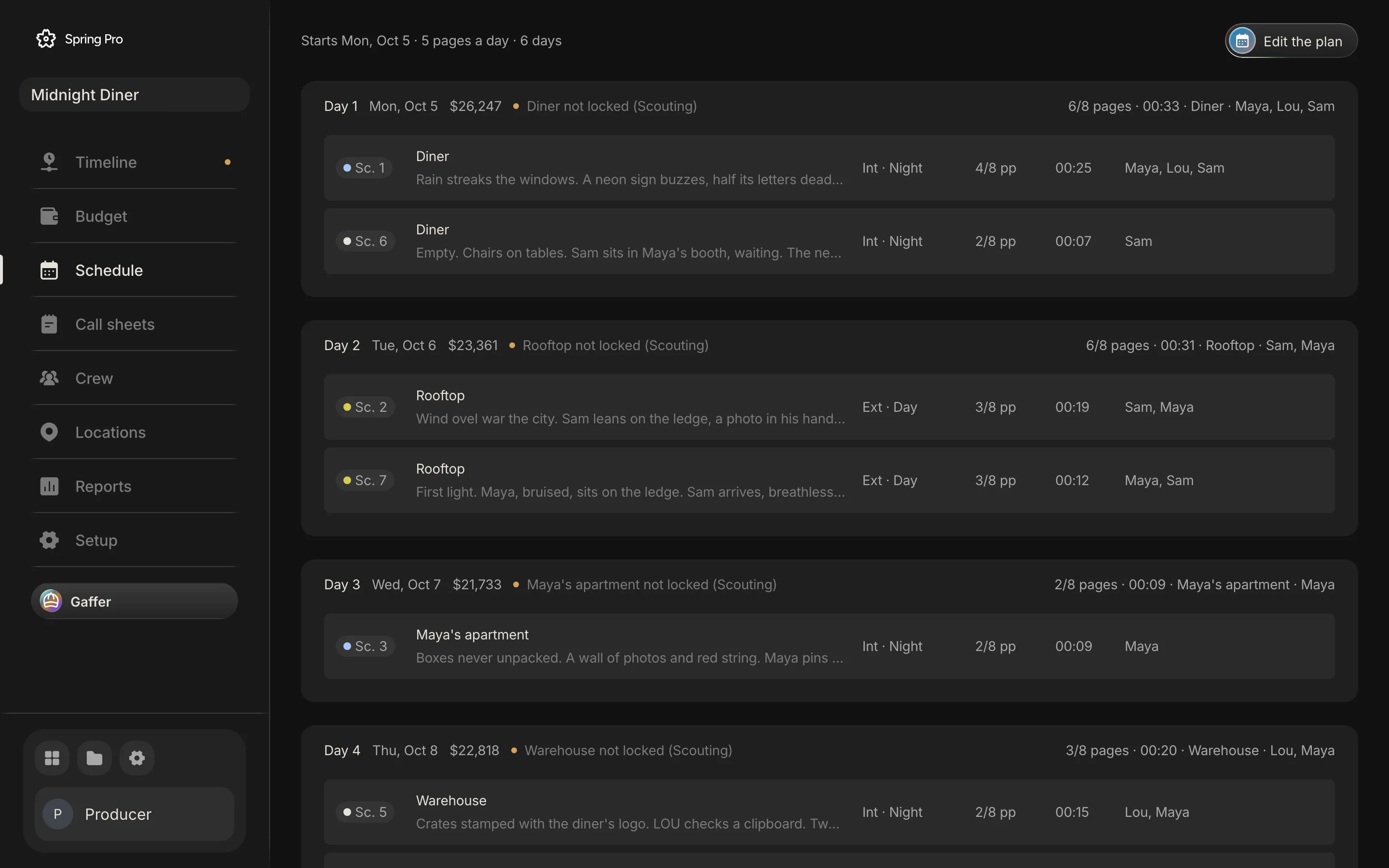
Real screen: Midnight Diner, our demo production, in Spring Pro.
The short answer. A weather cover day is an interior day you swap in when rain rules out an exterior day. Choose the cover before you need it, swap the two days, then check three things: who ends up on hold, what each day now costs, and whether the rest between days still clears. Write down who calls it, and by when.
Most schedule guides say to plan for rain, and few show what the plan does once it runs. This guide runs one on a sample production, Midnight Diner, with an invented cast and rates and Spring Pro's own engines doing the sums: the rooftop on Day 2 trades places with Maya's apartment on Day 3. Then it checks what the swap does to the cast, the cost of each day and the rest between days, and what the sources say about who calls it and by when. It builds on step 10 of how to make a shooting schedule and sits inside film production scheduling.
In this guide 17 sections
- Quick answers
- Why a weather cover day matters, and who pays
- The film we are covering
- Step 1: Choose the cover day before you need it
- Step 2: Swap the days and read the cast
- Step 3: Price the swap
- What a lost day costs
- Step 4: Check the rest between days
- Step 5: Say who calls it, and by when
- When the cover day rains too
- How people protect a schedule from weather today
- From a short to a feature: what changes
- Doing it in Spring Pro
- The checklist
- How these numbers were made
- Questions people ask
- Sources
Quick answers
What is a weather cover day? A day of interior work you swap in when weather rules out an exterior day. The usual term is a cover set: Wikipedia says some producers arrange cover sets near exterior locations, so the unit can move straight to interior scenes. This guide covers the day-level version, where two days trade places.
Does the swap cost money? Not in the four-day total. On Midnight Diner it moves $1,628 from Day 2 to Day 3 and gives Sam one hold. The app's day out of days calls a hold a paid day, so that is $1,200 at his day rate, on top of the day costs.
What does a lost day cost instead? About $23,361 here: the planned day is spent and the rooftop still has to be shot. Sam then holds on Days 3 and 4 until the rooftop shoots on Day 5, so add $2,400 for those two holds.
Does the swap fix the rest between days? No. On the illustrative times in step 4, every version leaves one pair of days short. The swap moves that pair or shortens it, and does not remove it.
Who calls it, and by when? No source we read names one person or one deadline for a swap. Two of them give pay clocks, and the figure they share is 12 hours: it is about when a cancellation becomes a paid day, not about who decides.
Do you need software? A spreadsheet can hold the swap, and the schedule template is a start. The hold, the day cost and the rest check are then yours to redo by hand.
Why a weather cover day matters, and who pays
Weather is the one change nobody on the production decides, so it arrives on its own schedule. Most guides we read explain what a cover set is and say to plan one. None of the ones we read works a swap through the cast, the cost of each day and the rest between days, and that is where a swap costs money.
| Reader | What they need | What goes wrong if the call is late |
|---|---|---|
| Crew | A call they can plan around | Called to a day that cannot shoot, and paid for it |
| Cast | To know whether they work or wait | Held, or called a day early with no notice |
| Art, props and grip | The cover set ready a day early | The apartment is not dressed when the crew arrives |
| The location contact | The cover date, in writing | The cover is not free the day you need it |
| The production office | One number for the day | A lost day nobody priced |
Two of the sources in step 5 turn this into pay rules: a cancellation made late is a paid day.
The film we are covering
Midnight Diner has four shoot days. Day 2 is the rooftop: scenes 2 and 7, 6/8 pages, both exterior. Day 3 is Maya's apartment: scene 3, 2/8 pages, an interior. If it rains on Tuesday 6 October, the rooftop cannot shoot and the apartment can.
Two things in the sample need saying. Scene 3 is headed night, so the apartment is a night interior, and the sample's calls are all the app's default 07:00, not a real plan. Neither set is secured: the schedule flags both as not locked, still at Scouting.
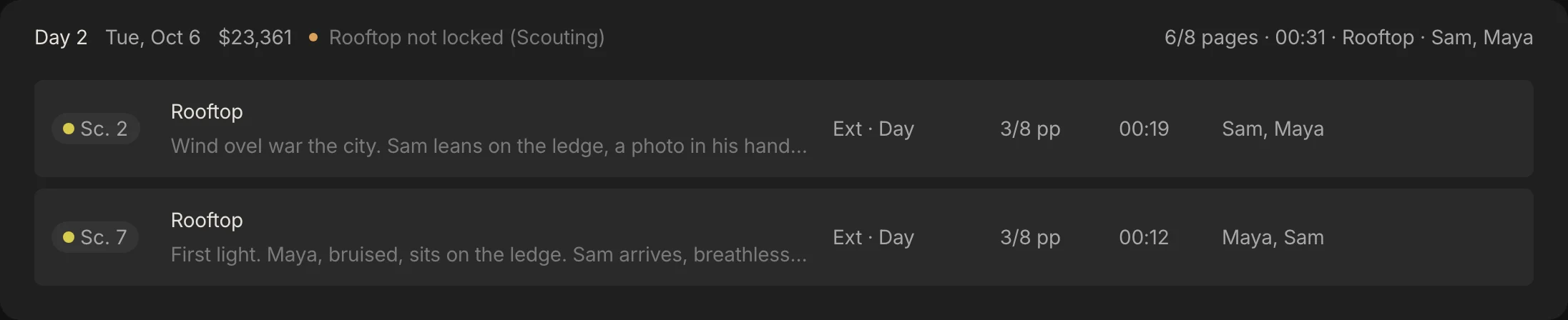
Midnight Diner is a demonstration production, so its cast and rates are invented, and its dates, Mon 5 Oct to Sat 10 Oct, are fixed and already past: read them as a plan laid out on a calendar, not as days still to come. Scene 7's heading says dawn, and the app files dawn under day light, so its strip reads "Ext · Day".
| Day | Date | Scenes (heading) | Set | Pages | Planned cost |
|---|---|---|---|---|---|
| 1 | Mon 5 Oct | 1 (int night), 6 (int later) | Diner | 6/8 | $26,247 |
| 2 | Tue 6 Oct | 2 (ext day), 7 (ext dawn) | Rooftop | 6/8 | $23,361 |
| 3 | Wed 7 Oct | 3 (int night) | Maya's apartment | 2/8 | $21,733 |
| 4 | Thu 8 Oct | 5 (int continuous), 4 (ext night) | Warehouse | 3/8 | $22,818 |
Step 1: Choose the cover day before you need it
A cover day has to pass four tests. Run them while the weather is still a forecast, not on the morning.
- No exterior scene. A cover day with an exterior has the same weather problem.
- Ready a day early. Location, cast and departments can work a day earlier than booked.
- Cast already on the rain day. Nobody new is called, and whoever is not in the cover scenes is released.
- Secured. A cover you have not booked is a guess. The schedule flags a set that is not locked, and here it flags both.
| Day | Set | Exterior scene? | Cast called | Result |
|---|---|---|---|---|
| Day 1 | Diner | No | Maya, Lou and Sam | Not available: it comes before the rain day |
| Day 3 | Maya's apartment | No, scene 3 is an interior | Maya | A cover. Sam is released |
| Day 4 | Warehouse | Yes, scene 4 is an exterior | Lou and Maya | Not a cover |
The usual cover set is a place near the exterior, so the unit can make a short company move the same day. Here we use the other kind, a swap of two days, because that is what a schedule can hold.
Step 2: Swap the days and read the cast
Swap them. Day 2 now holds scene 3 and Day 3 holds scenes 2 and 7. The dates stay with the day positions, so Day 2 is still Tuesday 6 October and Day 3 is still Wednesday 7 October. In Spring Pro that is three right-click moves, shown in the Spring Pro section below.
Then read the day out of days, because a swap can create a hold. Maya and Lou do not change. Sam works Day 1, waits on Day 2, and works Day 3.
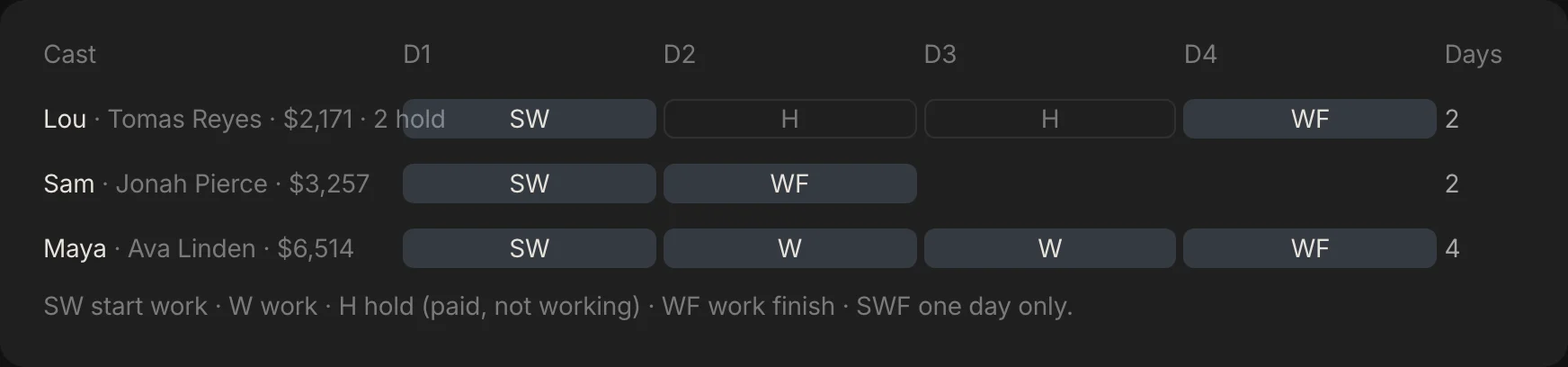
| Character | Actor | As planned | Swapped | Holds before | Holds after |
|---|---|---|---|---|---|
| Maya | Ava Linden | SW, W, W, WF | SW, W, W, WF | 0 | 0 |
| Lou | Tomas Reyes | SW, H, H, WF | SW, H, H, WF | 2 | 2 |
| Sam | Jonah Pierce | SW, WF, -, - | SW, H, WF, - | 0 | 1 |
Sam's hold is the price of the swap. His deal is $1,200 a day, so one hold is $1,200: the app's day out of days key calls a hold paid, and his own contract has the last word. The cost engine does not count holds, so the day costs below leave it out and it goes on top. Lou's two holds are there either way, and the day out of days guide works that trade.
The hold only exists if it rains, so a cover plan is cheap to carry.
Step 3: Price the swap
A day costs what its scenes and its people cost, so a swap moves cost between the two days and creates none. Day 2 gets cheaper by $1,628 and Day 3 dearer by the same. That amount is Sam's day, his rate for the planned 11-hour day with 18% fringes, and he moves with the rooftop.
| What | As planned | Swapped |
|---|---|---|
| Day 2 shoots | The rooftop (scenes 2 and 7) | Maya's apartment (scene 3) |
| Day 2 planned cost | $23,361 | $21,733 |
| Day 3 shoots | Maya's apartment (scene 3) | The rooftop (scenes 2 and 7) |
| Day 3 planned cost | $21,733 | $23,361 |
| All four days together | $94,159 | $94,159 |
| Planning warnings on Days 2 and 3 (page target, one set, day and night) | None | None |
| Not-locked flags | Day 2: Rooftop. Day 3: Maya's apartment | Day 2: Maya's apartment. Day 3: Rooftop |
The schedule's planning warnings stay quiet either way: each day still holds one set and one kind of light. The not-locked flags travel with the sets, so each of the two days still carries one. None of the flags knows it is a rain plan, and none checks the rest. The budget reads the same days, so its cost per shoot day moves the same way.
What a lost day costs
Now the other branch. If it rains on Day 2 and there is no cover, the crew has been called and nothing is shot, so the planned day is spent. The rooftop then goes to the next free date, which here is Day 5, the empty day dated Friday 9 October. The engine prices the rooftop there at $23,361, the same as Day 2.
So the rain costs about one more day of that size, plus holds. Sam works Day 1, is called on the lost Day 2, then waits on Days 3 and 4 until the rooftop shoots on Day 5, so he has two holds, $2,400 at his day rate. The engine will not show either by itself: it prices a day by the scenes on it, so a day with the rooftop moved off reads $0, and the crew who were paid do not appear.
| Choice | What it costs | How it is worked out |
|---|---|---|
| Swap to the apartment | Nothing more in the four-day total ($94,159 both ways), plus $1,200 for Sam's one hold | The cost engine on the swapped days, and his day rate for the hold |
| Lose the day, shoot the rooftop on Day 5 | About $23,361 more, plus $2,400 for Sam's two holds | Day 2 is paid with nothing shot, Day 5 prices at the same $23,361, and Sam holds on Days 3 and 4 at his day rate |
| Call it off in time | Set by your agreement | Two examples are in step 5: a 12-hour notice, and a paid day if you are late |
| One more shoot day, as Gaffer's what-if tool prices it | $25,894 more than the current estimate | The average planned day plus 10% contingency. The Budget page's what-if panel compares with the locked budget instead, so it shows $26,610 more |
The lost day is priced as a called crew sent home at the end of a planned day. Call it off early and it costs less, and run it long and it costs more. These are worked examples on one production, not benchmarks, and we found no reliable average for what a lost day costs at a given budget.
Step 4: Check the rest between days
A swap changes which day sits next to which, so it changes the turnaround, the rest between them. The check is arithmetic: the wrap plus the minimum rest is the earliest legal call, as in turnaround and meal breaks. We use 10 hours, the minimum in the IATSE 2021 summary for productions with established terms; step 5 says how current that is. Your agreement sets yours, and Spring Pro's assistant, Gaffer, is told to aim for about 12 hours and never go under 10.
The sample's calls are placeholders, so the table uses illustrative times: a 17:00 call for a night day, a 05:00 call for the dawn rooftop, the sample's 07:00 for a day, and the plan's real 11-hour day. The calculator below opens on the plan's own pair, Day 1 to Day 2.
| Pair of days | As planned | Swapped, apartment on a night call (17:00) | Swapped, apartment on the 07:00 call |
|---|---|---|---|
| Day 1 to Day 2 | 1 hour after a 04:00 wrap: 9 hours short | 13 hours after a 04:00 wrap: clears | 3 hours after a 04:00 wrap: 7 hours short |
| Day 2 to Day 3 | 25 hours after a 16:00 wrap: clears | 1 hour after a 04:00 wrap: 9 hours short | 11 hours after a 18:00 wrap: clears |
| Day 3 to Day 4 | 13 hours after a 04:00 wrap: clears | 25 hours after a 16:00 wrap: clears | 25 hours after a 16:00 wrap: clears |
Every version leaves one short turnaround. In the plan, the diner's night wrap meets the rooftop's dawn call. After the swap, the apartment's night wrap meets it, or, if the apartment shoots by day, the diner's wrap meets a 07:00 call only 3 hours later.
So the swap does not fix it. The fixes are the four in the turnaround guide: a rest day, a later call, a different order or a shorter first day. In Spring Pro you can add a day after Day 2 by right-click, and the later days move to the next dates. If the apartment shoots by day, someone also has to answer what its windows show, because scene 3 is headed night.
Step 5: Say who calls it, and by when
A swap is a decision with a deadline, and a cover plan is only a plan once someone owns the decision. We read what the sources say about who owns it and when. They cover safety, pay and good practice, and they do not agree on a person or a time.
- The assistant director. Wikipedia describes the first assistant director's job as keeping the production on schedule through the day and keeping the staff and the shot safe. It does not mention weather calls.
- The weather action plan. Safety Bulletin #38 from the Industry Wide Labor-Management Safety Committee says the Location Manager, their department representative or production should write an action plan for locations with a weather hazard. It names one person to monitor the weather, calls a safety meeting when bad weather is possible, and sends people back to an evacuated area only on an all clear from a regulatory authority or Production Management. It is guidelines only, and it gives no deadline for swapping a day.
- Pay when you cancel for weather, a union example. The IATSE 2021 summary lets a producer issue a weather-permitting call for extreme weather events: for people not yet on payroll, notice can be given up to 12 hours before call, and daily hires told not to report more than four hours before call are paid four hours, otherwise the full minimum call is due. That summary's term ran to 31 July 2024. The 2024 memorandum runs to 31 July 2027, says the provisions of the current agreements stay the same unless it changes them, and does not mention weather. We did not read the current contract text, so check the clause in your own agreement.
- Pay when you hold a day, New Zealand. The Screen Guild says a weather hold is a pencil booking, and the production must confirm or release it at least 12 hours before the estimated crew call. If it is not released in time, it is a paid day, even if the shoot does not go ahead because of weather. A confirm-or-release request made within 48 hours of the estimated crew call needs an immediate answer. That is a New Zealand Blue Book rule, so it is a second example, not the same one.
- A vendor's advice. Filmustage, a scheduling software vendor, advises establishing who makes the final call on weather-related decisions and keeping weather-dependent scenes swappable with indoor ones. It names no role and no time.
So the answer to who and by when is in your own paperwork. The two sources with pay clocks share one figure, 12 hours, and it measures when a cancellation becomes a paid day. Each adds a second clock (a four-hour rule in the IATSE summary, an immediate answer inside 48 hours of crew call in the Screen Guild article), and neither is a deadline for swapping a day. For when a call sheet goes out, where sources also differ, see how to make a call sheet.
Our view, not a standard: before the first exterior day, write down one name who makes the call and a deputy, the times the forecast is checked, a cut-off earlier than the earliest pay clock in your agreement, who is told in what order, and a fallback date.
When the cover day rains too
A cover plan protects one wet day. The rooftop still needs a dry date, and the swap only gives it Wednesday. The sample's plan has six days and four carry scenes, so Day 5, Friday 9 October, is a second fallback: it is empty and prices at $0 until something is moved onto it.
| Rung | The rooftop shoots on | What shoots on Day 2 | Cost against the plan |
|---|---|---|---|
| The plan | Day 2, Tue 6 Oct | The rooftop | Nothing |
| The swap | Day 3, Wed 7 Oct | Maya's apartment | Nothing in total, plus $1,200 for Sam's hold |
| The spare day | Day 5, Fri 9 Oct | Nothing: Day 2 is lost | About $23,361 more, plus $2,400 for Sam's two holds |


How people protect a schedule from weather today
There are several common ways, and they differ in what you must redo when the weather turns. This is our view of the trade-offs, not a test of products.
| Way | What it protects | What you redo when it is used |
|---|---|---|
| Shoot exteriors early | Time to recover if they are rained off | Reschedule the exterior that was lost |
| A cover set near the exterior | The same day: the unit moves to an interior | Tell the departments and the cast, and change the call sheet |
| A cover day, swapped in | The date, and the crew's day | The cast report, the day costs, the rest check and the call sheets |
| A spare day | The end date, if the weather goes wrong once | Cast and crew bookings for the new date |
| Weather-permitting terms and weather holds | The pay, when you cancel in time | Tell people before the cut-off |
| Weather insurance | Some of the loss, as the policy says | A claim, with the dates and the cause |
| Accept the risk | Nothing | Everything downstream, and about $23,361 for a lost day here, plus Sam's holds |
Wikipedia's production board article describes the first two: weather-prone outdoor scenes are sometimes scheduled early so there is time to recover, and some producers arrange cover sets near exterior locations. The pay rules are in step 5. Tokio Marine HCC, an insurer, lists rain, snow, lightning, hurricane and temperature as insurable perils on one of its production covers. We have not compared policies, so ask a broker what is covered.
From a short to a feature: what changes
The swap works the same at every size. What changes is what a lost day costs and how many people hold a clock on it. These sizes are rough labels, not industry definitions, and the right-hand column is our view.
| Size | What weather does | What to plan |
|---|---|---|
| Solo or YouTube video, 1 to 2 days | Moves the day, with no pay clock | Watch the forecast and shoot another day |
| Short film, 2 to 10 days | One lost day can break an actor's window | A cover for each exterior day, read for holds and rest, and a spare date |
| Commercial, 1 to 3 days | A lost day is a large share of the shoot | Book the cover early, put weather terms in deals, tell the client |
| Indie feature, 15 to 40 days | Many exterior days, and each lost day costs a lot | A cover for each exterior block, a priced lost day, a decision on insurance |
| Series or episodes | Several units may need a call at once | Not Spring Pro yet: one unit and one script per project |
| Game cutscenes | Only outdoor capture days | Treat capture days as shoot days |
For capture days on a game, see game preproduction. The wider picture is in film production scheduling.
Doing it in Spring Pro
In Spring Pro every shoot day shows its date, planned cost, pages, cast and flags, so you read the swap where you make it. Right-click a scene, or drag it, to move it to another day. There is no swap-two-days button, so the rain swap is three moves: scene 3 up to Day 2, then scenes 2 and 7 down to Day 3.
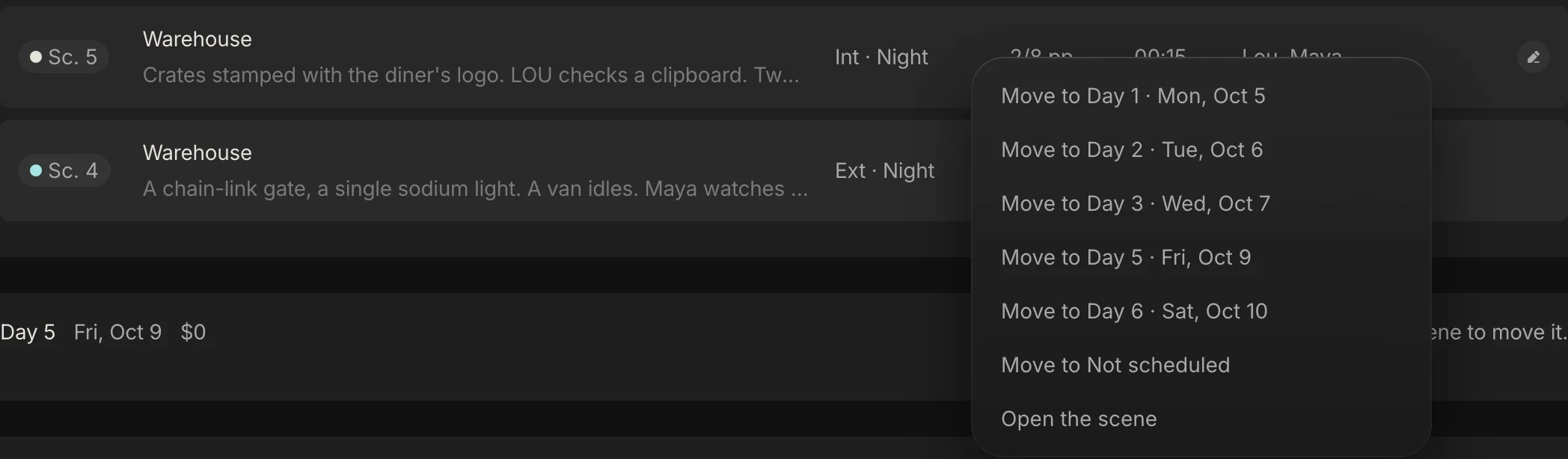
Everything built from the schedule follows. The day out of days shows Sam's new hold, the day costs shift, and the not-locked flag moves with the set. Day 2's call sheet then calls Maya and Day 3's calls Sam and Maya.
Gaffer, the assistant, can swap two whole days in one step when you ask. Its swap moves each day's scenes, calls and notes together, so the crew call travels with the scenes, while a hand move leaves each day's call where it was. Dates stay with the day positions either way, and one "undo that" reverts a run. Its instructions tell it to answer "it will rain on Day 3" with options, each with its cost in days, holds, pages and money.
On the day, the daily report ticks each scene shot, lists the rest as not shot once the day is shot, and has a box for delays and incidents.
What it does not do yet: the schedule and the call sheet have no weather field or forecast (the call sheet's Notes box is where weather goes, and the film bible's Weather setting describes the story's world, not the shoot), no way to mark a day as a rain plan, and no check of the rest between days: Gaffer is told to watch turnaround, but no screen or tool measures it. A day with its scenes moved off prices at $0, so the cost of a lost day is yours to add. It handles one unit and one script. See shooting schedule software for the whole tool and call sheet software for the day view.
The checklist
Copy this. Tick it before the first exterior day.
- Every exterior day has a named cover day, or a spare date
- The cover has no exterior scene, and its cast is already on the rain day
- The cover location, cast and departments can work a day early, and the set is booked or locked
- Anyone left out of the cover day is told, and their hold is priced
- The day costs before and after are read, and the total is checked
- The rest between each changed pair of days clears your agreement
- One name makes the call, with a deputy, and the cut-off is earlier than the earliest pay clock in your agreement
- A spare date is held for the case where the cover day rains too
- The revised call sheets go out as one version, and the day's delays go in the daily report
How these numbers were made
Every number about Midnight Diner comes from the sample project, computed with Spring Pro's own schedule and budget engines, and the page stops building if the project changes so that the story no longer holds. The planned day is 11 hours, overtime starts after hour 10 at 1.5 times, fringes are 18% and contingency is 10%. The cost engine does not price holds, so a hold is added by hand at the day rate, before fringes, as a paid day.
The one-more-day figure is the difference from the current estimate, as Gaffer's what-if tool returns it. The Budget page's what-if panel measures against the locked budget ($358,654), so it shows $26,610 for the same day.
The clock times in step 4 are illustrative: the sample's own calls are all the default 07:00, and no wrap is set. Midnight Diner is a demonstration production, not a case study of a real shoot. Outside facts come from the sources below, read on 2026-10-12, and the contract text controls.
What we could not verify: a standard deadline for calling a weather swap, an average cost of a lost day by budget level, and any source that names one person who calls a swap. We found no reliable source for these, so we state none of them.
Questions people ask
What is a cover set in film?
A set near an exterior location that the unit can move to, so it can shoot interior scenes if bad weather makes the exterior unusable. Wikipedia's production board article describes producers arranging them near exterior locations. This guide swaps whole days, which is the same idea at the scale of a day.
What is a film weather cover day?
An interior day you can swap with an exterior day when it rains. On Midnight Diner, the apartment on Day 3 covers the rooftop on Day 2. Check the holds, the day costs and the rest between days after the swap.
Who decides to call off or swap a shoot day for weather?
The sources we read do not name one person. Wikipedia gives the first assistant director the job of keeping the day on schedule and safe, and Safety Bulletin #38 puts the weather action plan on the Location Manager, their department representative or production. Write the name down before the first exterior day.
How much notice do you need to cancel a shoot day for weather?
Your agreement sets it. The IATSE 2021 summary allows notice up to 12 hours before call for people not yet on payroll, and the Screen Guild says a New Zealand weather hold must be confirmed or released at least 12 hours before crew call. Both are examples, not advice.
What does a rained-out shoot day cost?
On Midnight Diner a lost Day 2 costs about $23,361: the planned day is spent and the rooftop still has to be shot. Add $2,400 for Sam's two holds while he waits for it. Swapping to the apartment costs nothing in the four-day total, and $1,200 for Sam's one hold. These are worked examples, not benchmarks.
Can I swap two days in Spring Pro?
Yes. By hand it is three right-click moves, because the schedule has no swap button, or you can ask Gaffer to swap the two days. Dates stay with the day positions either way, and the day out of days, the costs and the call sheets follow. See shooting schedule software.
What if the cover day rains too?
A cover plan protects one wet day. Hold a spare date for the second: on Midnight Diner the empty Day 5 is dated Friday 9 October, and the rooftop would price at $23,361 there.
Should exteriors be scheduled first?
Sometimes. Wikipedia's production board article says weather-prone outdoor scenes are sometimes scheduled early in principal photography, so there is time to recover. It is a trade-off, because the early days carry the weather risk. Here the rooftop is Day 2 of four, with two shoot days and a spare date after it.
Sources
Every outside claim that names a source comes from one of these, read on the date shown. Standard conventions, such as the eighths rule and the usual specialist cases, are common practice. Figures from agreements and summaries change at each negotiation, so check the current text before you rely on a number.
- Industry Wide Labor-Management Safety Committee, Safety Bulletin #38, guidelines for inclement or severe weather (revised 19 December 2023; hosted in a compiled bulletins PDF by the Contract Services Administration Trust Fund; guidelines only). Checked 2026-10-12.
- IATSE Basic Agreement, 2021 negotiations summary (Editors Guild, a union summary). Checked 2026-10-12.
- IATSE Basic Agreement, 2024 memorandum of agreement (a copy held by the Berkeley Labor Center). Checked 2026-10-12.
- The Screen Guild (Screen Industry Guild of Aotearoa New Zealand), Know your rights: weather holds, how they work (16 April 2026). Checked 2026-10-12.
- Wikipedia, production board. Checked 2026-10-12.
- Wikipedia, assistant director. Checked 2026-10-12.
- Filmustage, the impact of weather on shooting schedules and how to plan (a software vendor, July 2024). Checked 2026-10-12.
- Tokio Marine HCC, commercial production protection (an insurer, weather cover for productions). Checked 2026-10-12.
More about shooting schedule
A schedule is a labour bill. The cost of an error is paid in hours.
- Film production scheduling: the whole picture. The complete guide
- Scenes become strips. Strips become shoot days. The tool
- A film shooting schedule template, laid out as a stripboard.
- How to make a shooting schedule for a film, with a real sample.
- Turnaround and meal breaks on a film shoot: the rules and a calculator.
- What a day out of days report is, and how to read one.
- One line schedule vs stripboard: the same four days, three ways.
- How to schedule a night shoot for film: the calls, the meals, the rest and the loadings.
- Scheduling through script revisions: the colours, the routine and what each change costs.
- What is a stripboard?
- What is a day out of days?
- What is turnaround on a film set?